Empidonax Introduction
The genus empidonax (empid for short) contains 14 species which I divide for teaching purposes into 3 groups: the Eastern Empids, Western Empids and Southern Empids. This last group consists of the White-throated, Pine, Yellowish and Black-capped Flycatchers which are native to Mexico, the Caribbean and/or Central America, so I will not not discuss them further here. (Although there was some excitement in 2009 over what was initially thought to be a Pine Flycatcher at Choke Canyon State Park, it was later determined to be a Least Flycatcher. The Pine Flycatcher was first recorded in the United States in 2016 in Arizona). (Note: the word “Empidonax” has been translated as “Gnat Master” or “Lord of the Gnats”, which I find very fitting).
Empids have a reputation for being very difficult to identify. However, over the years advances in field ID have made it possible for many, if not all, Empids to be identified. The empids require a great deal of study and experience to master their subtle variations, however the basics of empid ID can be learned in a few sessions.
For this reason I have developed what I call “The Empid Checklist” and the “Empid Cheat Sheet“. I developed these resources by thoroughly reviewing and condensing the information found in “The Empid Checklist References” based on 20 different field marks which I have ranked in order of usefulness and reliability for field identification. (Any mistakes or misinterpretations in this checklist are my own). Though condensed from the references, “The Empid Checklist” is still a 10-page (1 page for each Empid) document containing a great deal of subtle information. For this reason I further condensed what I thought the most important information into “The Empid Cheat Sheet” which is a 1 page PDF discussing the visual identification of 9 Empids (Alder & Willow as well as the Western Flycatcher are discussed as single entries).
Perhaps the primary reference used in developing “The Empids Checklist” was derived from the work of Bret Whitney and Kenn Kaufman who thoroughly addressed Empid identification in a series of 5 articles called “The Empidonax Challenge” in Birding Magazine in 1986. The information in these articles was later condensed and re-written as a chapter of Kenn Kaufman’s excellent book The Kaufman Field Guide to Advanced Birding which came out in 1990 and was revised in 2011.
More recently (2023) the Field Guide to North American Flycatchers: Empidonax and Pewees by Cin-Ty Lee and Andrew Birch has added a great deal to the field identification of Empids. I found the beautiful paintings by Andrew Birch to be the best representations of Empids I have seen. Though I have read this excellent book, I have not yet revised “The Empid Checklist” to incorporate its findings. However, I have incorporated much of Cin-Ty Lee’s advice based on a presentation he prepared and a Webinar he gave in 2021 (which I also recommend).
Advice for Studying Empids
Often, vocalizing Empids are more readily identified than silent ones. Therefore, my first advice for learning Empids is to learn their songs (recall that “songs” are vocalizations involving mate attraction & territory acquisition and maintenance, while “calls” are every other sort of vocalization). Empids do “sing” during migration, including through Texas, though less frequently than on their breeding territories. The songs and calls of Empids are summarized in “The Empids Checklist”, however for a more in-depth understanding of Empid vocalizations I recommend the excellent website of Arch MaCallum, Empidonax Demystified.
Although a complete mastery of Empid identification is difficult, the basics can be learned in a few sessions. In visual identification of Empids I recommend looking at structural characteristics first, then supporting them with plumage characteristics. The important structural characteristics start with: wing proportions, tail shape, size of bill & head, and overall body size and shape. Next study the plumage characteristics including: eye-ring size, intensity, & shape, wing-bar color intensity & contrast, throat color & contrast, and the overall coloration and contrast of the upper-parts, the lower-parts and the wing-panel. This is the approach suggested in “The Empid Checklist”. (For more on using color & contrast in Empid ID, see the Lee & Birch book).
After becoming familiar with “The Empid Checklist”, I recommend reviewing many photographs found in Cornell Lab’s Macaulay Library and comparing them with the ID points summarized in the checklist. Pay attention to date and location as you review photos. If after this you are still interested in studying Empids (no sure bet!!!) I recommend reading the references of the checklist (especially Reference 3 by Pete Dunne and Reference 4 by Kenn Kaufman, as well as the Lee & Birch book). As Kenn Kaufman points out, the ideal way to study Empids is to visit them where they sing & breed — and therefore announce their species. This would entail travel to the woods and mountains of the American West and Canada for many species, and the East and Northeast U.S. (including East Texas) for the Acadian. After that all you have to do is study and photograph every Empid you see over the next 30 years and you might consider yourself well-versed in Empids.
A Note on Empid Photographs
For this website I try to use my own photographs as much as possible, or to have permission to use other people’s photos. Because of the complexity of Empid identification, the relative infrequency of Empid sightings in Texas, and the difficulty of photographing these small, quick birds, my photographic record of Empids is somewhat incomplete, despite having chased Empids with a camera off-and-on for about 6 years. For further photographic review of Empids I highly recommend the many photos found in Cornell Lab’s Macaulay Library.
Eastern Empids
I group the Acadian, Least, Trails (Willow & Alder) and Yellow-bellied Flycatchers as the Eastern Empids. Although subspecies of the Willow are also present in the American West, and the Least and Yellow-bellied are also infrequently recorded as vagrants in the west. With identification advances promoted in Lee & Birch’s book many Willow and Alder are visually differentiable, however I have not yet studied these methods in detail. For the discussion below I stick to referring to these 2 species as the “Trails” except when differentiated by voice.
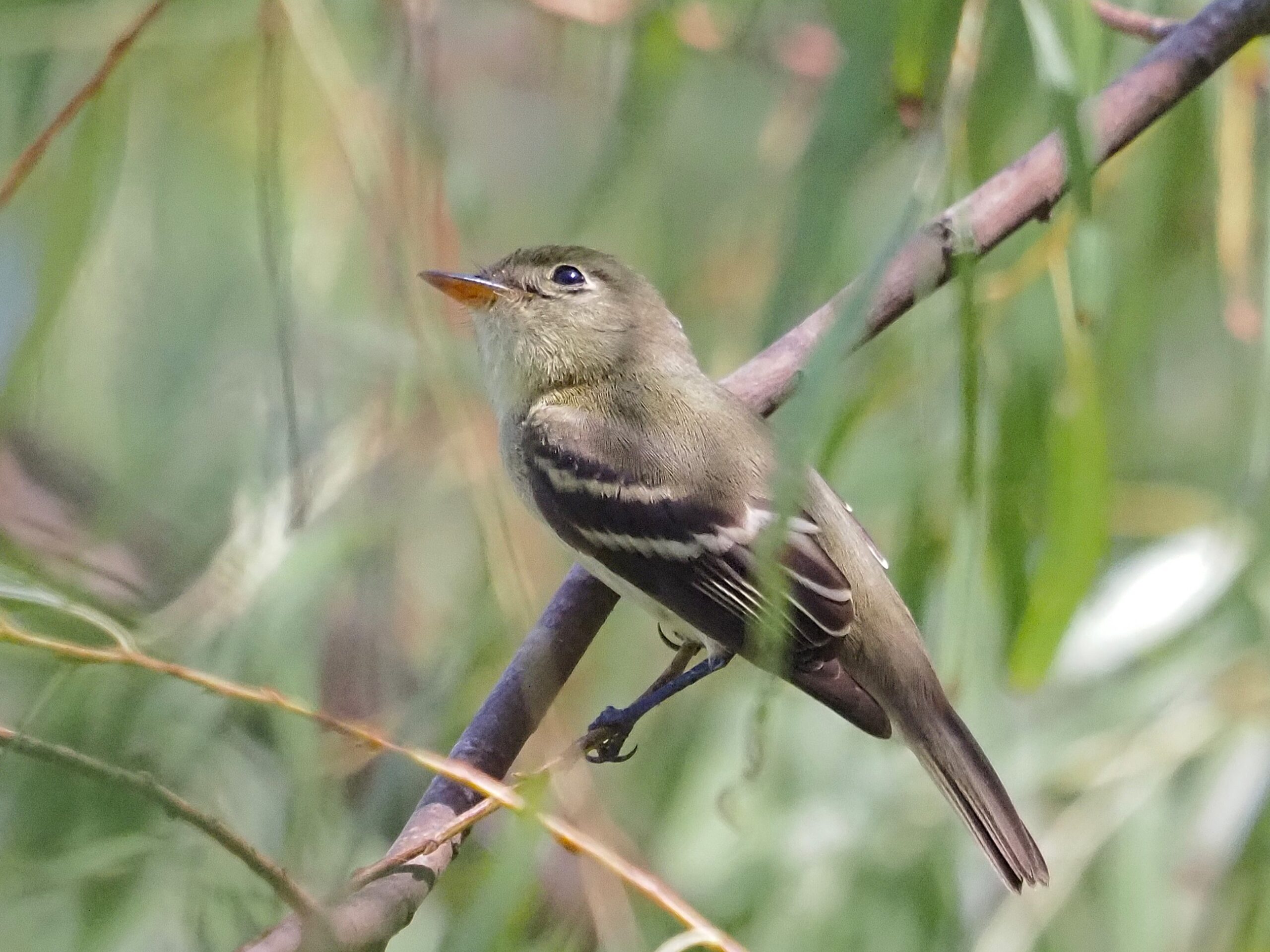
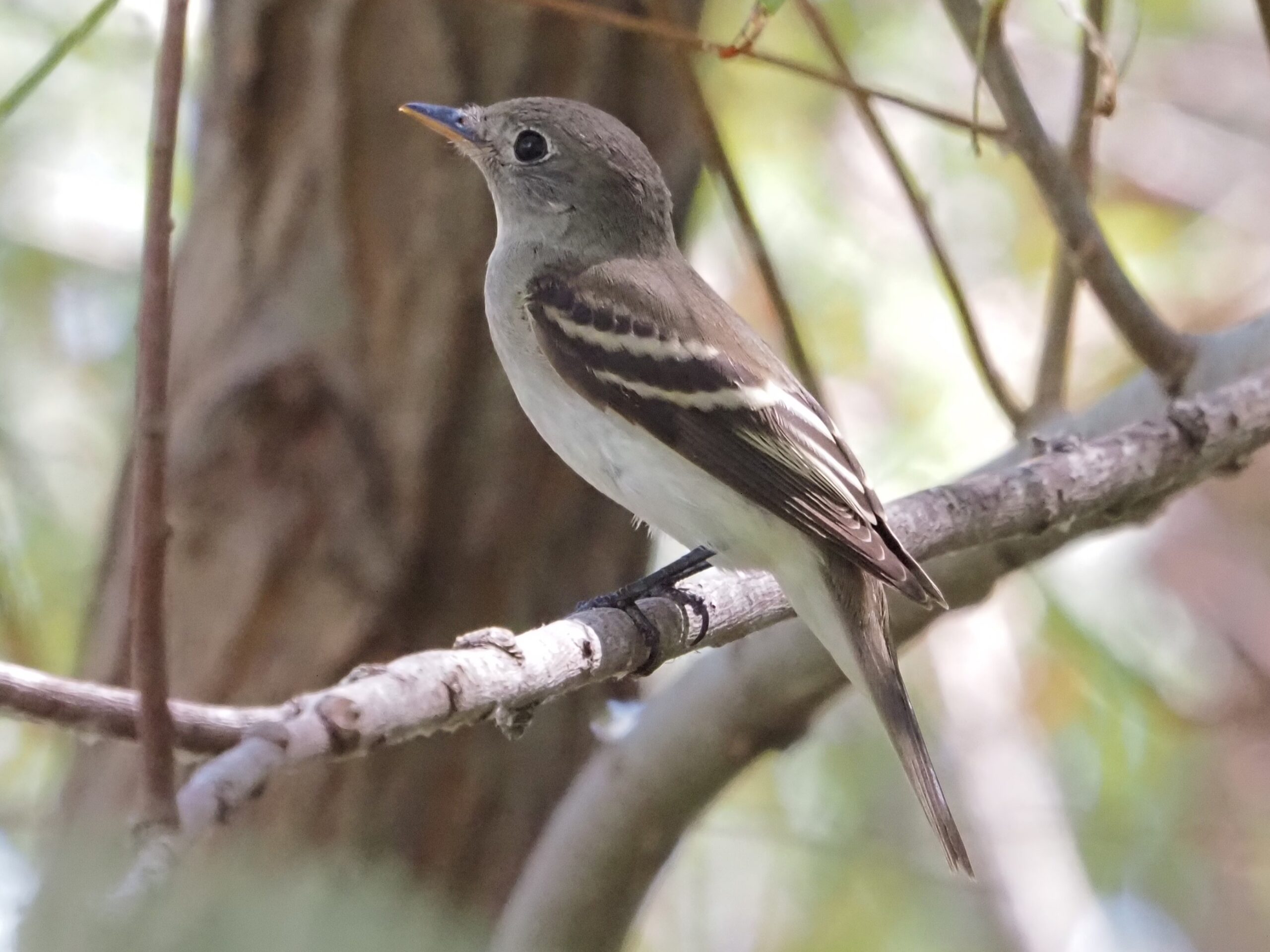
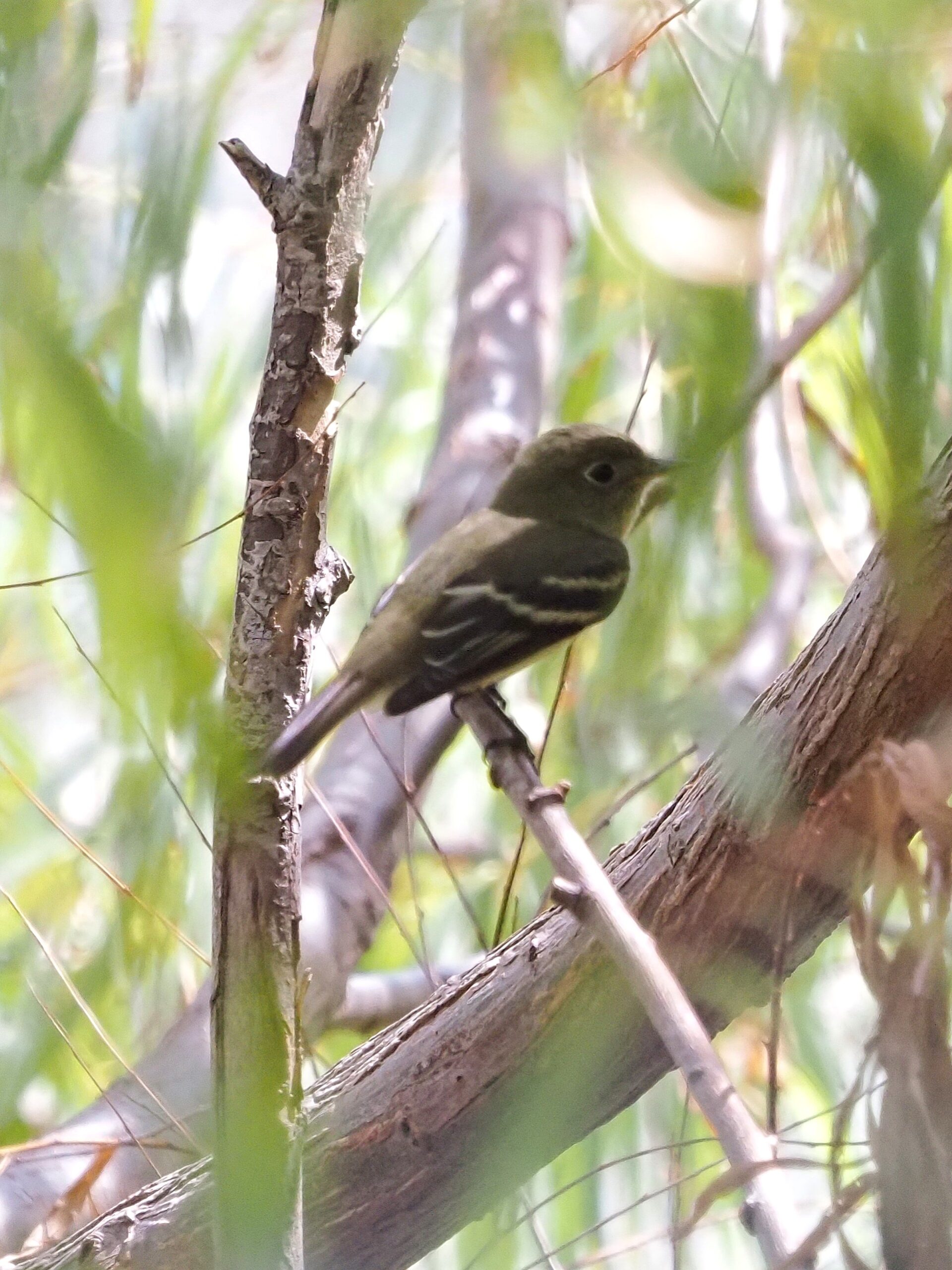
I further divide the Eastern Empids into the “big-uns” (Acadian & Trails) and the “little-uns” (Least & Yellow-bellied) based on a generalization of their size and structure. The “big-uns” are shown in the following photos and the “little-uns” below. Although I hesitate using size alone for identification, especially of a lone bird, I think the impression of size (GISS) of these 2 groups of Empids can be helpful based on the overall body proportions and the size of the wing-panel (width vs length).
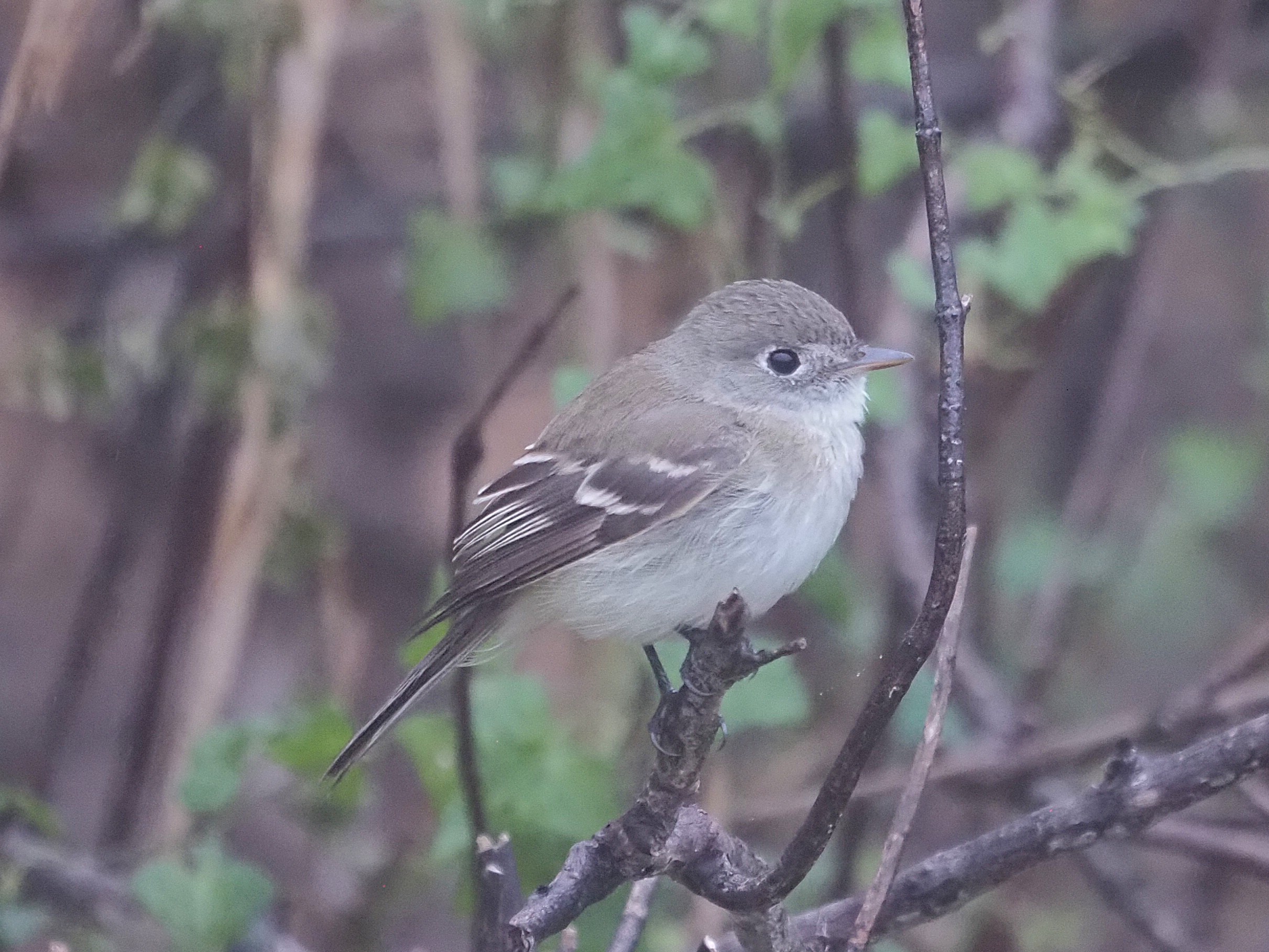
Western Empids