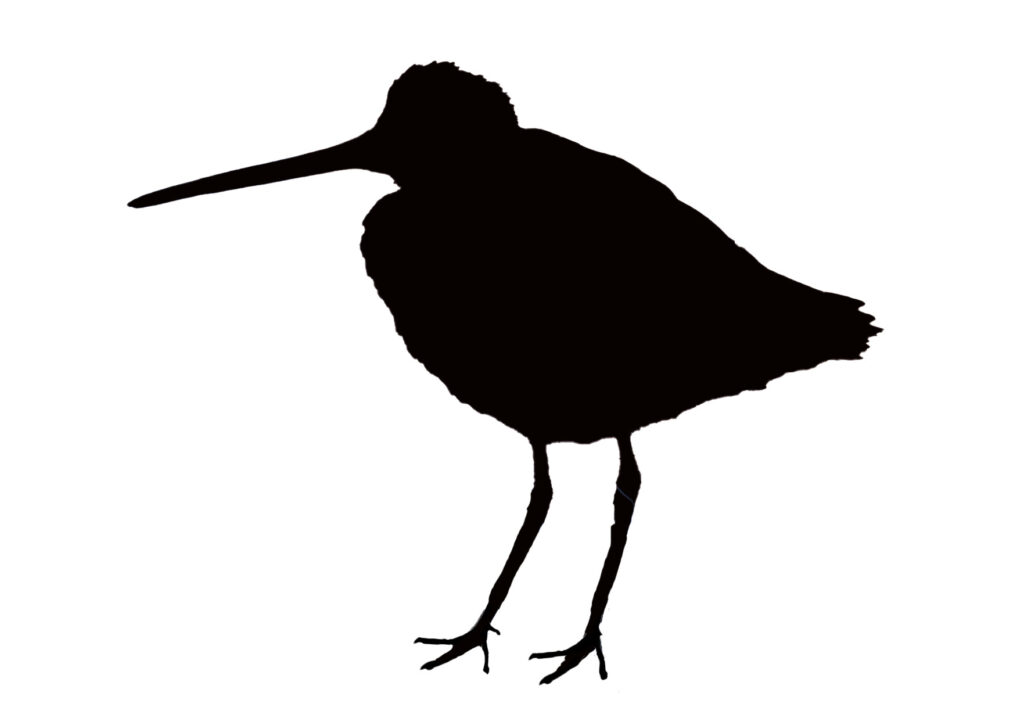
Dowitchers are plump, round-bodied, fairly long-legged shorebirds with sturdy, mostly straight bills.
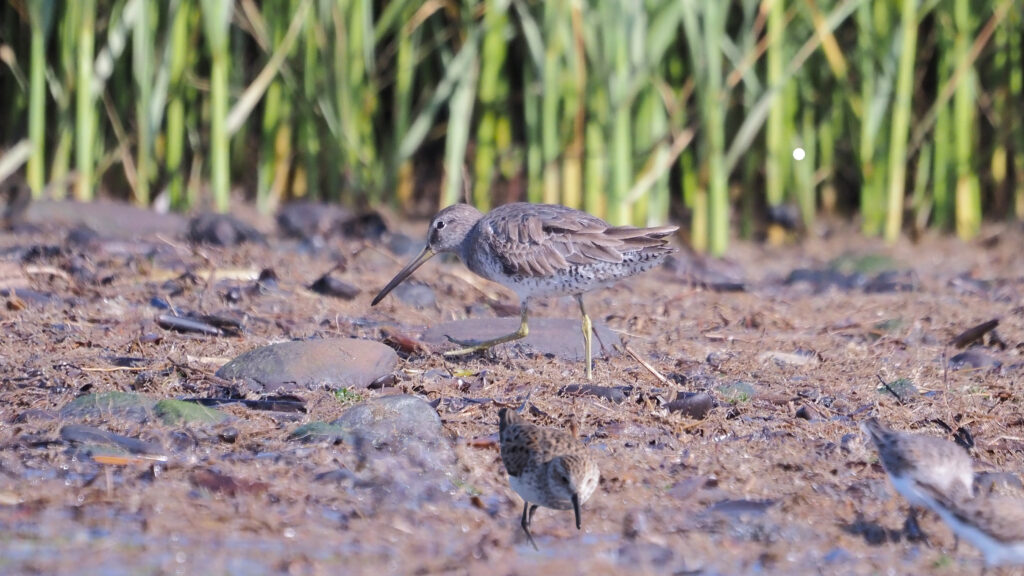
They are medium-sized shorebirds and it is sometimes surprising how they tower over smaller shorebirds.
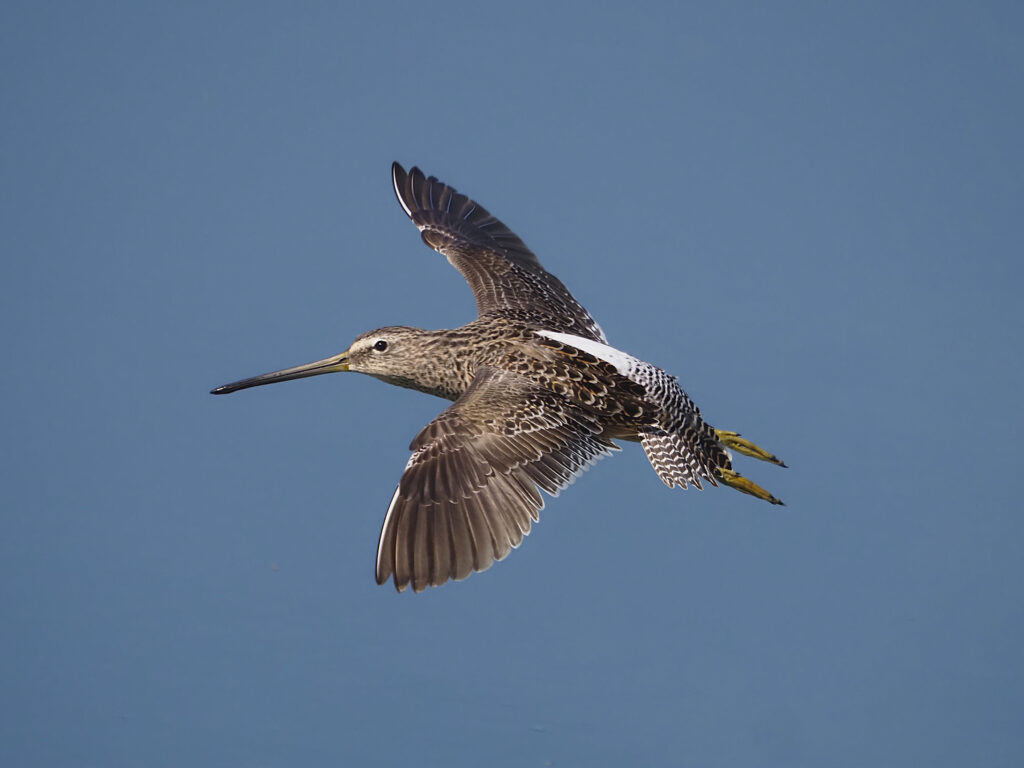
As shown in the photo below, in flight both dowitchers show a prominent white stripe from the rump up the back. Their long, straight bills are also prominent in flight.
Plumages and Molt of Dowitchers
Birds need their feathers to live. However, feathers wear out due to salt, sun, parasites, abrasion and mishap. Molt is the growth of new feathers pushing out and replacing old, worn feathers.
In many bird species these new feathers provide a new “look” which is called a “plumage”. Plumages can indicate age, maturity and health, and aid in mating, territory defense, and camouflage.
NOTE: What was formerly called “winter” plumage or “non-breeding” plumage is now more practically called “basic” plumage. Likewise, what used to be called “summer” or “breeding” plumage is now called “alternate” plumage. These older terms represent a Northern Hemisphere bias which does not accurately reflect the molt strategies of many species. A more detailed discussion of molt in birds can be found here Molt in Birds: a Basic Guide (by Avian Report).
In general, shorebirds (including Dowitchers) have 3 plumages: juvenile, basic and alternate. Molt is a gradual process, which is also subject to individual variation, so the growth of a new plumage occurs over time and individuals in transition from one plumage to another are often seen during transition periods.
There are various molt strategies and timings for each species, but in general shorebirds molt twice a year. For Dowitchers a full molt (called the pre-basic molt) where all feathers are replaced, occurs in approximately August to November resulting in basic plumage. A partial molt where flight feathers are (generally) not molted occurs in about February to April. This molt is called the pre-alternate molt and it results in alternate plumage.
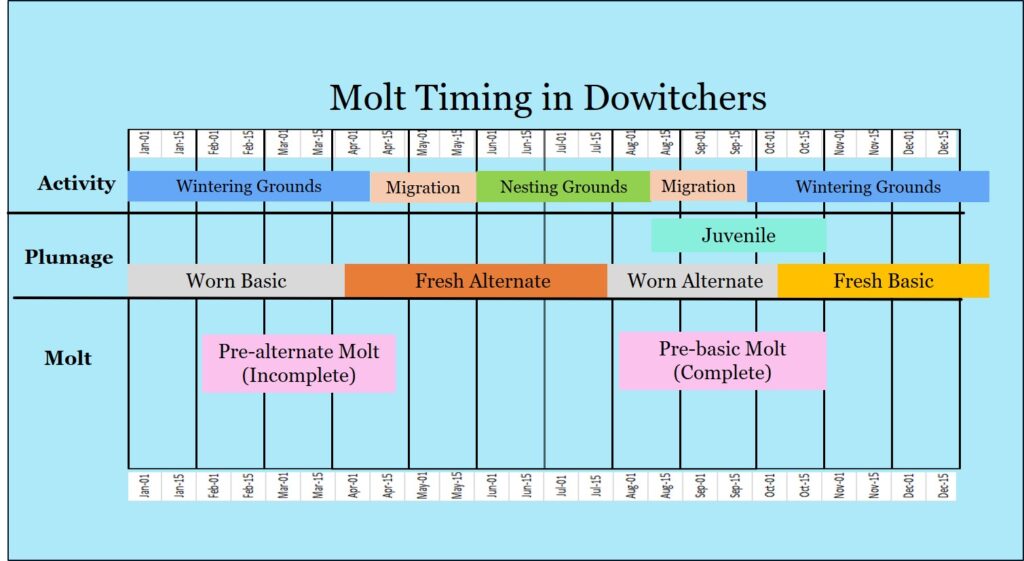
By late November most dowitchers are in basic plumage which they hold till about March when the pre-alternate molt begins. By April many, if not all, dowitchers are at least partially in alternate plumage, while many are fully decked out and ready for the breeding grounds in Canada and Alaska. It is not unusual to see molting dowitchers in Texas in April. The graphic above provides a summary of approximate dowitcher molt schedules. But remember: there is no bright line when 1 day a bird is in worn basic and the next is in fresh alternate — molt is a gradual process.
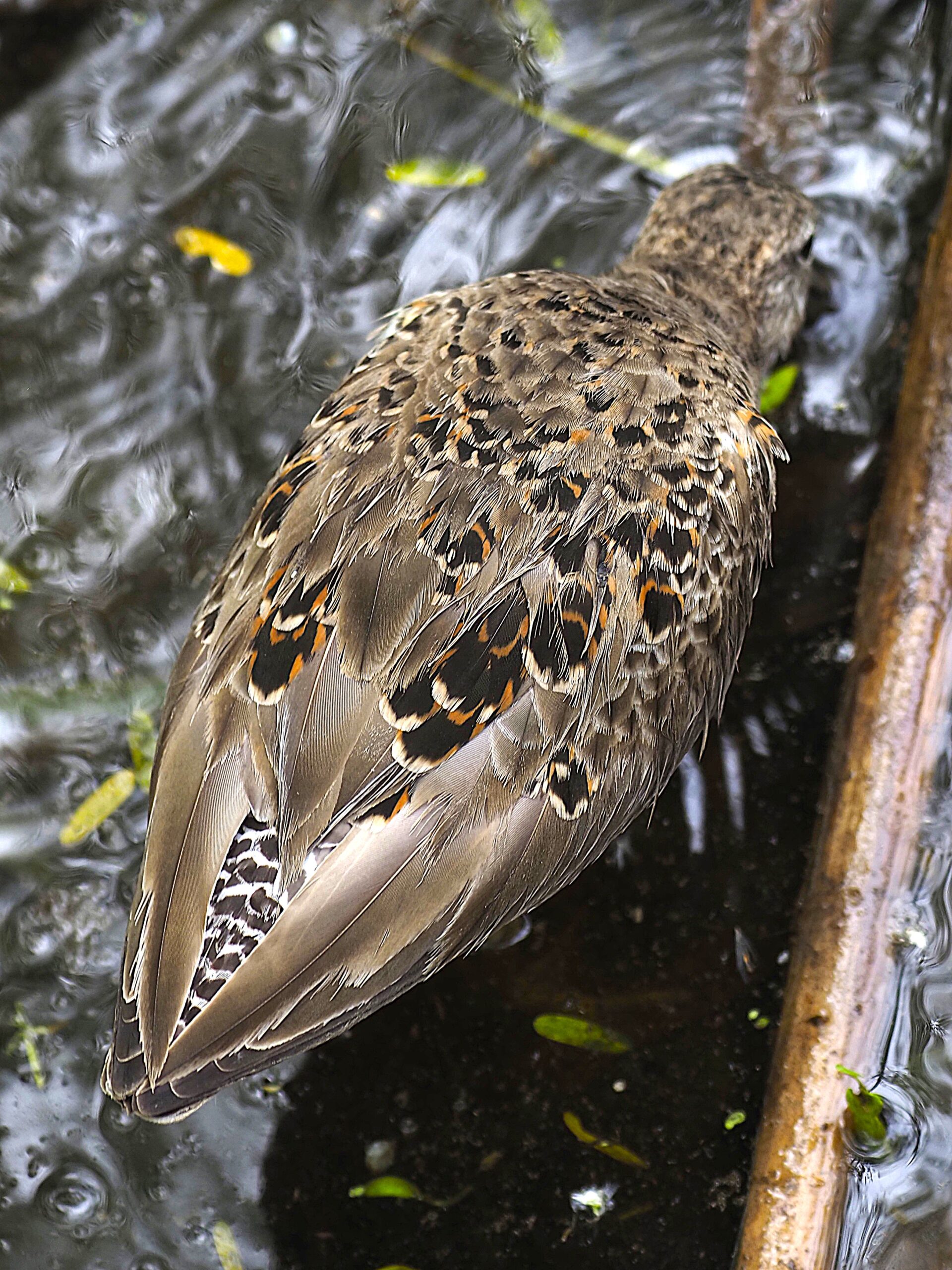
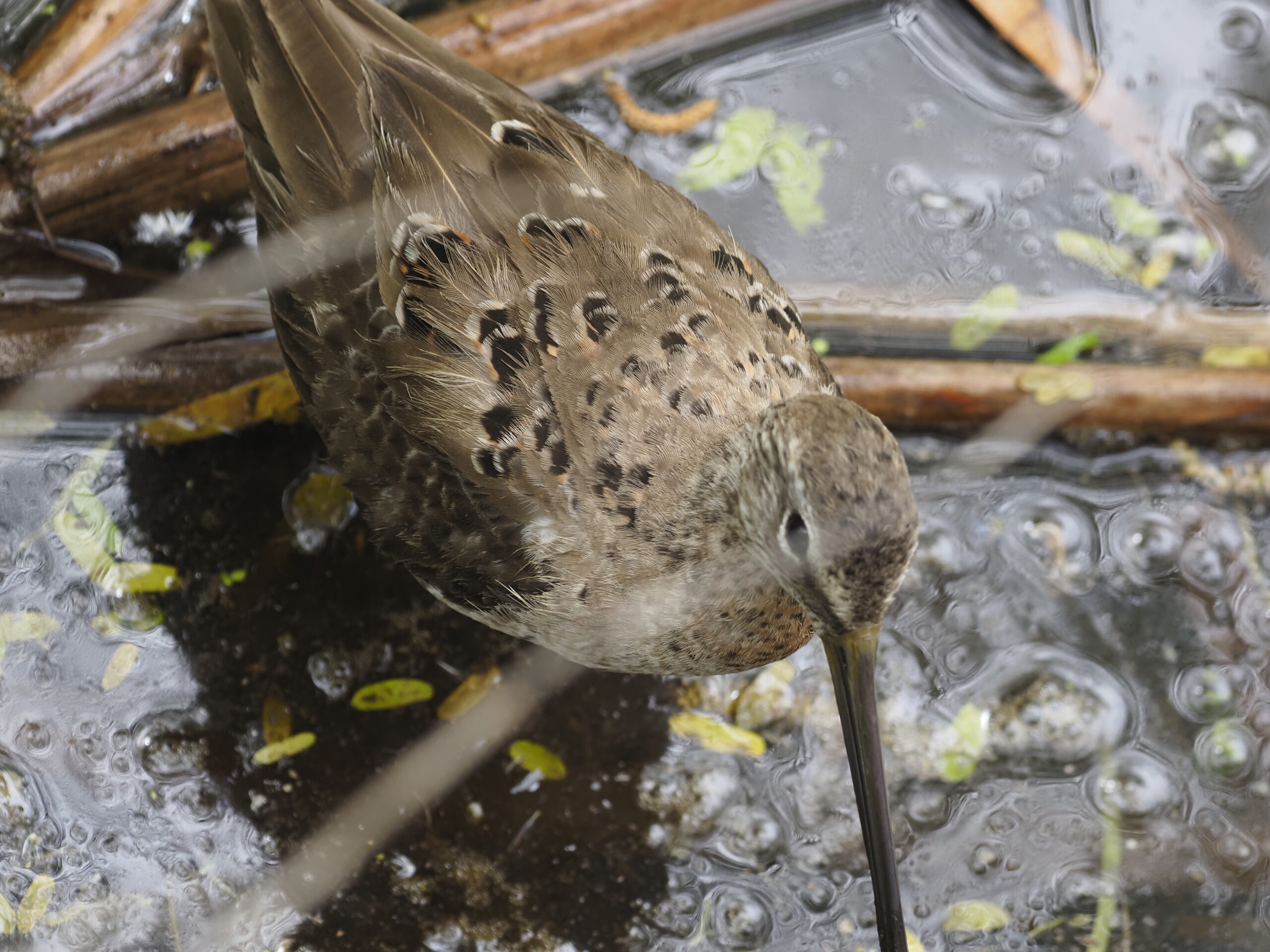
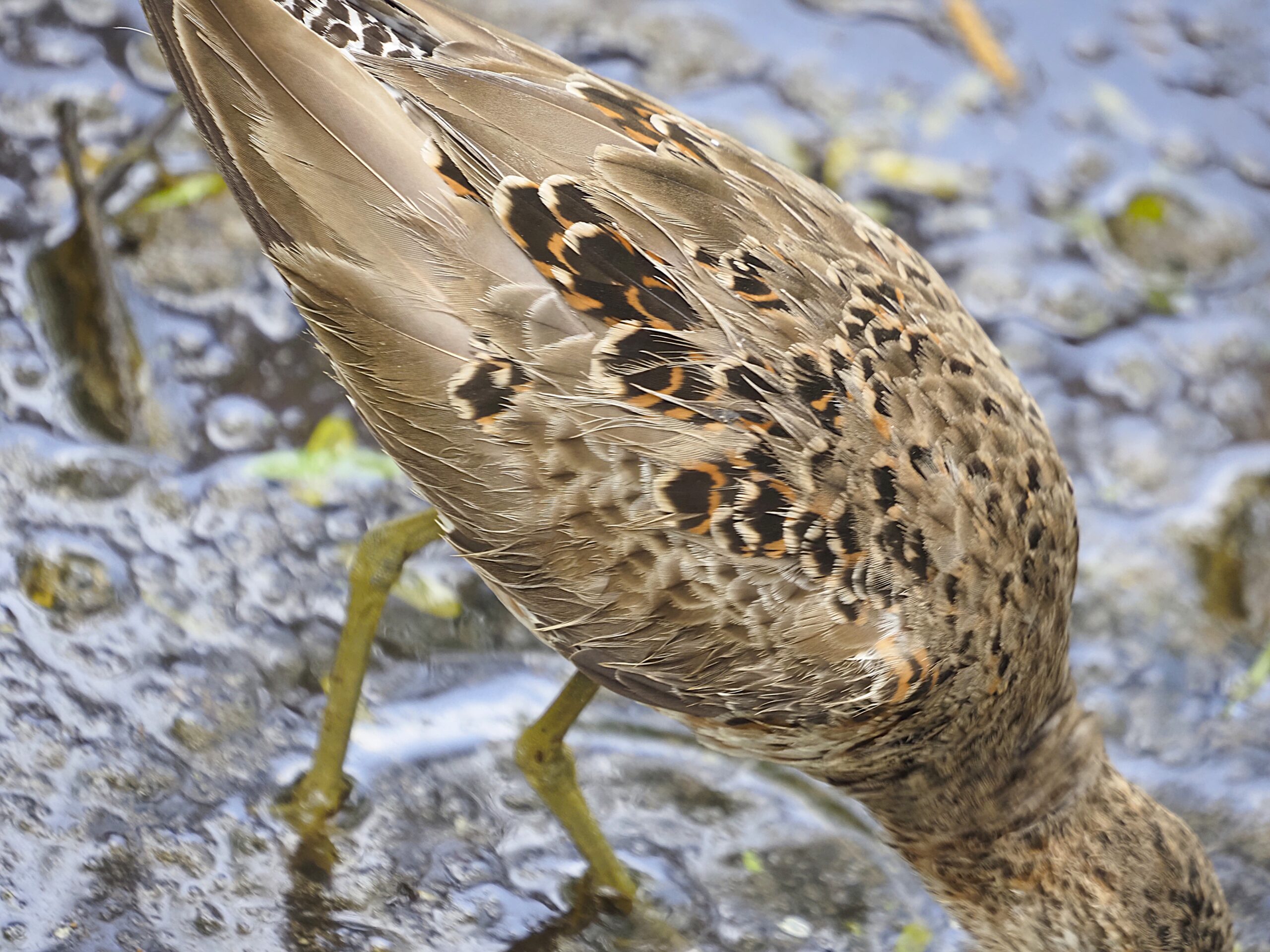
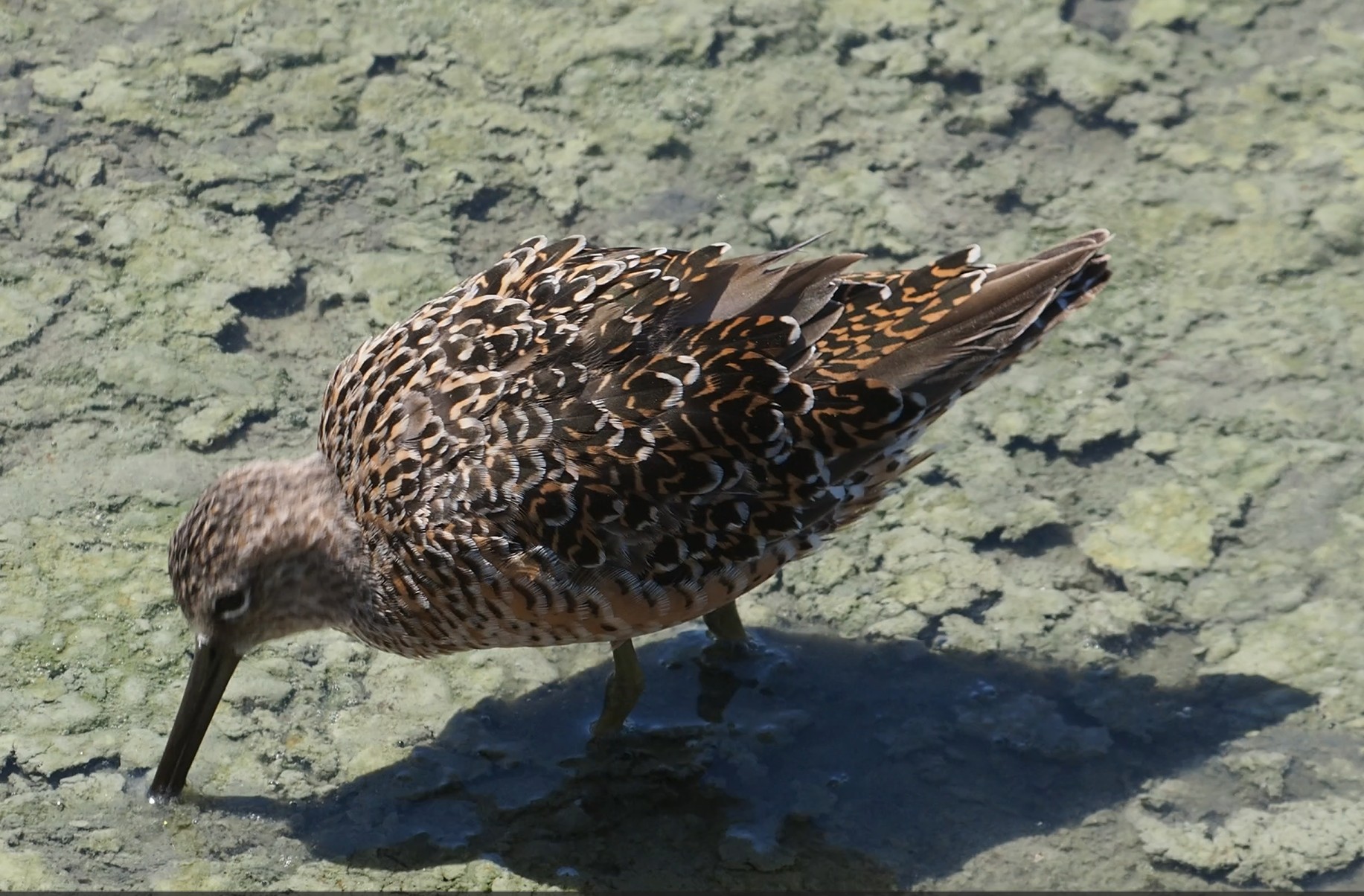
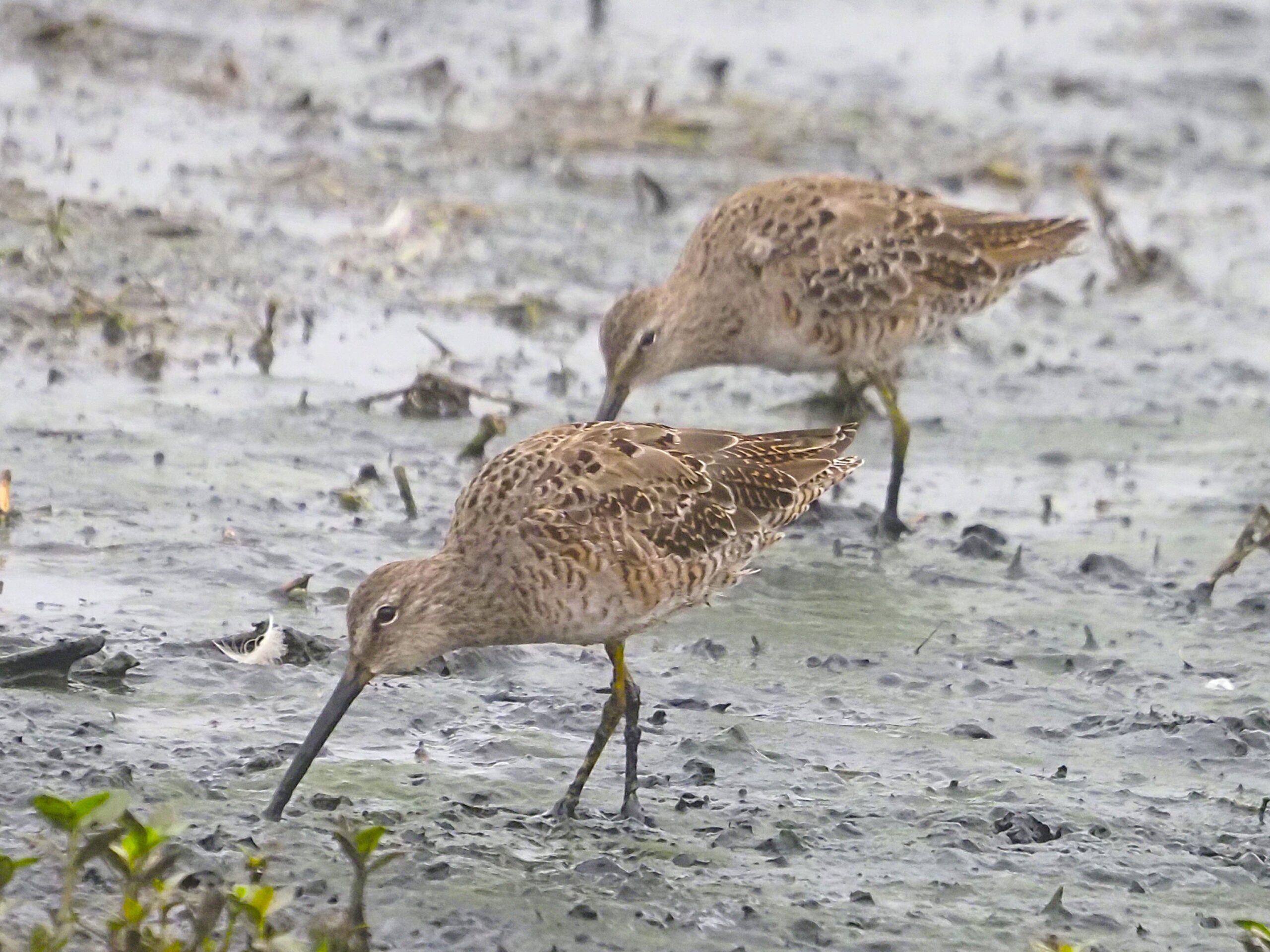
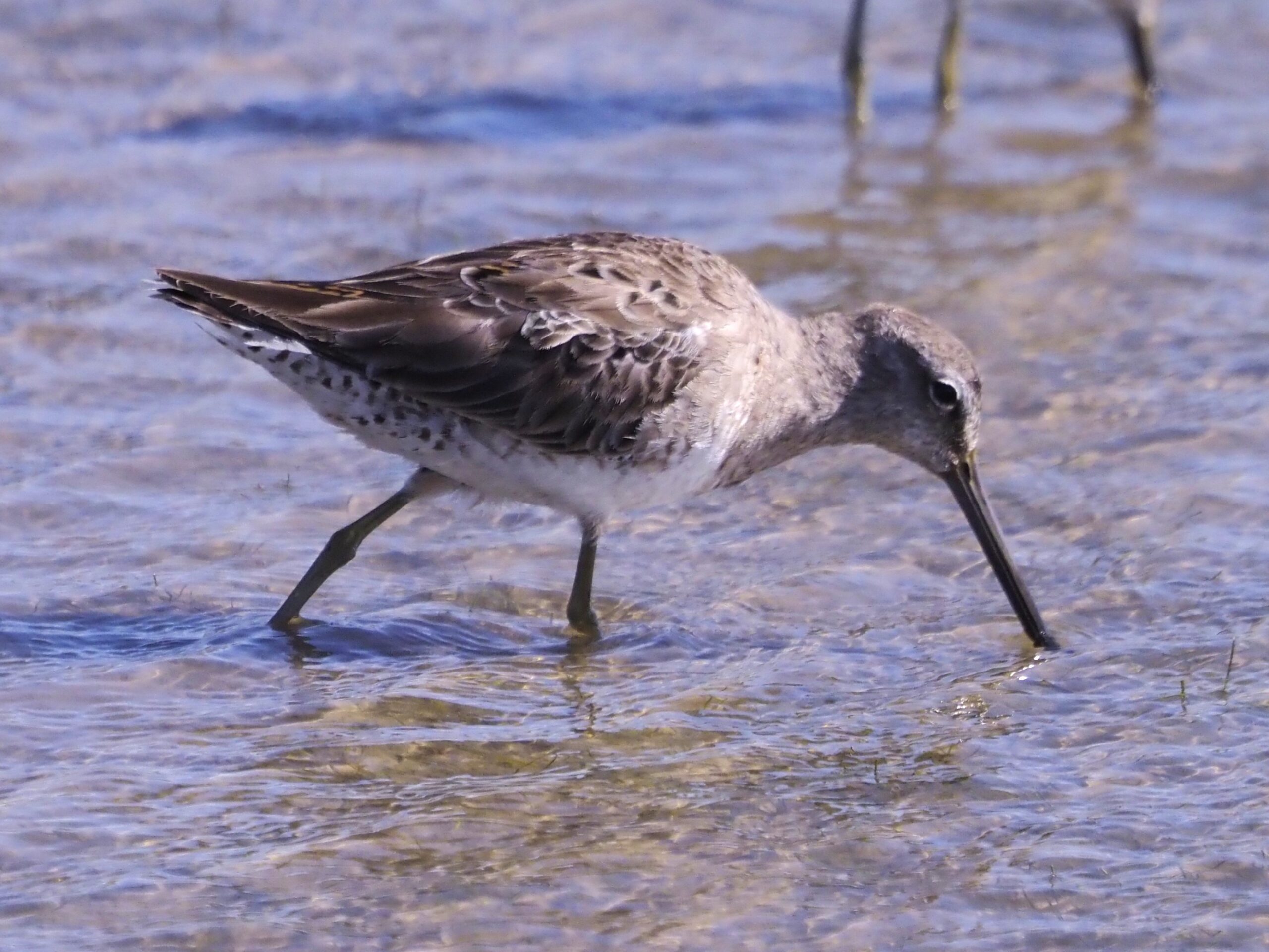
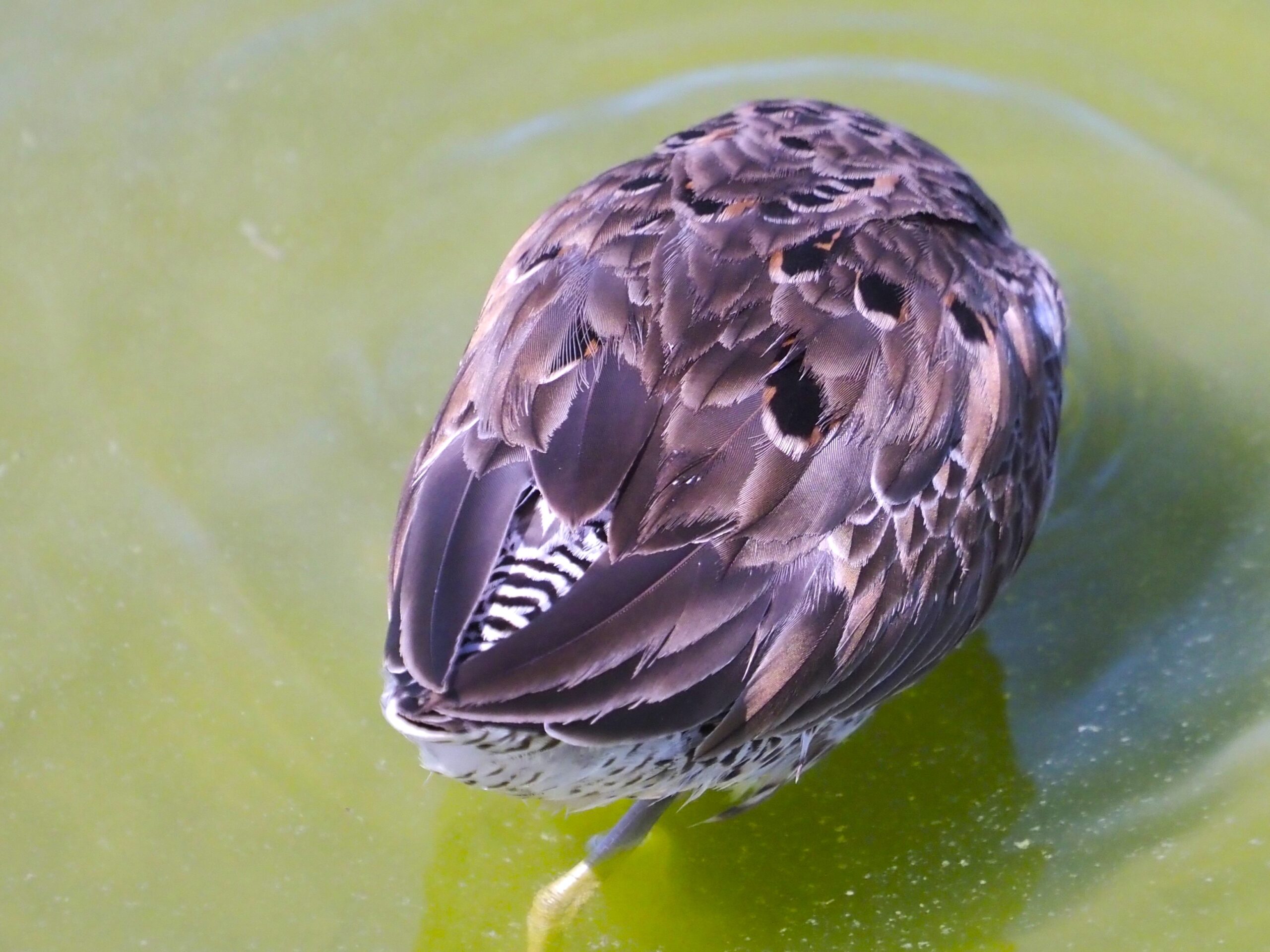
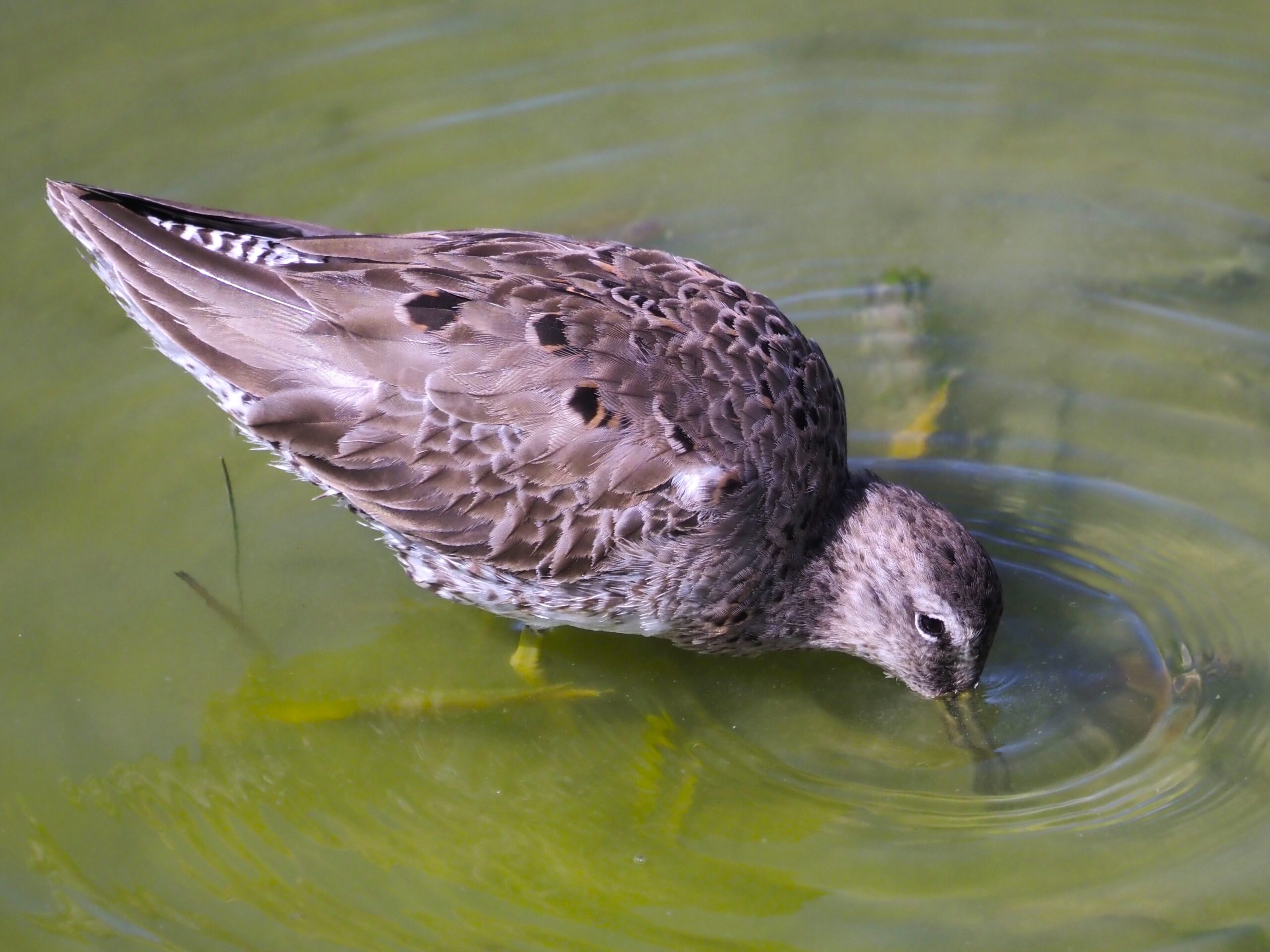
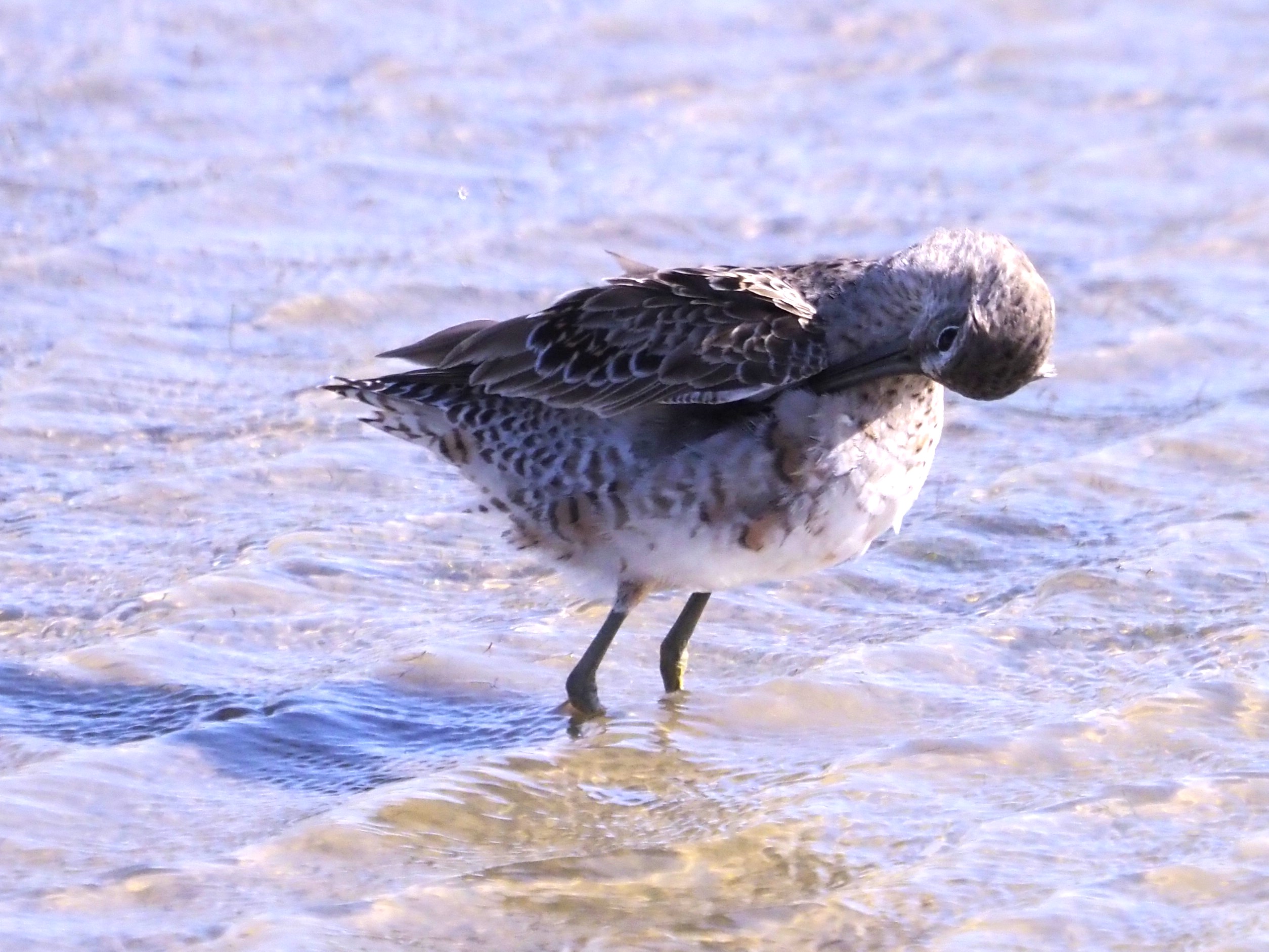
The photos in the gallery below show Long-billed in various states of transition from one plumage to another. These photos were taken in April during the molt to alternate plumage (pre-alternate molt), so the colorful feathers (black, white and orange) are just coming in, while the gray feathers are on their way out.
Dowitcher Field Marks
Separating the two dowitchers species can be difficult especially in basic plumage. Many different field marks have been proposed. Some field marks work well with one plumage, but not at all in another. Other field marks require experience or are subjective. A further complication is that the Short-billed Dowitcher consists of 3 subspecies with subtly different plumage details.
A table (found here: Dowitcher Identification Table) lists the dowitcher field marks that are discussed and illustrated with photos below. A second version of this table (found here: Dowitcher Identification Table with Comments) provides my review on the reliability and usefulness of each field mark.
Dowitcher Vocalizations
Start with learning dowitcher calls!!! Calls are the least ambiguous of field marks for dowitchers.
The Long-billed Dowitcher calls frequently during many different activities (feeding, preening, when startled, etc.). The call of the Long-billed is a high-pitched “keek, keek” similar to that of the Blue-winged Teal. The call of Long-billed can be found here https://xeno-canto.org/239631/embed?simple=1
The Short-billed Dowitcher’s call is a mellow “tu tu tu”, not unlike a rapid Lesser Yellowlegs call. The Short-billed mostly calls in flight. Short-billed’s call can be found here: https://xeno-canto.org/7314.
Mnemonic
As a mnemonic for their calls, notice that the word “keek” is long for Long-billed, while the word “tu” is short for Short-billed.
Water Salinity Preference
The next thing to know about dowitcher identification is that they have a strong preference for either salt or fresh water; the Long-bill prefers fresh, while the Short-bill prefers salt water. Banders on the Texas Coast have noted that they have never captured a Long-billed in salt waters over many years of banding. This rule-of-thumb may be less helpful at freshwater migration stopovers, and both may appear at times in brackish water. In any event I recommend this preference only be used as an indicator, not as a diagnostic field mark
Juvenile Plumage
The key to using one of the most diagnostic and visible field marks for juvenile dowitchers (discussed below) is that you must first be sure that you are looking at a juvenile dowitcher. The first question in that regard is: Is it the right time of year for juveniles? Dowitchers are only in juvenile plumage for a few months, roughly mid-August to early November of their first year. Their fall arrival in Texas peaks in early to mid October, so juvenile plumaged birds may be encountered in Texas during this period.
As shown in the following 2 sets of photos, the mantle and scapular feathers of both juvenile Long-billed and juvenile Short-billed have buffy edges and are usually neat and pristine (like other juvenile shorebirds).
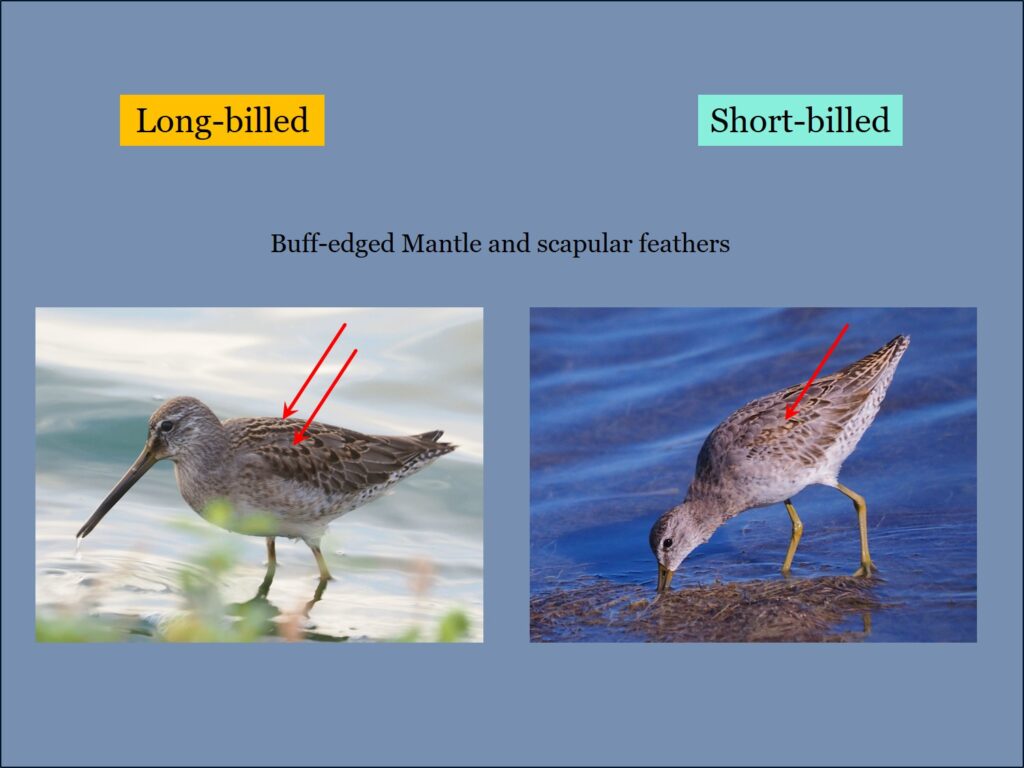
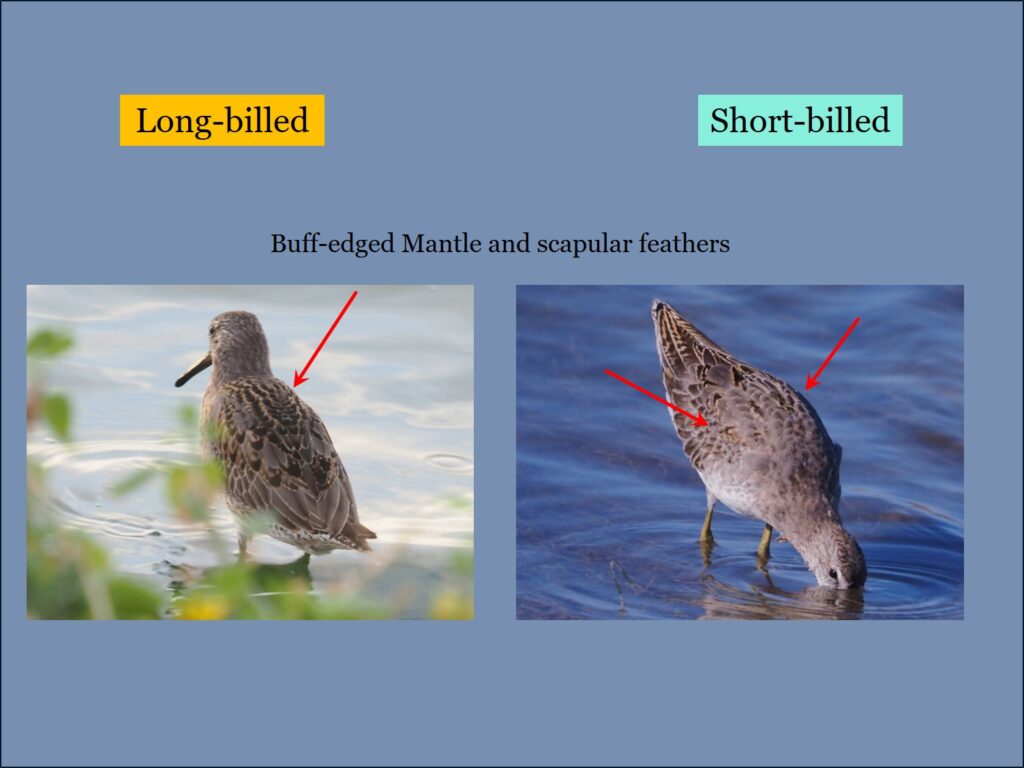
Once you know you have a juvenile Dowitcher, you should check the tertial feathers and see that in the Long-bill those feathers are plain, while in the Short-billed the tertials are “tiger-striped”. The tertials sit atop the primaries and secondaries on the folded wings. (Note that the tertials of the Long-billed in the photos below appear to be growing in).
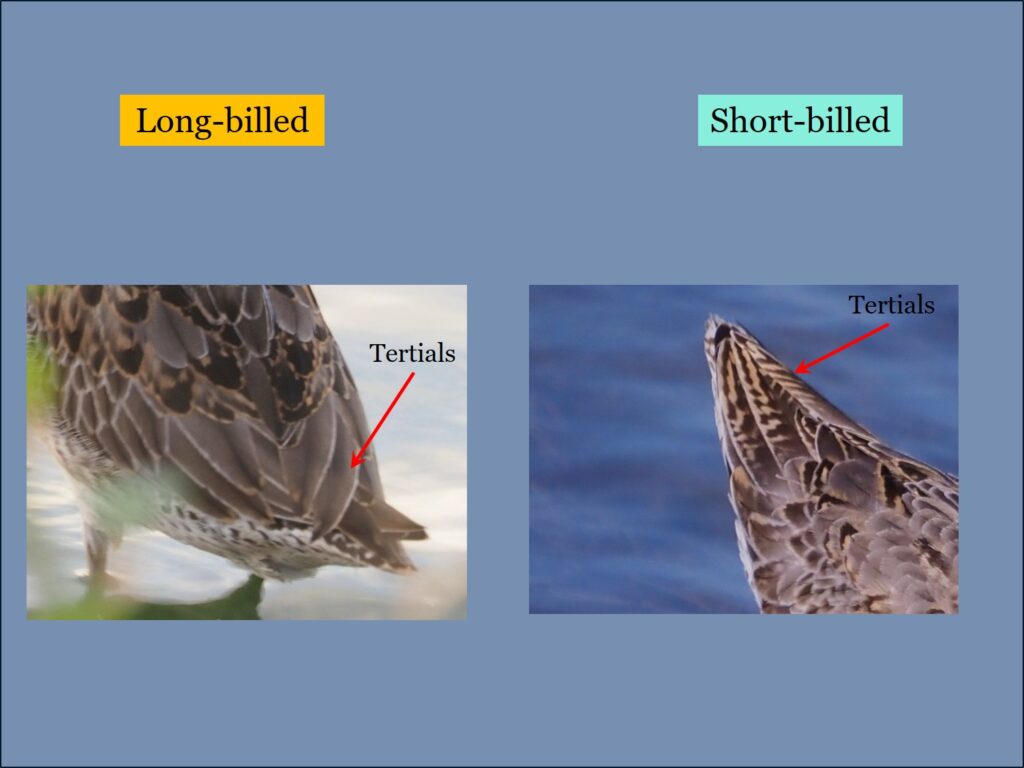
There appears to be only 1 or 2 tiger-stripped tertials on the young Short-billed photograph below, from early October. The same individual is shown in the second photo below with an adult in basic plumage.
The Bill
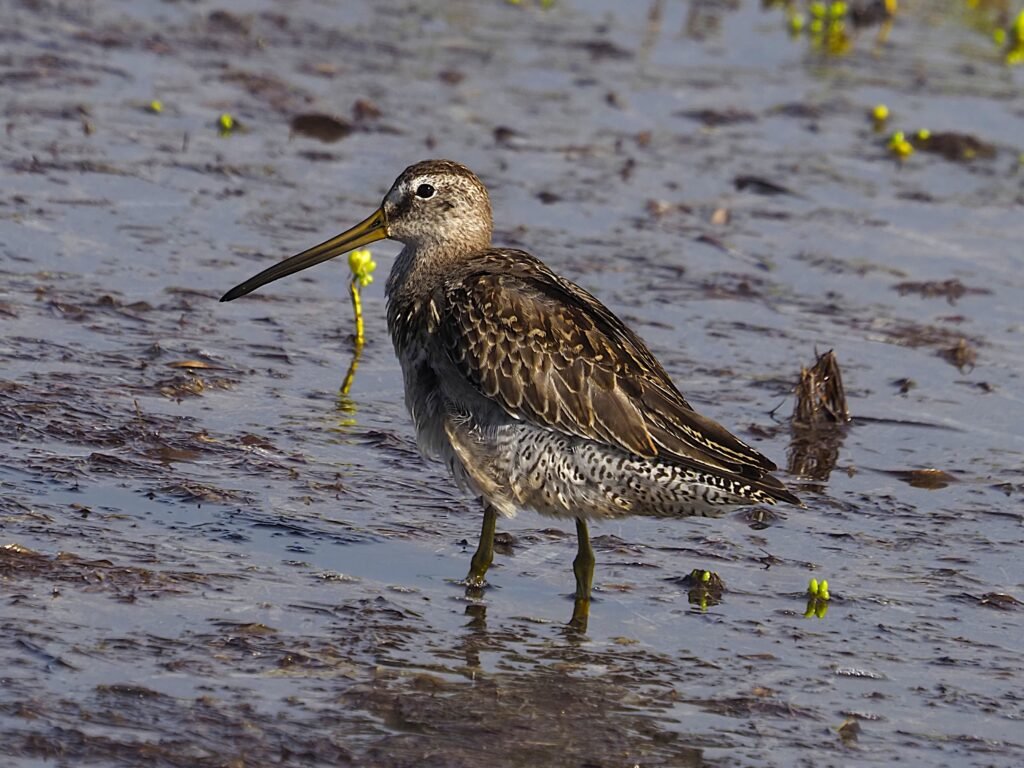
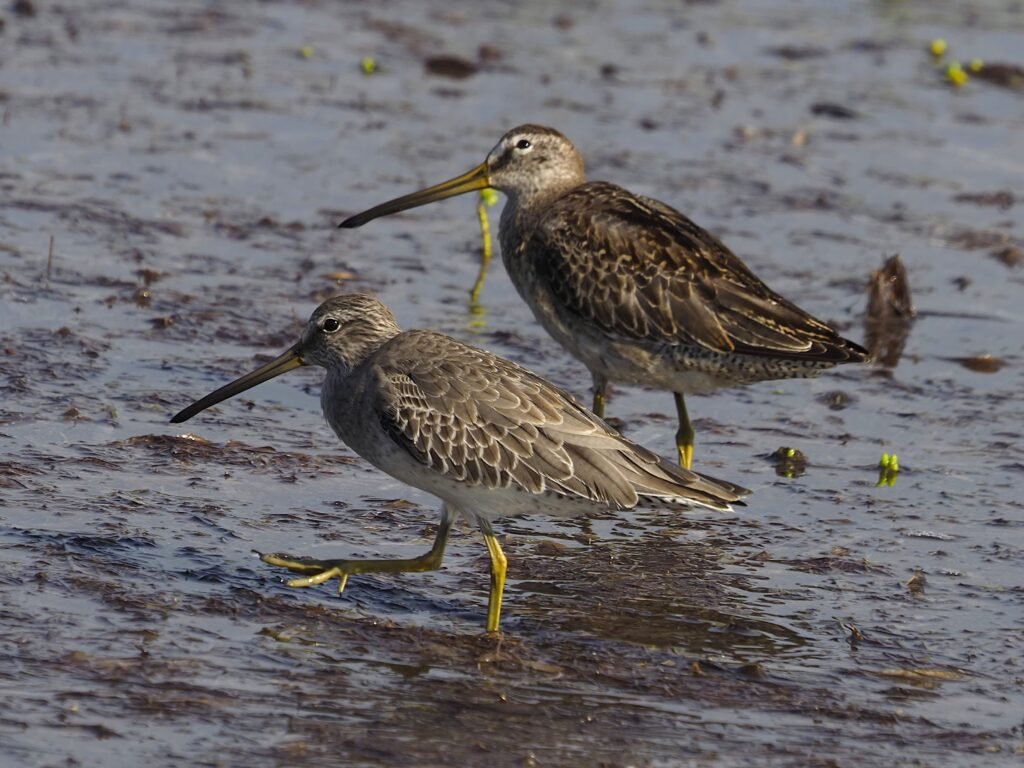
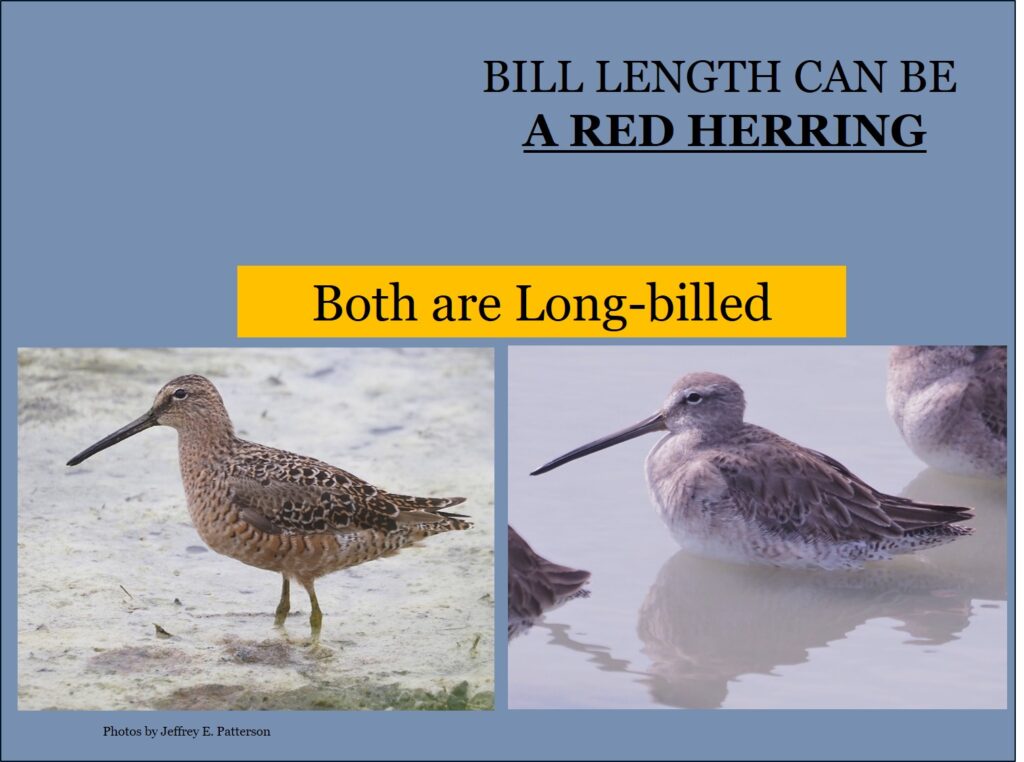
The dowitcher species are named for the average length of their bills. Long-billed average longer bills. While it can be indicative of species in extreme cases, there is enough overlap in bill length that the length of the bill should not be relied upon for identification.
As shown in the photos below there are many cases where the bill-length is misleading. The bird on the right shows an extremely long bill and in cases like this it is indicative of a Long-billed Dowitcher. However, I recommend additional field marks be used because bill lengths can be ambiguous, as demonstrated by the bird on the left below, which is also a Long-billed.
The Shape of the Bill
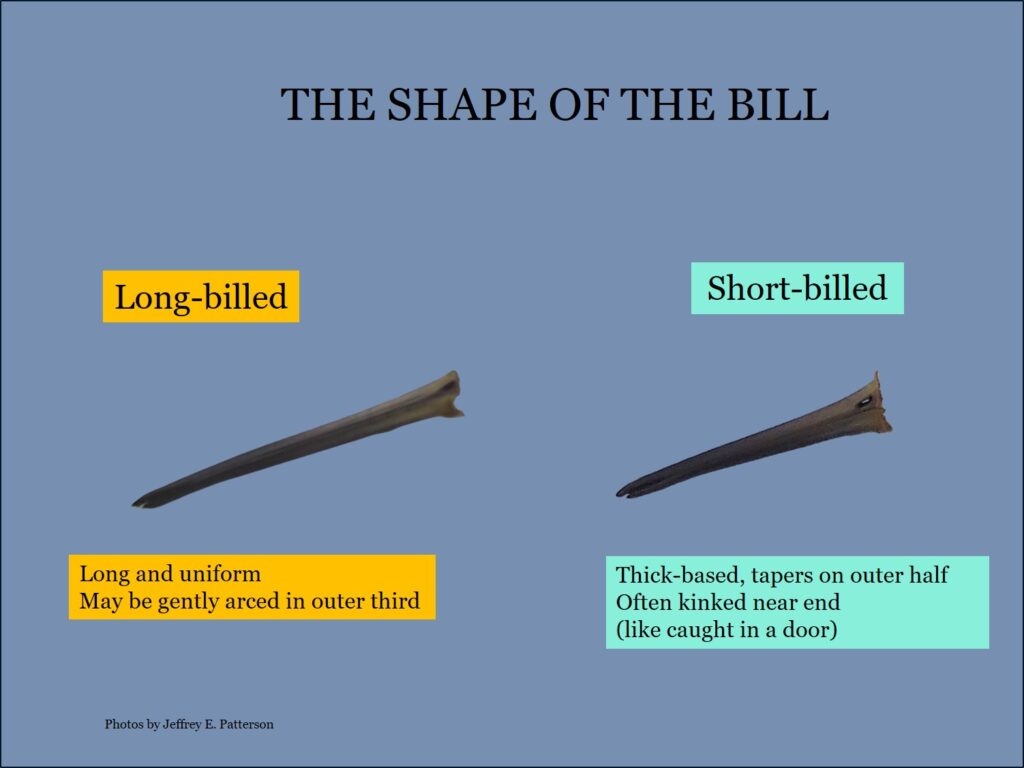
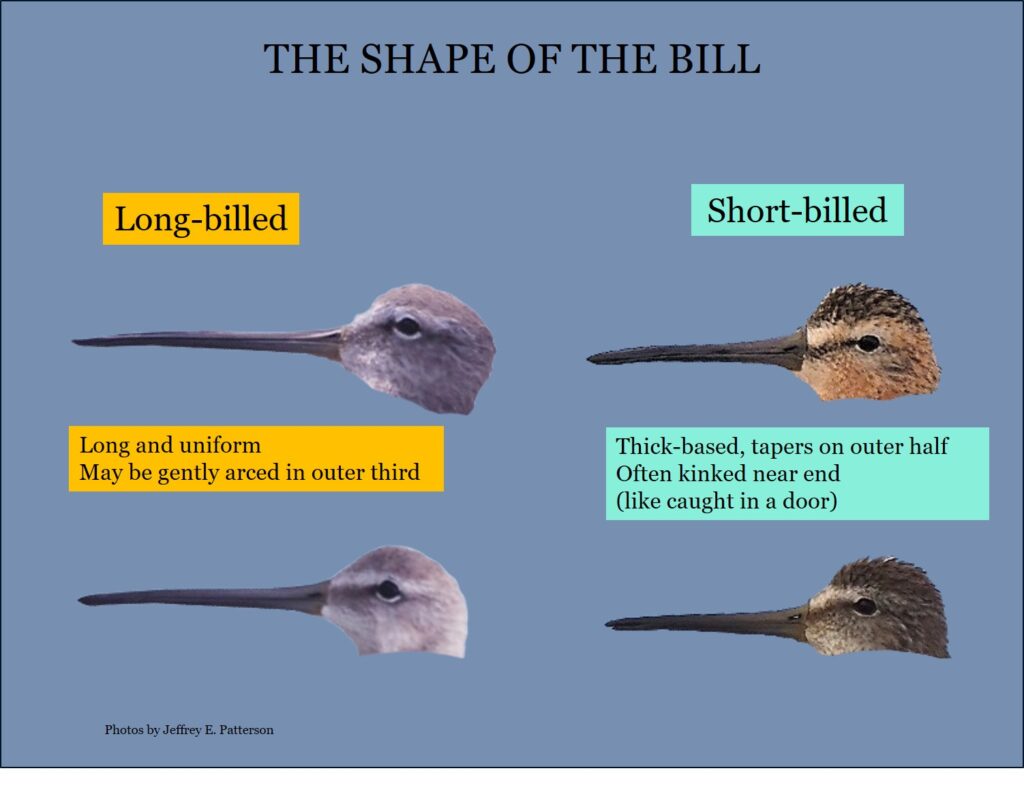
The classic shape of the bill of the Long-billed is long and uniform with a gentle arc in the outer third. The bill of the Short-billed is typically thick at the base, with a taper at the outer half and often a kink near the end (which has been described as “as if it were caught in a door”).
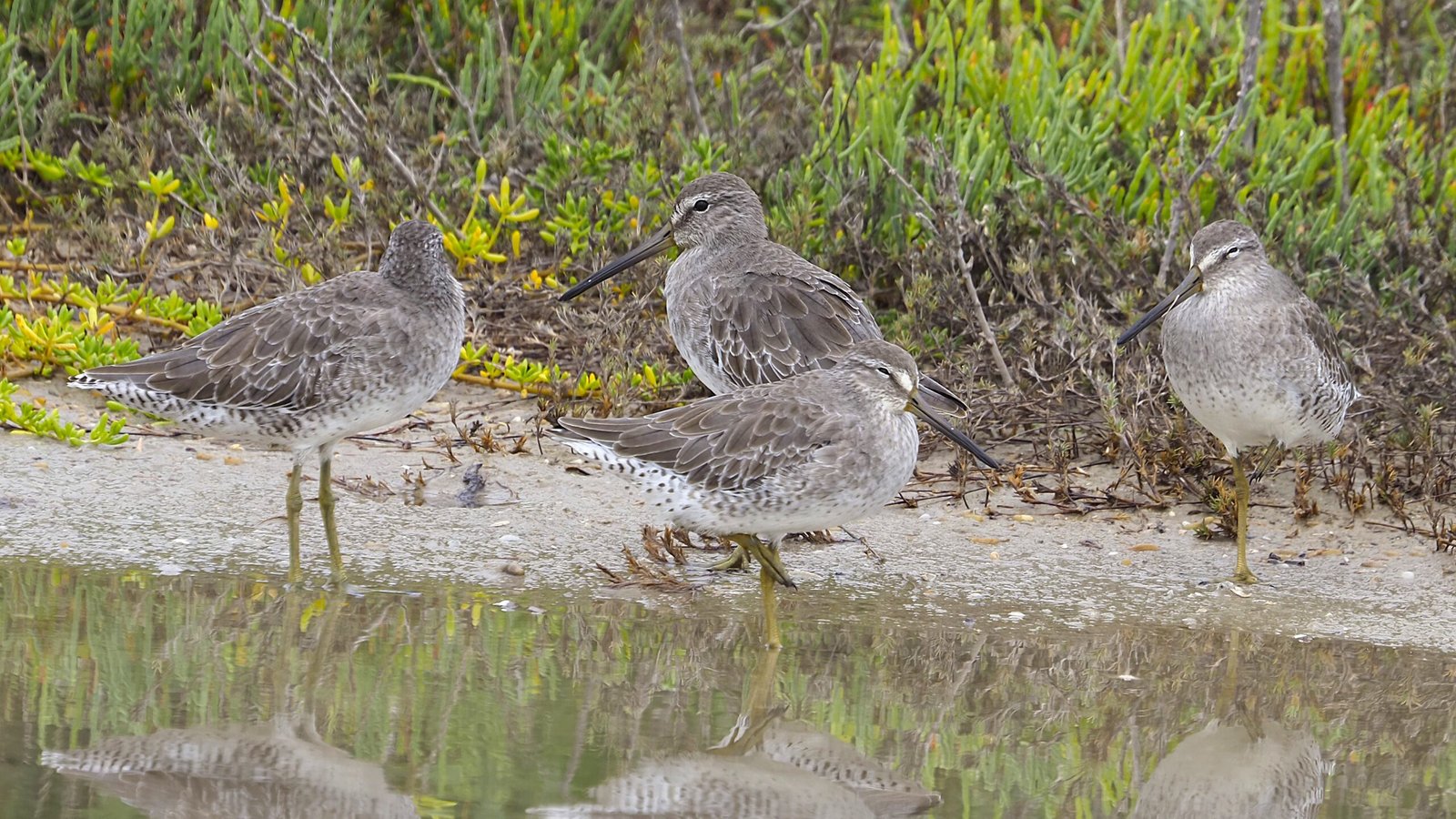
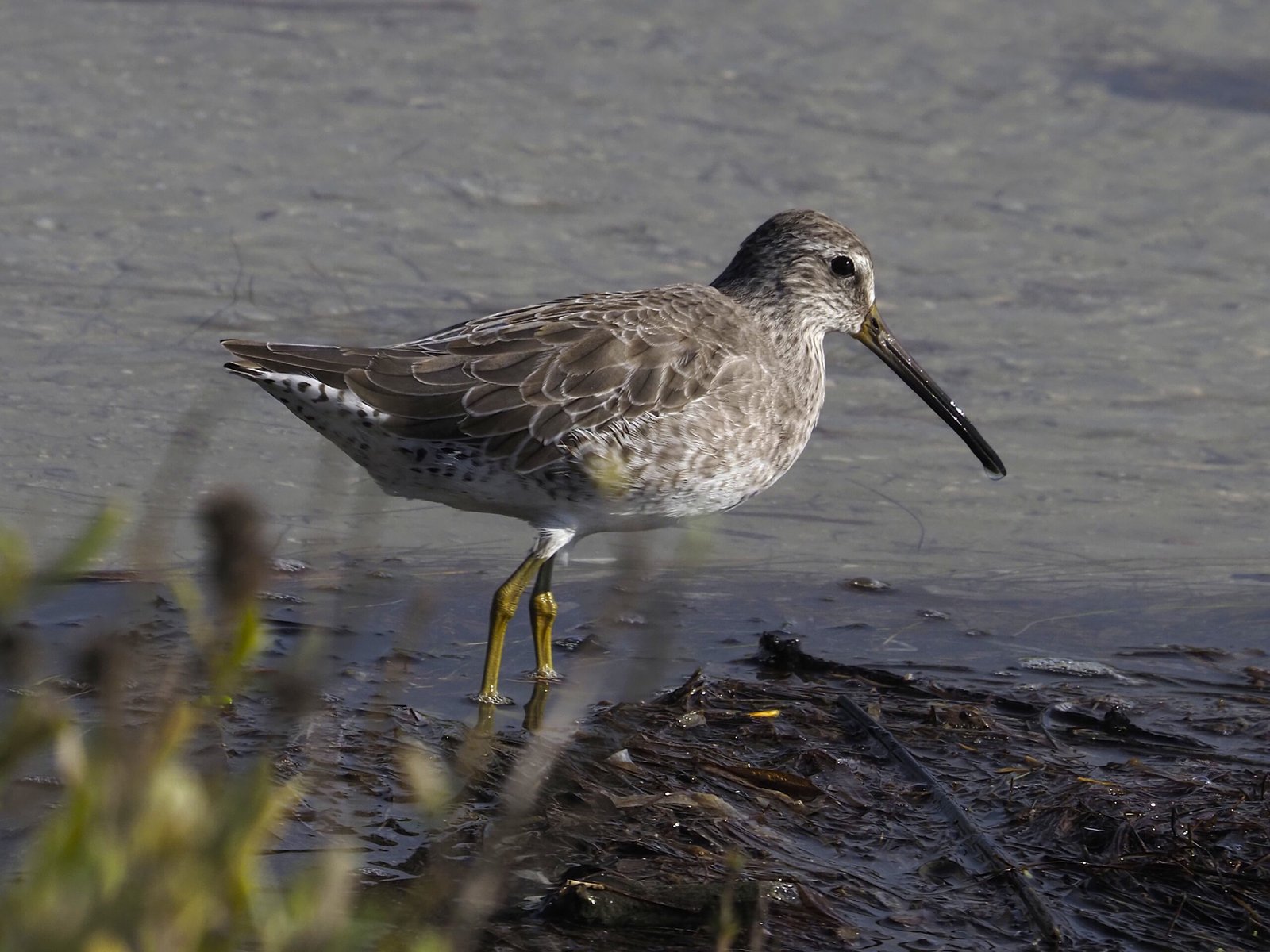
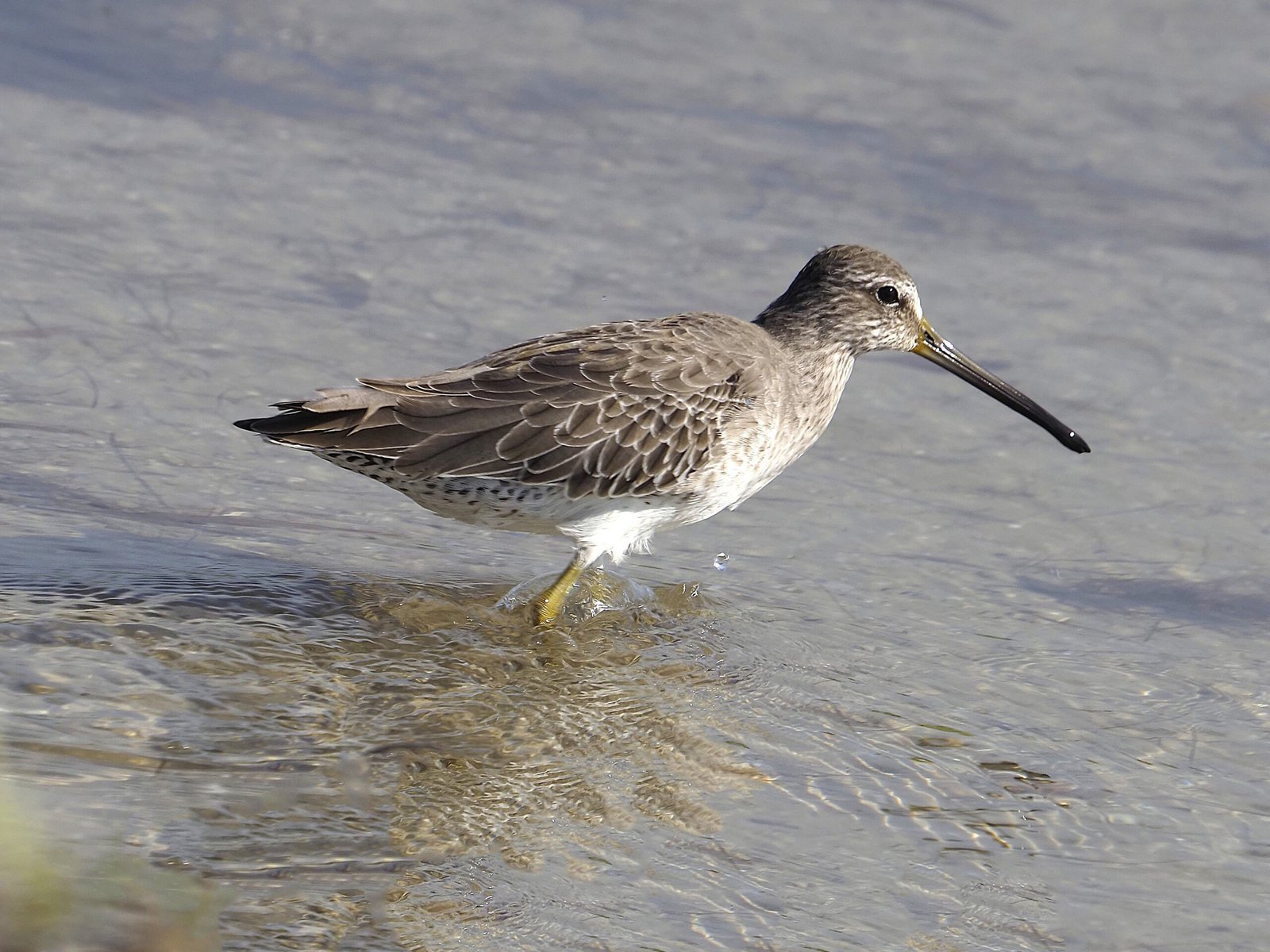
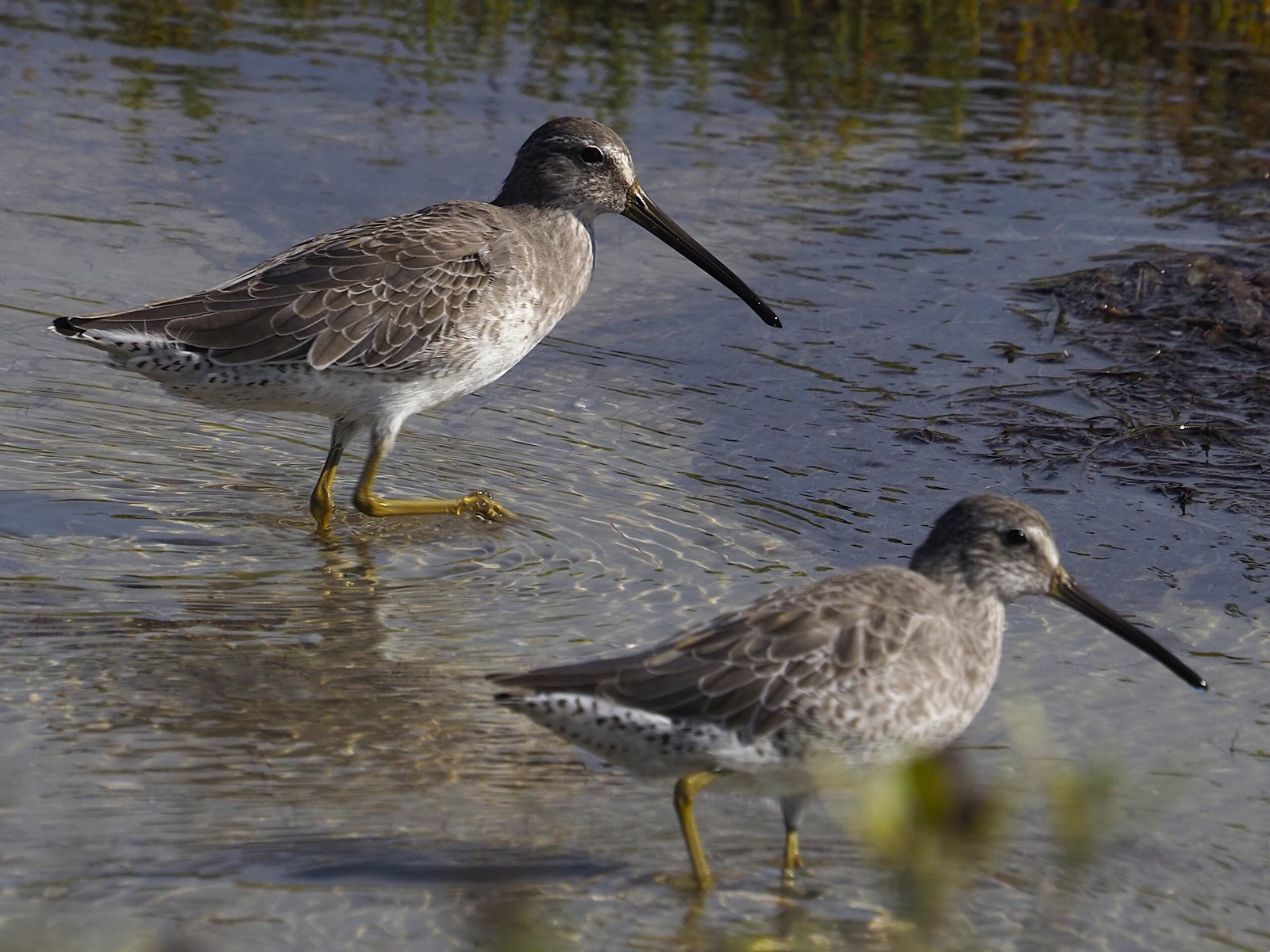
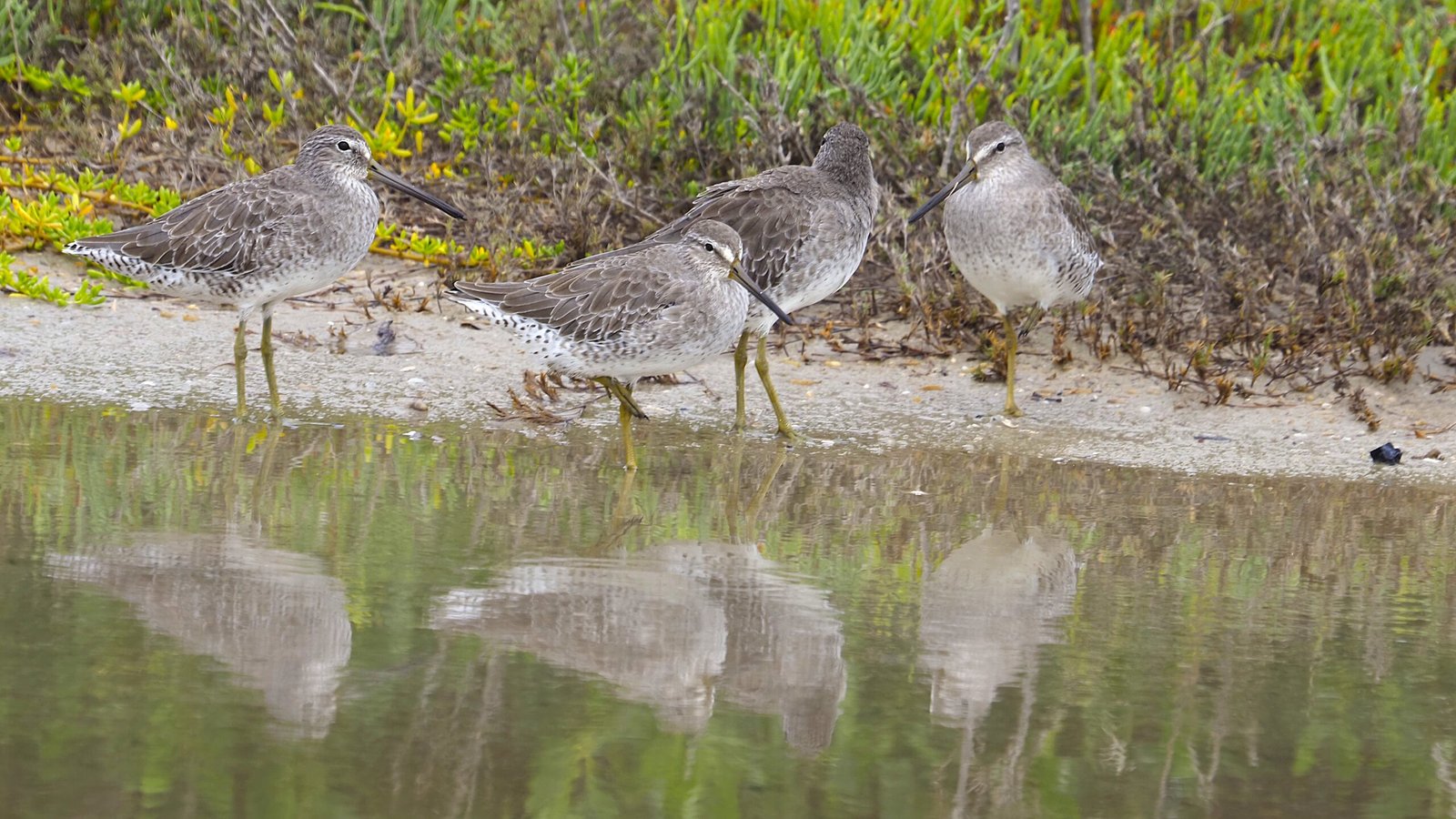
Several Short-billed in basic plumage are shown in the gallery below.
Body Shape
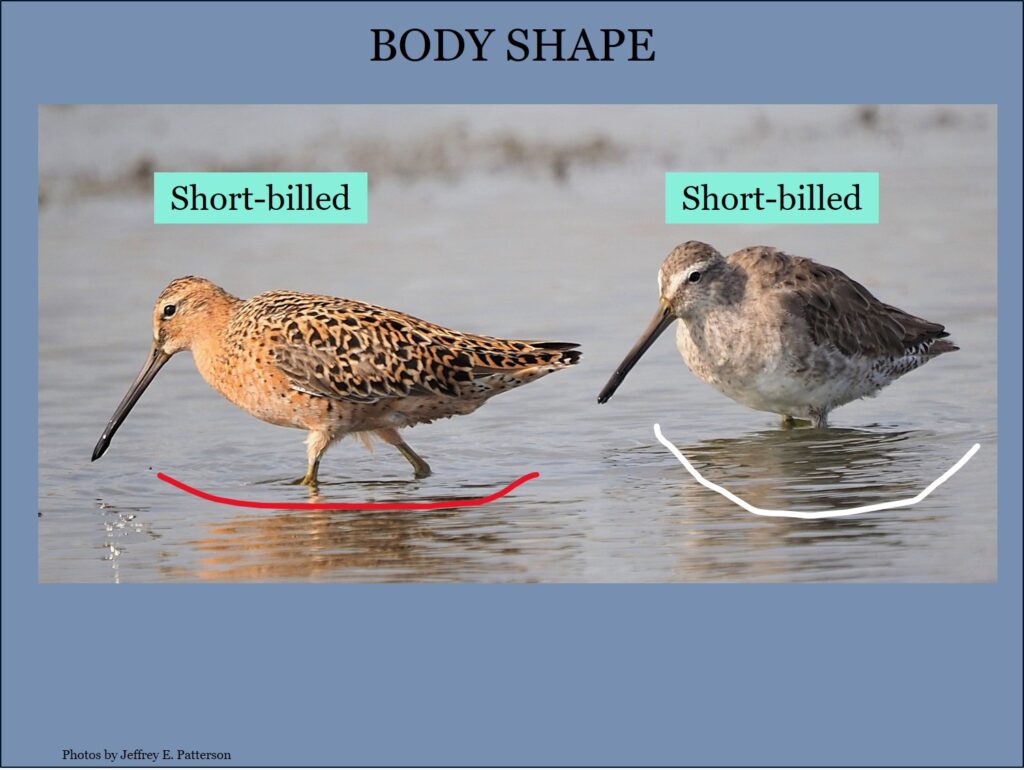
The shape of the body of dowitchers can sometimes be helpful, but should be used with care. The Long-billed is slightly larger and more robust. It has a rounded undercarriage, with a thicker neck and it appears slightly front-heavy. The Short-billed has a straighter undercarriage, with a slightly longer neck, smaller head and a more even-appearing weight distribution.
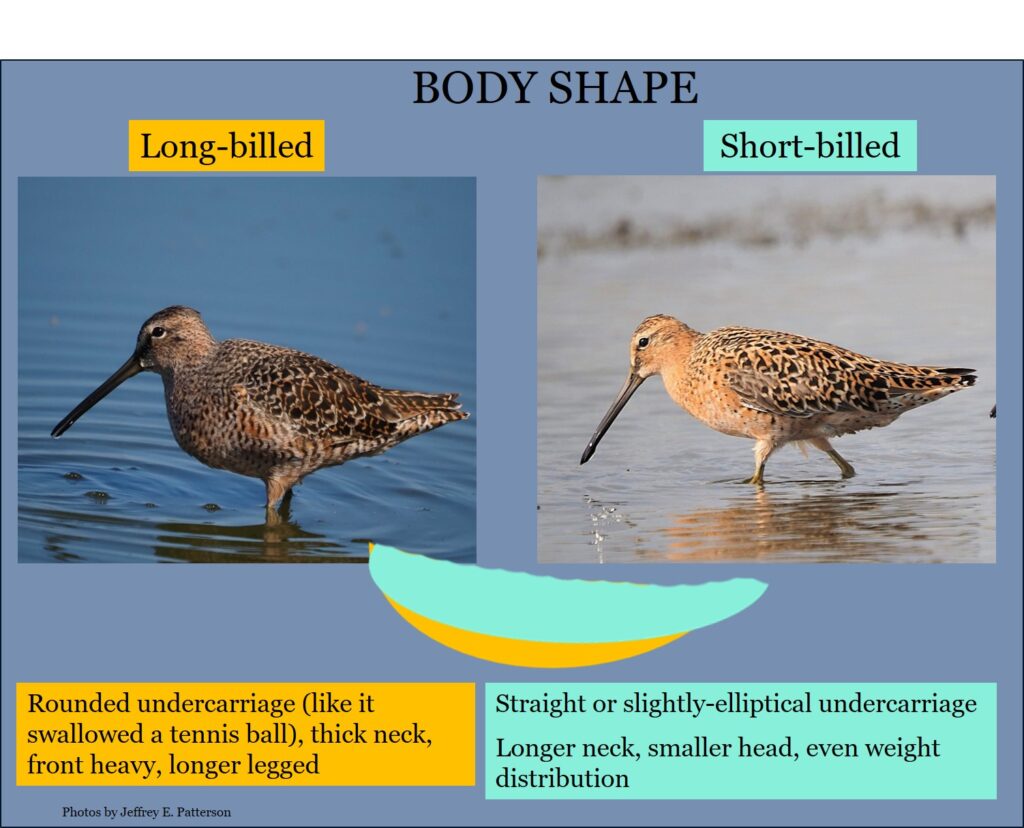
However, the shape of a birds body can vary greatly depending on the bird’s feeding status and how it is holding its feathers (all of which are moveable). At one migration stopover dowitchers were measured upon arrival. After a few weeks of feeding they gained up to 60% of their body weight.
Feathers are also moveable and so can mislead observers. The Short-billed on the right in the photo below appears much more robust and round in the under-carriage than the one on the left– perhaps due to puffed-out feathers and/or abundant food.
Primary Projection
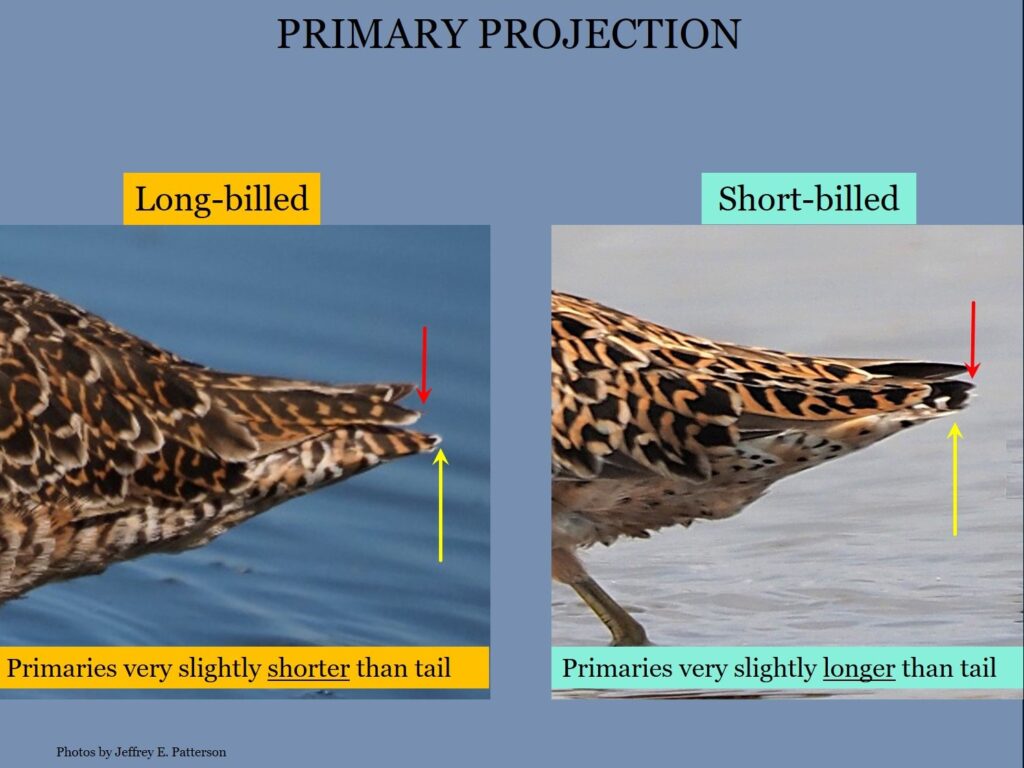
As shown below, the primaries of the Long-billed at rest are typically slightly shorter than the tail, while those of the Short-billed are slightly longer. However, this can be difficult to observe and of course tail and/or primary feathers in molt may be shorter than usual.
Year-round Field-marks
The boldness of the eye-ring, lesser underwing coverts, tail-bands are useful field-marks in any plumage, as are the vocalizations and water salinity preference.
Eye-ring
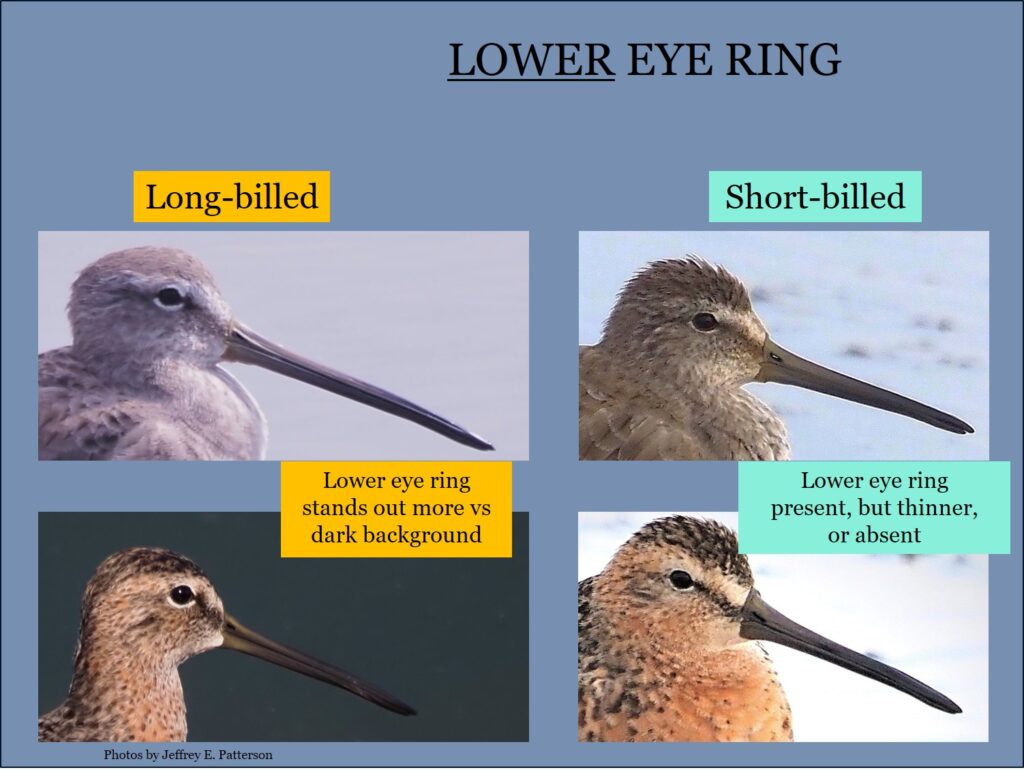
Although it is quite a subtle difference, the lower eye-ring of the Long-billed can be slightly more prominent because it contrasts with a slightly darker face.
Lesser Underwing Coverts
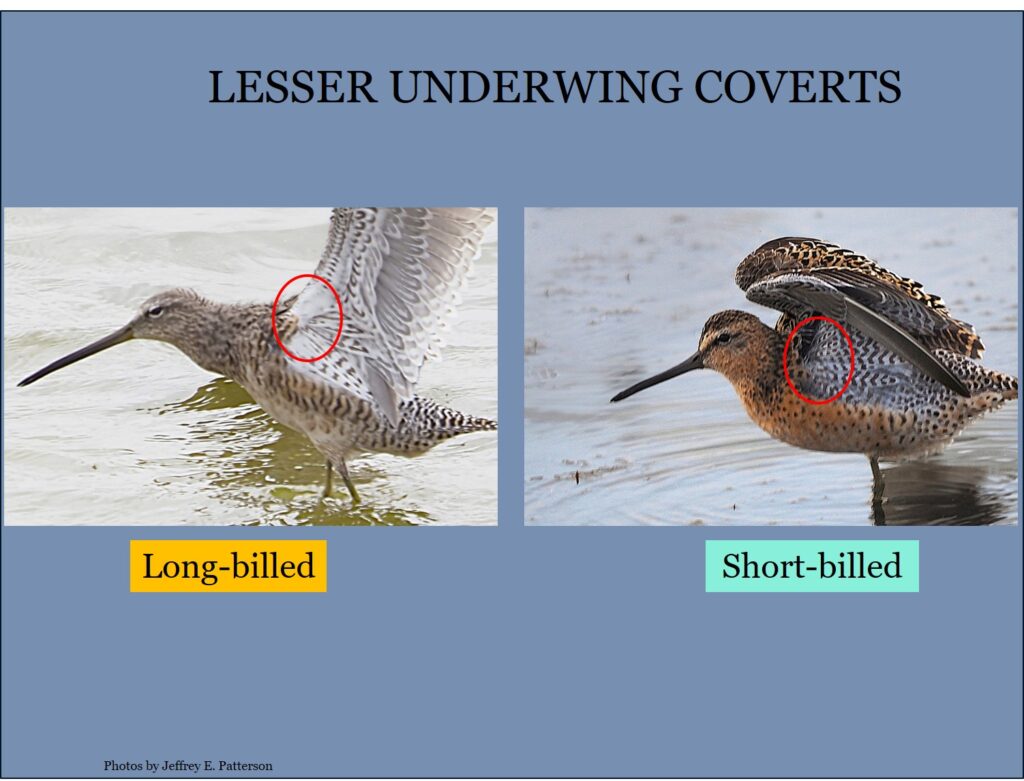
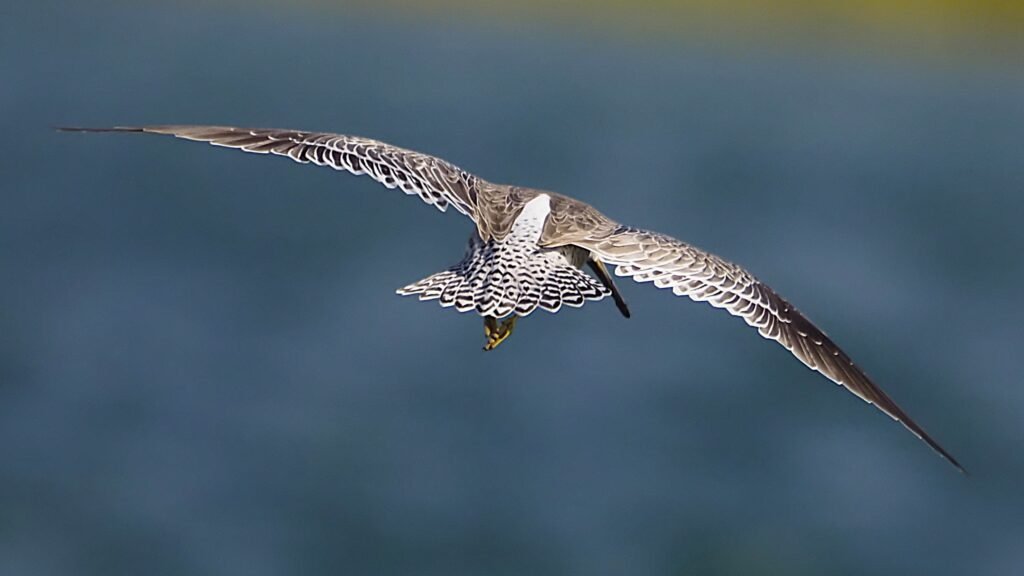
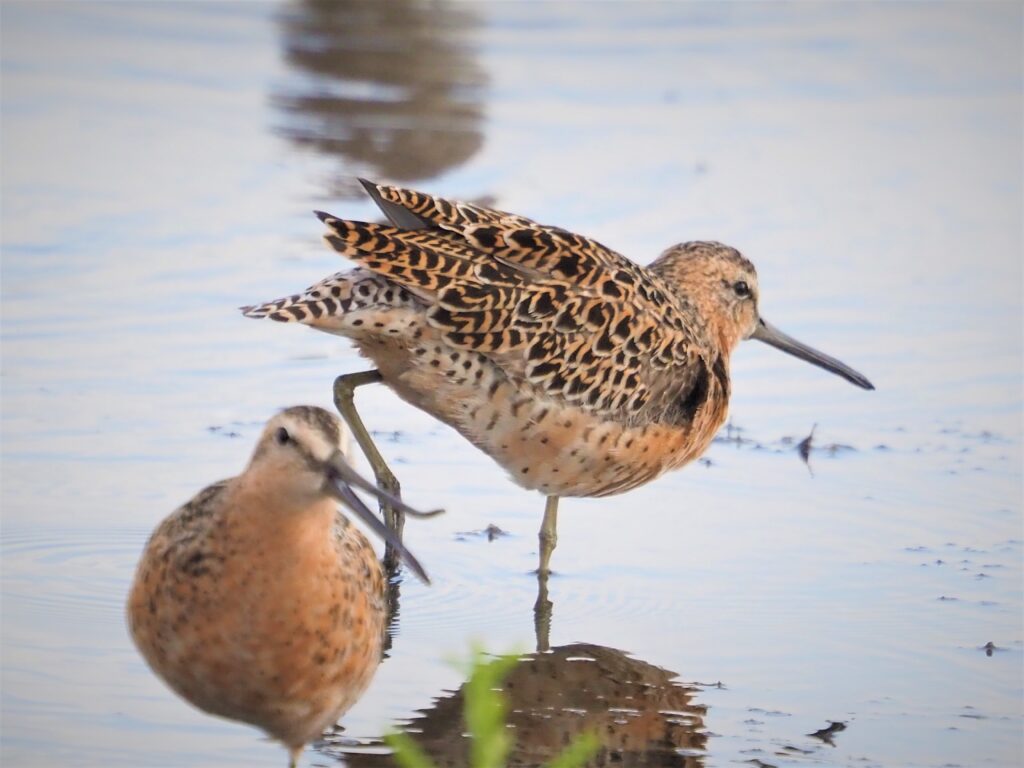
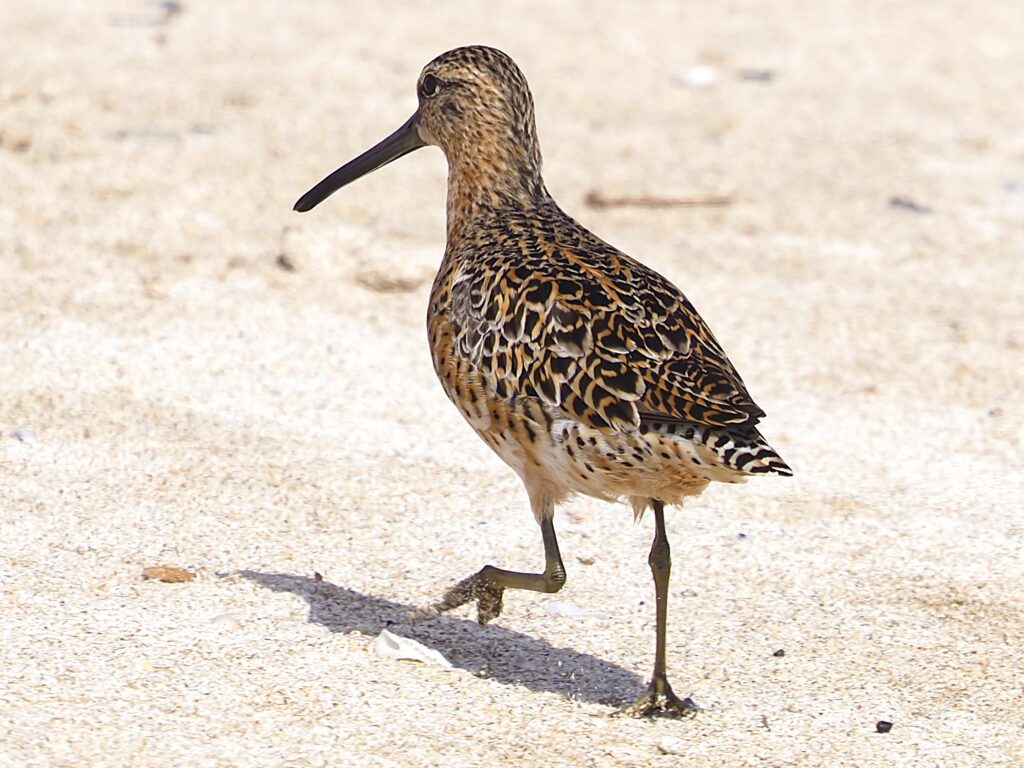
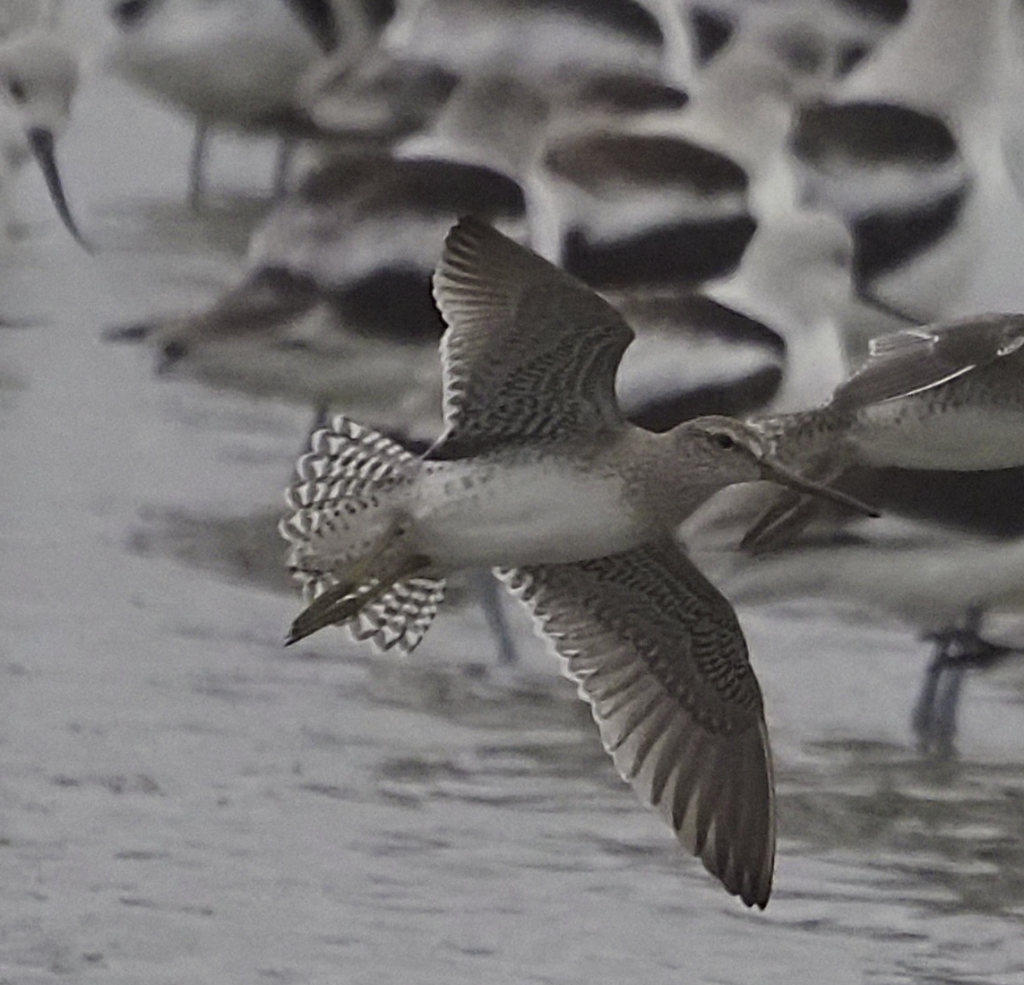
At last an unambiguous field mark!! Though it can be very difficult to see and is best captured in photographs, the lesser underwing coverts of the Long-billed are white at the base of the wing, while those of the Short-billed are patterned.
Tail Bands
The Long-billed has wider black bands, than white bands in the tail feathers. In the Short-billed the black and white bands are of approximately equal width.
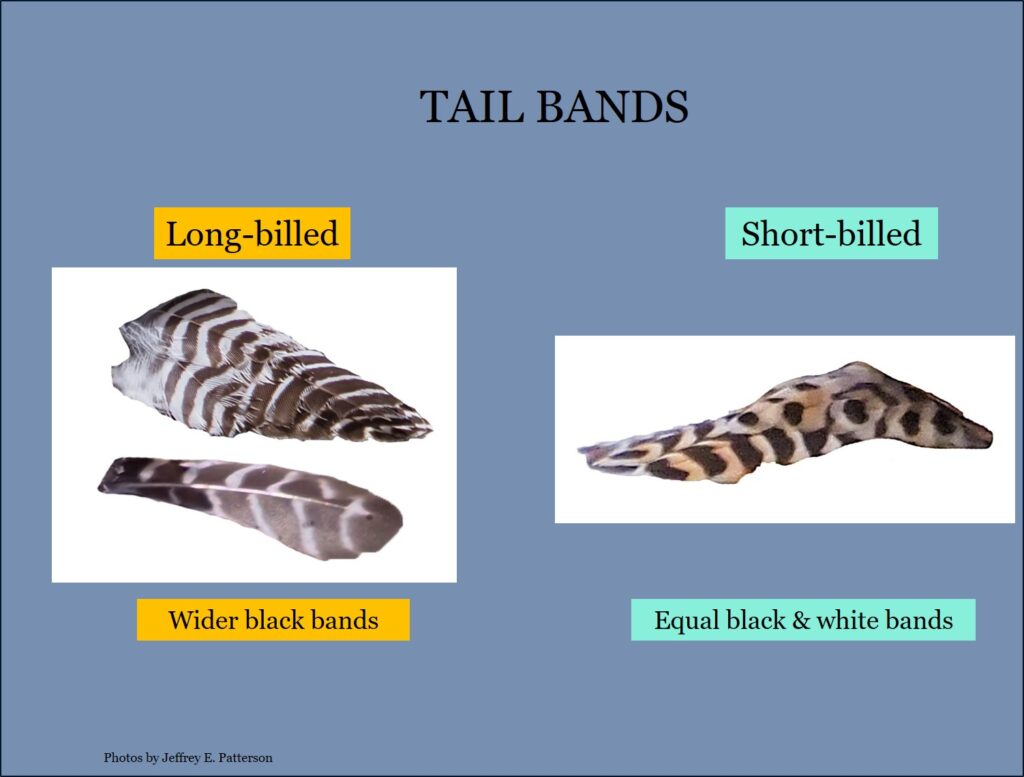
The Long-billed tail bands are shown in the photos below.
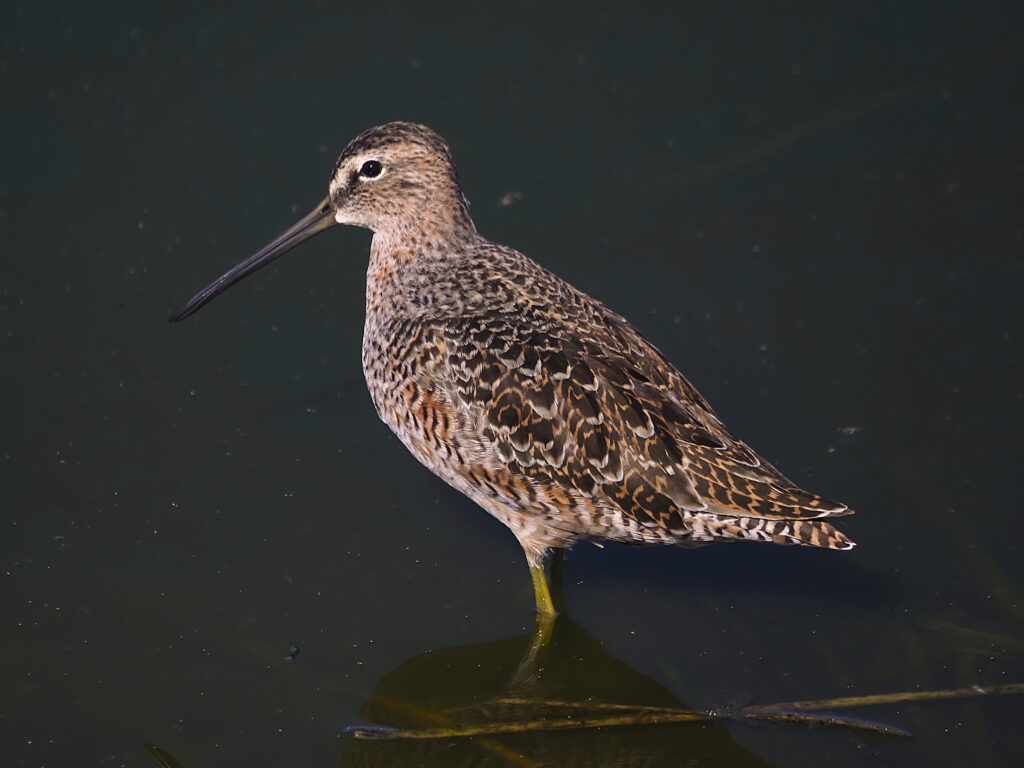
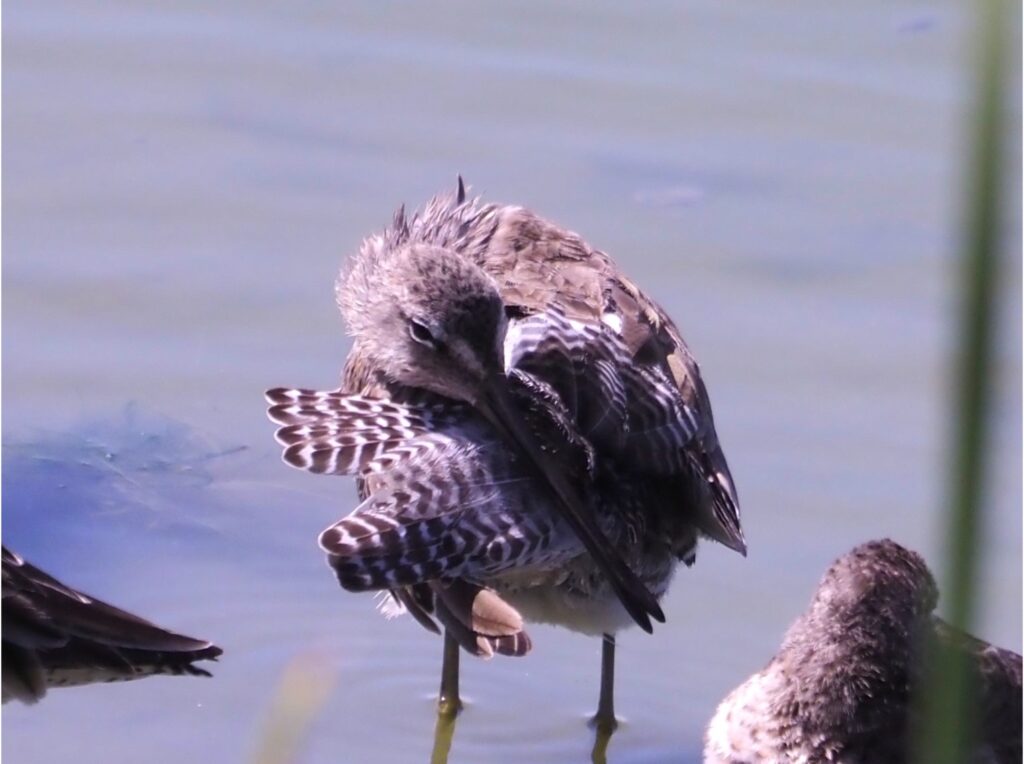
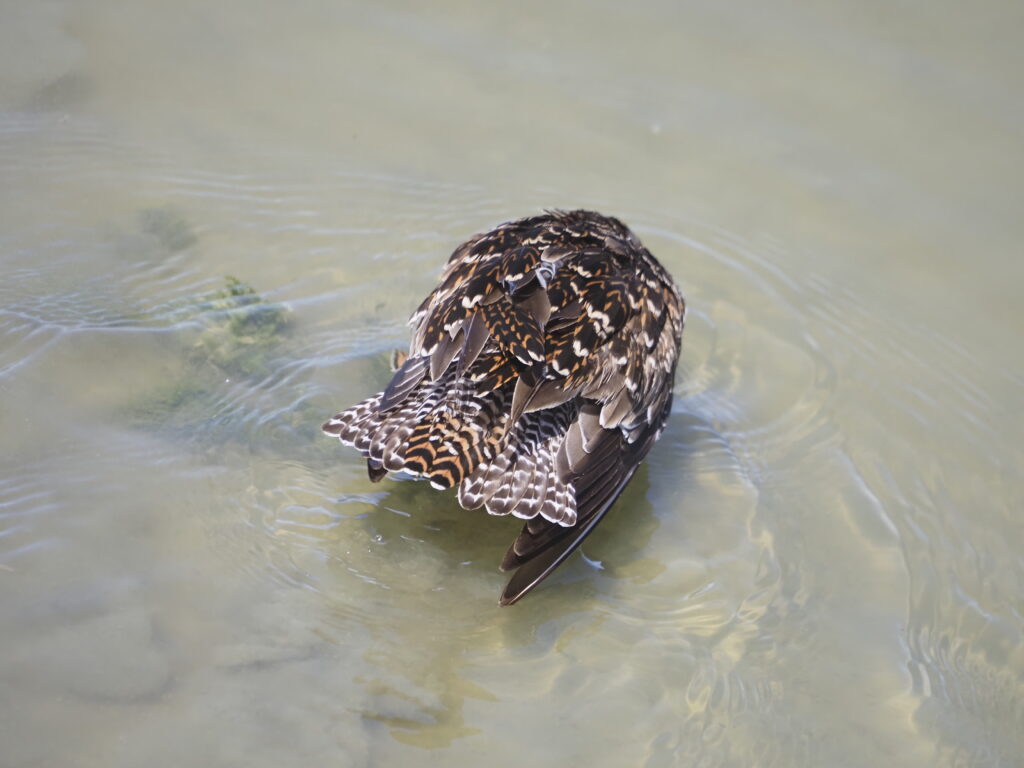
The tail bands of the Short-billed can be seen in the photos below.
Alternate Plumage Field-marks
Bars on Sides of Breast
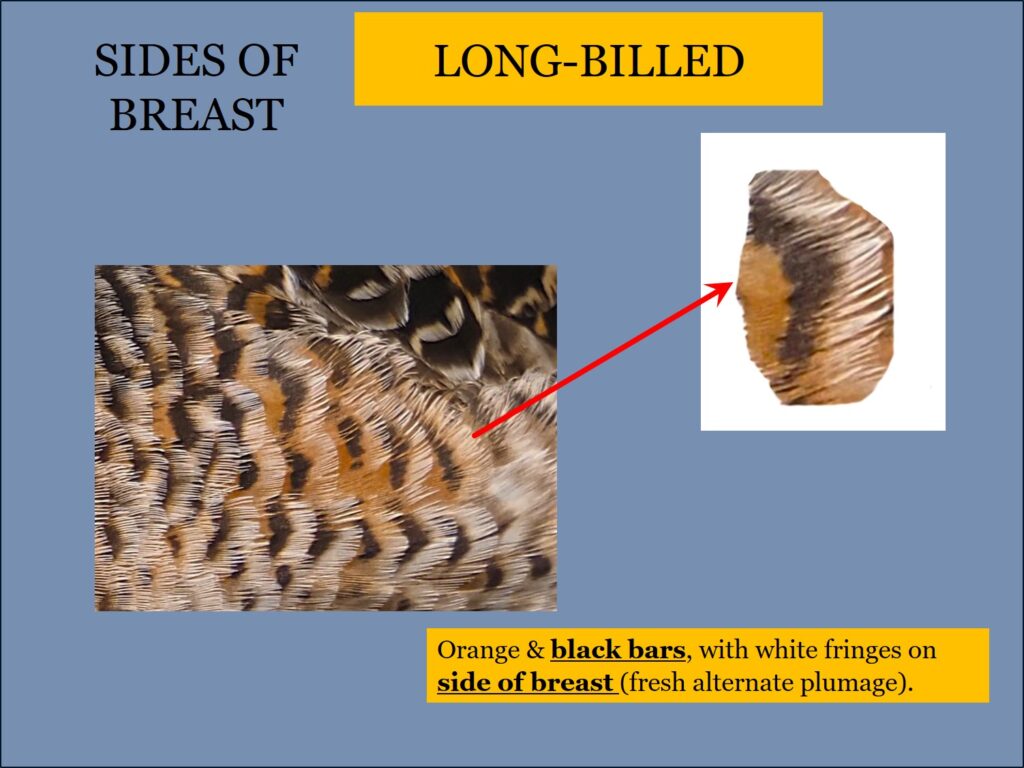
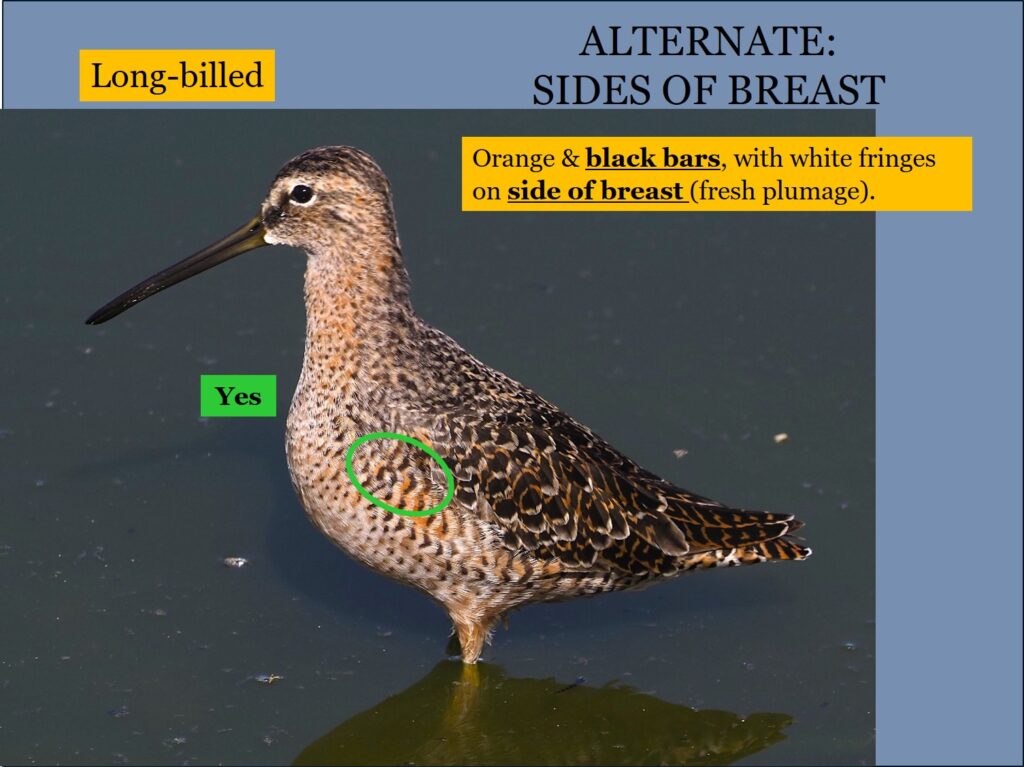
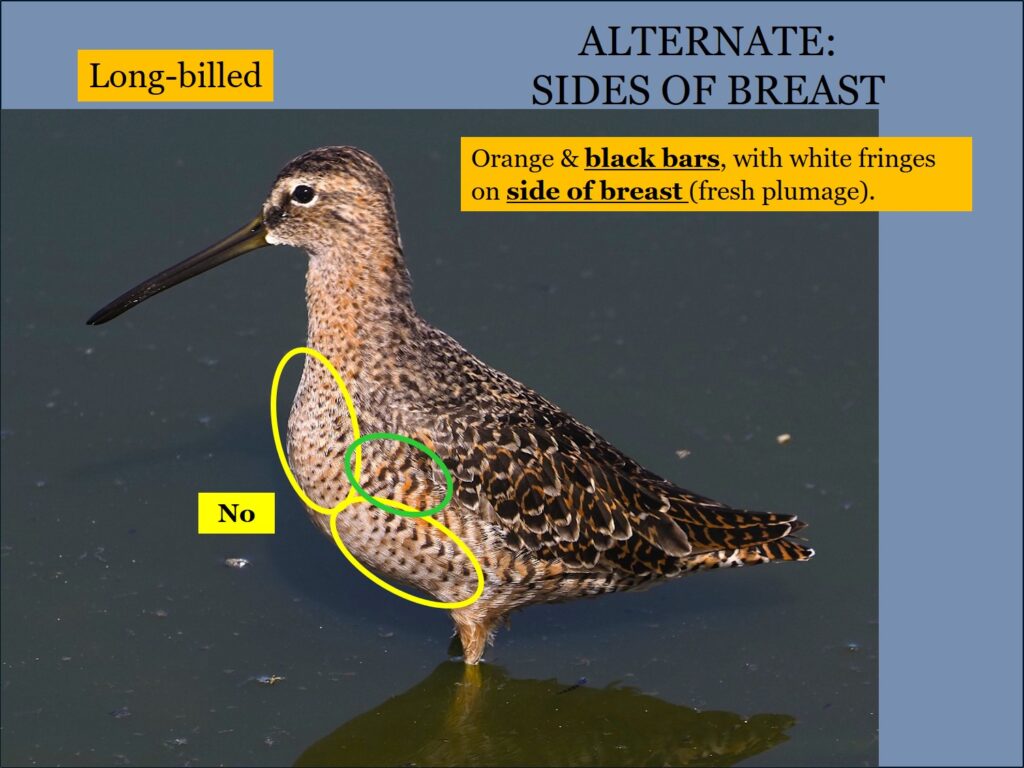
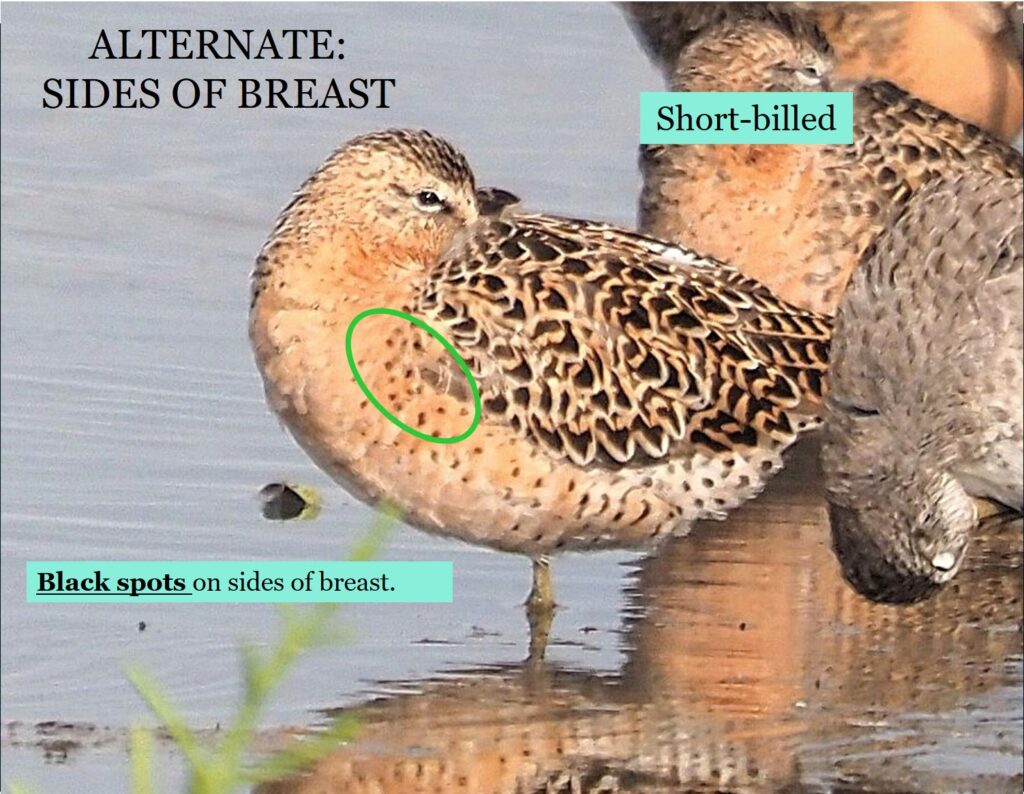
In alternate plumage one of the best field-marks are the bars or dots on the sides of the breast. The Long-billed has black and orange bars with white fringes. (The white fringes wear off later in the breeding season). In this same area the Short-billed shows spots. The observer must be careful to pin-point a very small area of the sides of the breast as shown in the photos below. Bars, dots and fringes can be ambiguous if not looking at this precise area.
Scapular Feathers
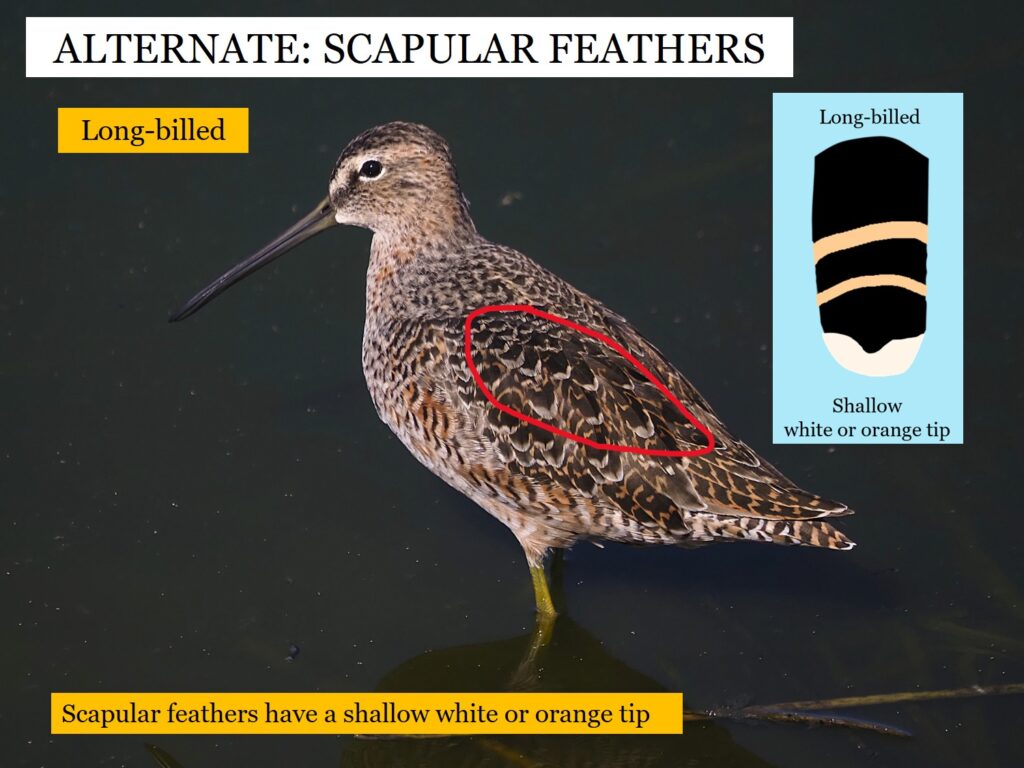
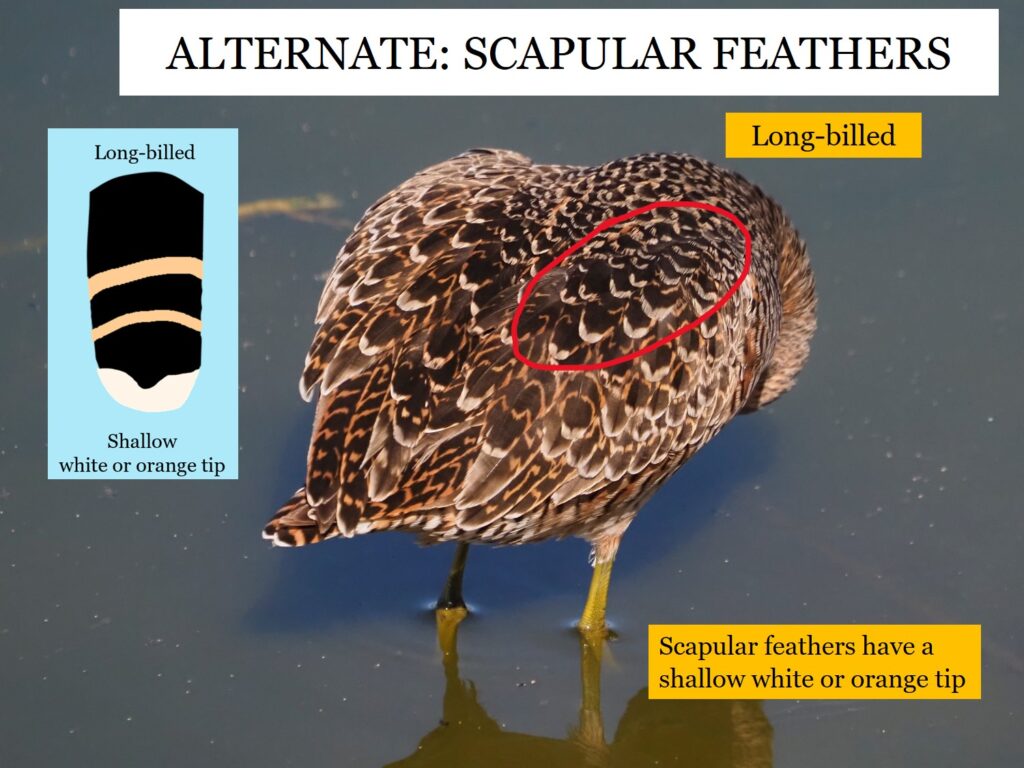
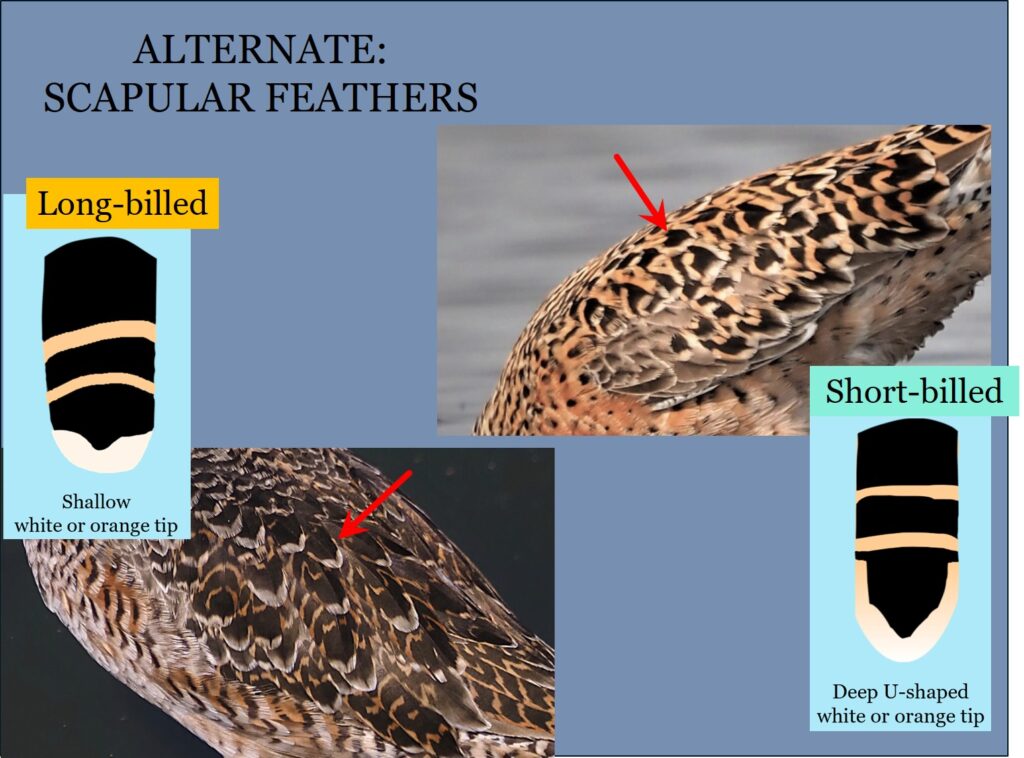
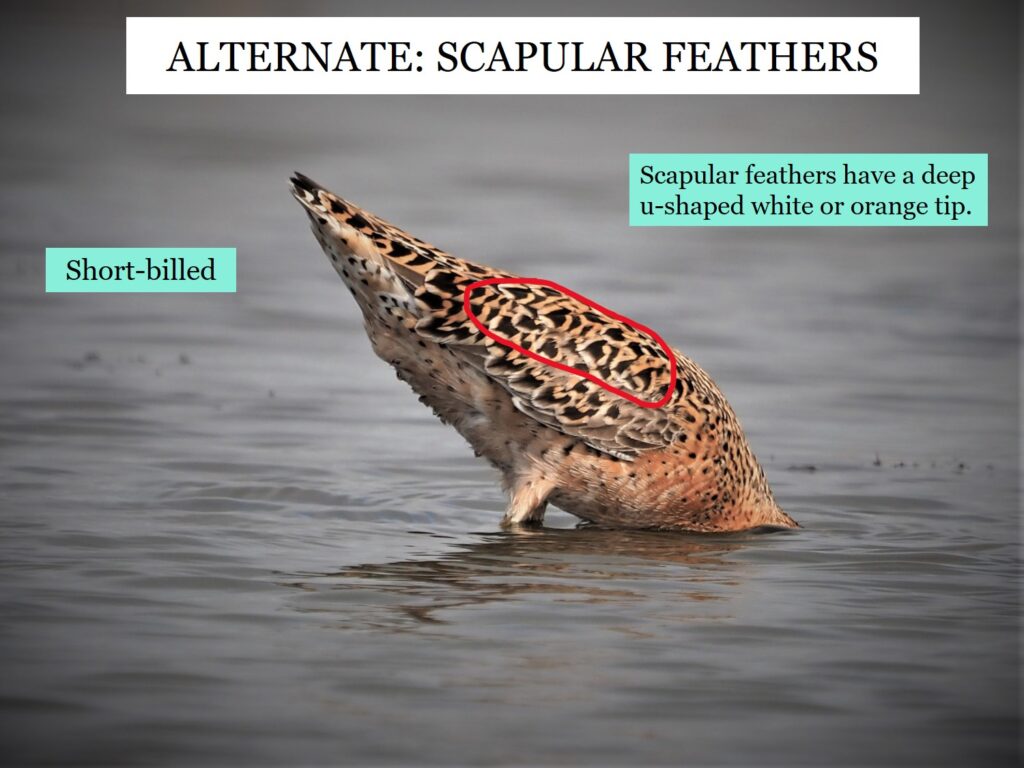
Another very good field-mark in alternate plumage are the individual scapular feathers. Each individual scapular feather of the Long-billed has a shallow white or orange tip. These feathers on the Short-billed have a deep U-shaped white or orange tip.
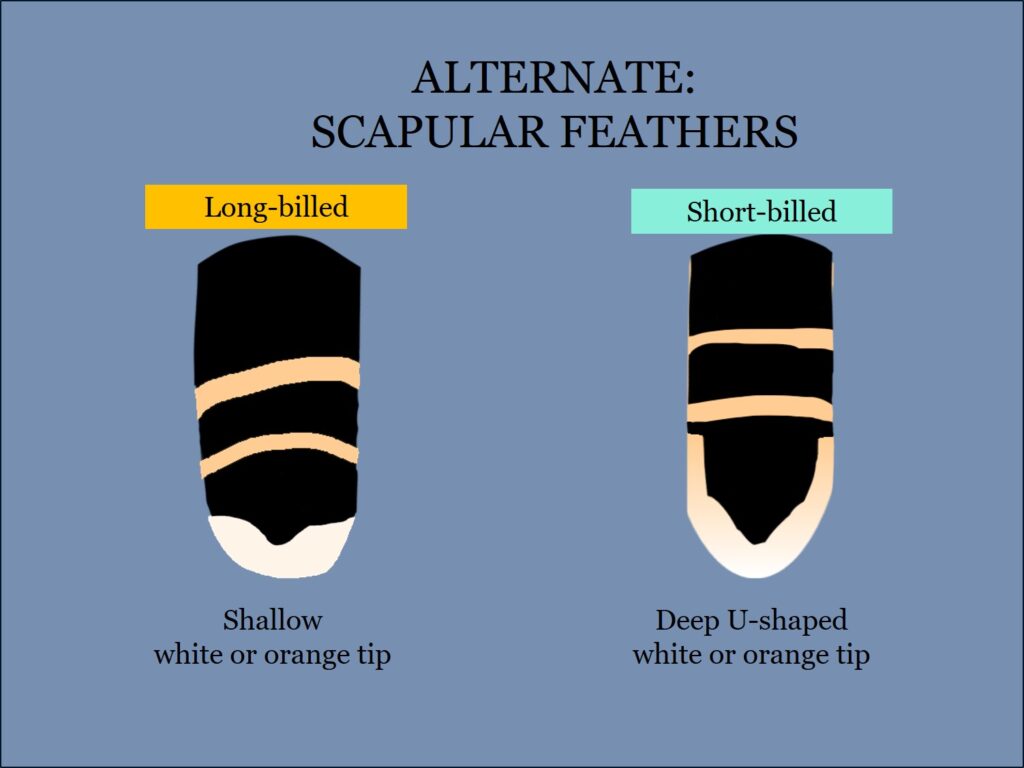
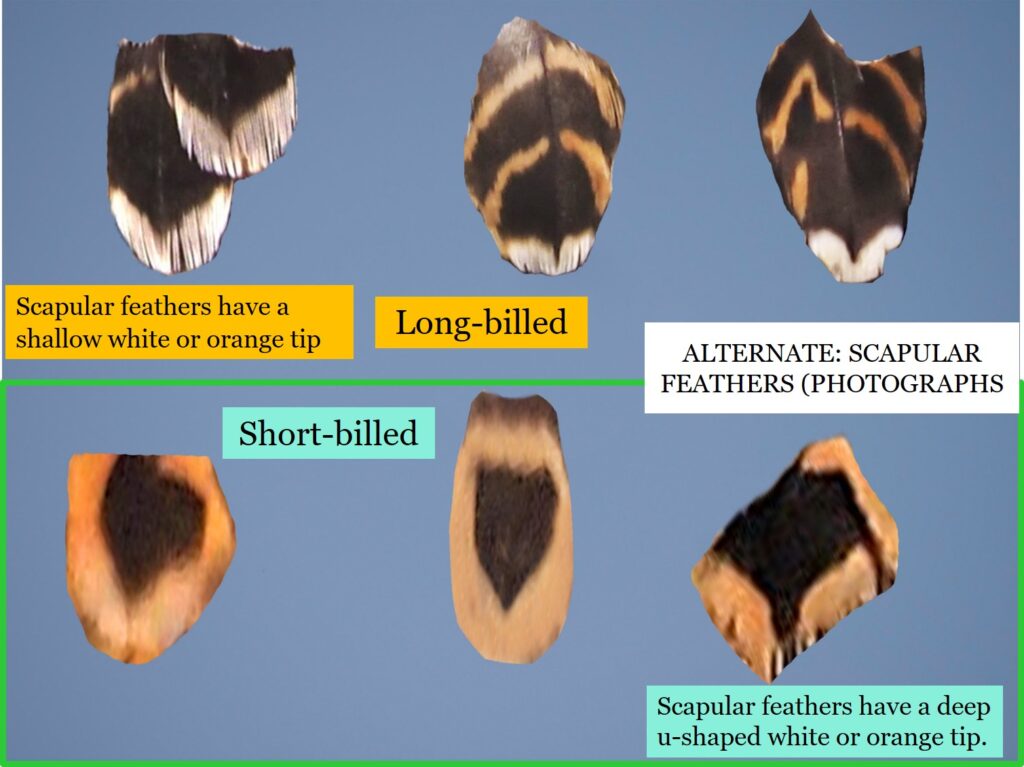
Although some authors also cite the tips of the mantle and wing-covert feathers in this regard, others say using these feathers can be ambiguous. So it is important to remember the location of the scapulars as shown in the photos below.
Basic Plumage Field-marks
Separating the two dowitchers in basic plumage (winter, non-breeding) can be difficult. Don’t forget the structural field-marks discussed above in this plumage (bill length and shape, body shape, and primary projection). Other field-marks which are useful in any plumage include: boldness of the eye-ring, lesser underwing coverts, tail-bands, vocalizations and water salinity preference.
Head and Neck
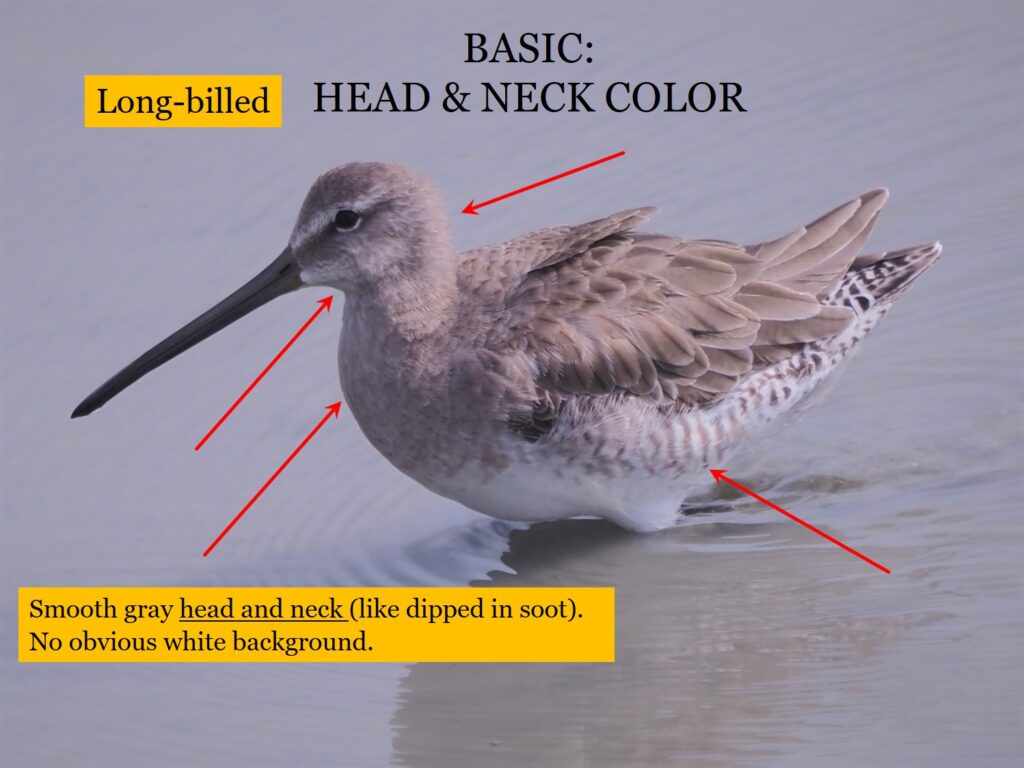
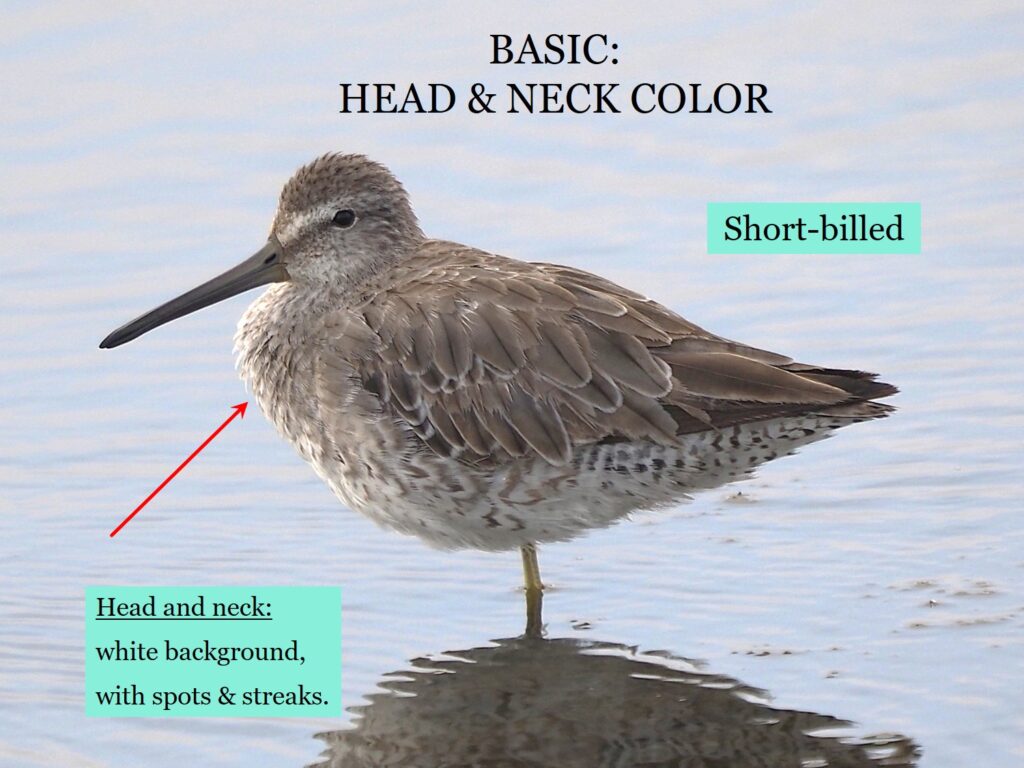
The head and neck of the Long-billed in basic are a uniform dark gray and have been described as “dipped in soot”. The Long-billed’s head and neck have no obvious white background, while the Short-billed’s head and neck appear to be white overlain by small gray spots and streaks.
Chin
The Short-billed tends to have a more prominently white chin which is more noticeable from a distance, while the Long-billed tends to grade more gradually from gray neck to a more limited area of white on the chin.
Flanks
The flanks of the Long-billed are washed with dusky or dark gray vertical bars, which tend to give more contrast between the flanks and belly. The flanks of the Short-billed have slightly paler gray splotches or spots (occasionally arranged in vertical bars), which provide less contrast with the belly.
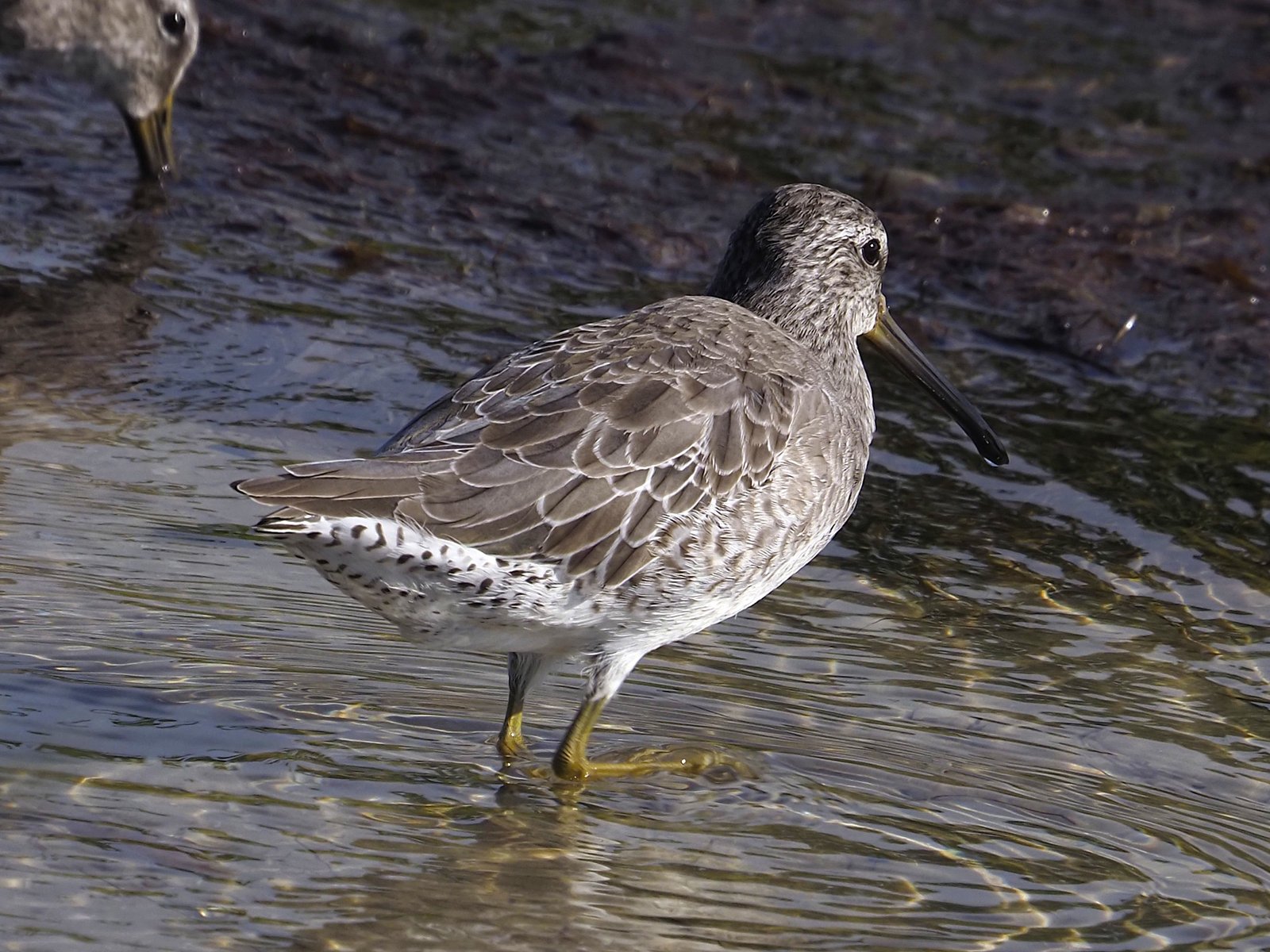
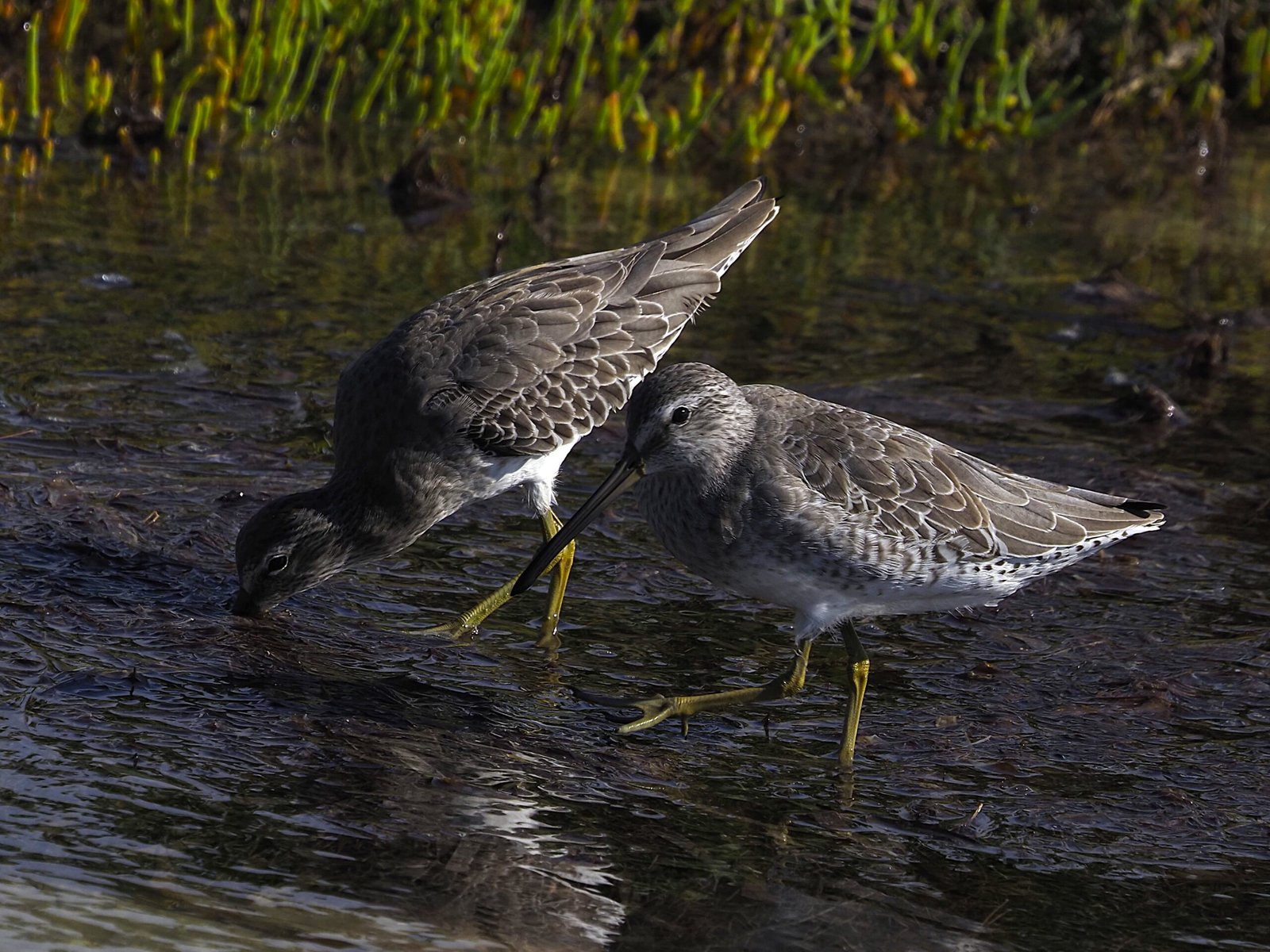
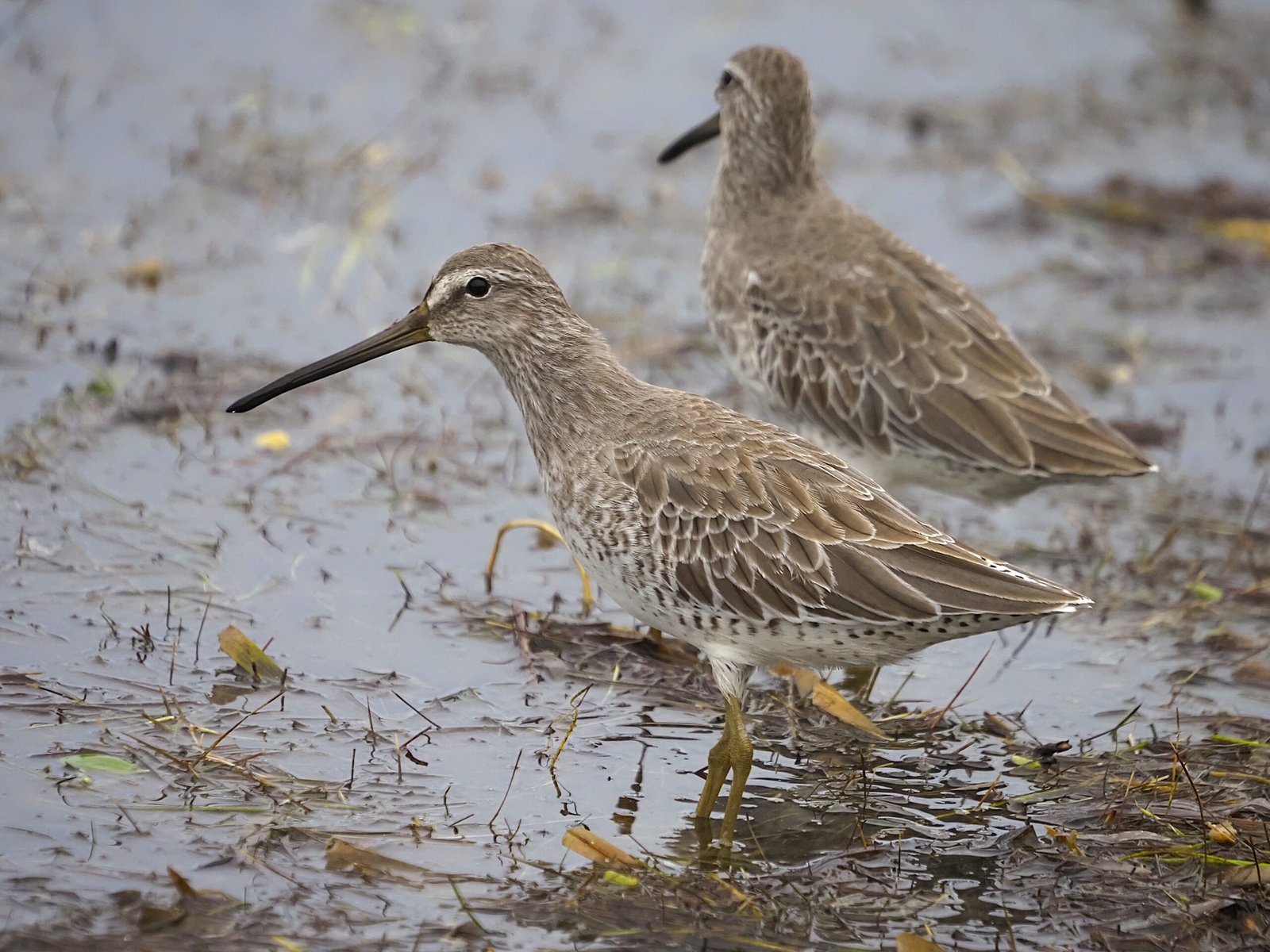
Several photos of Long-billed in basic plumage are shown in the gallery below.
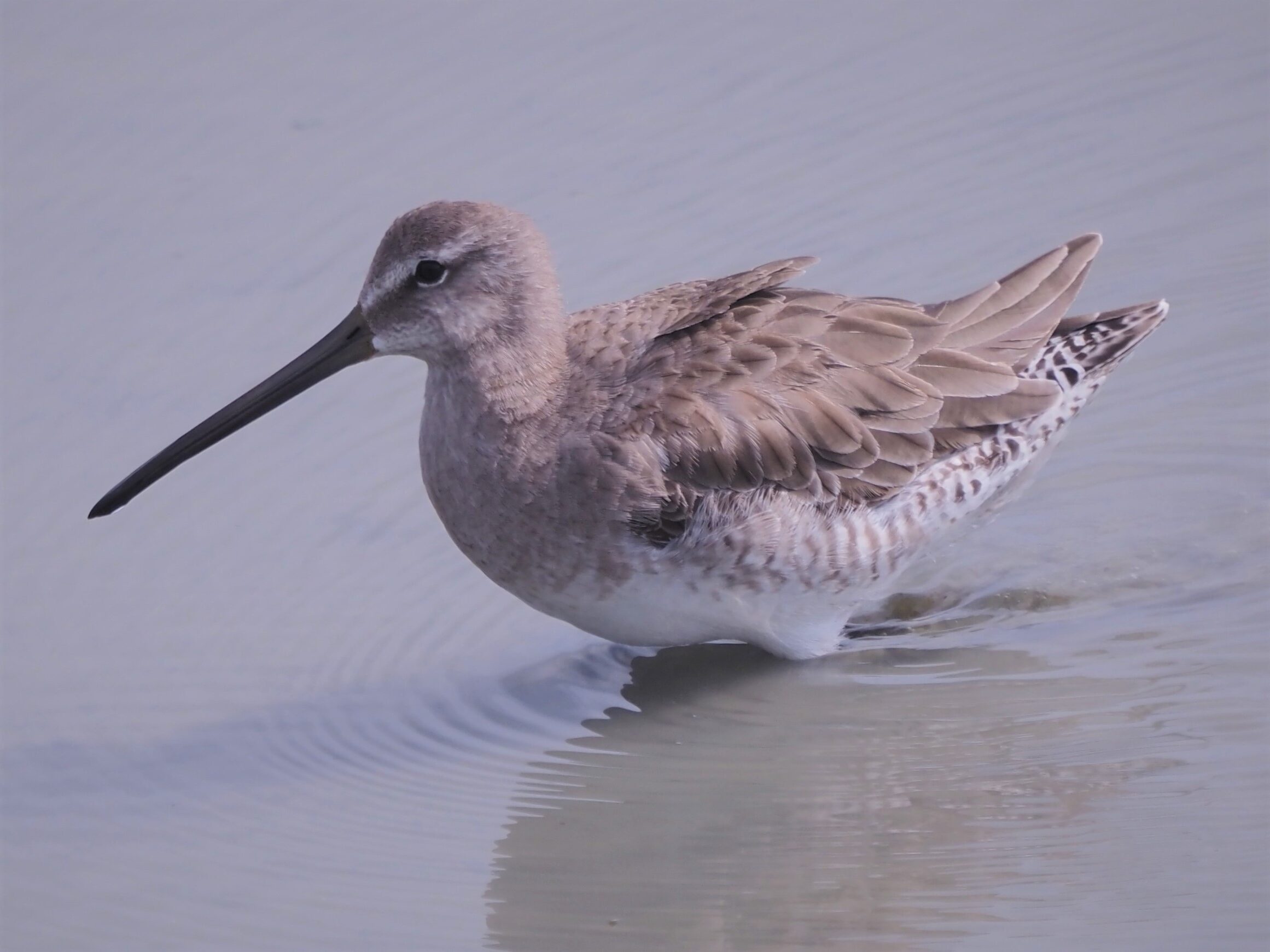
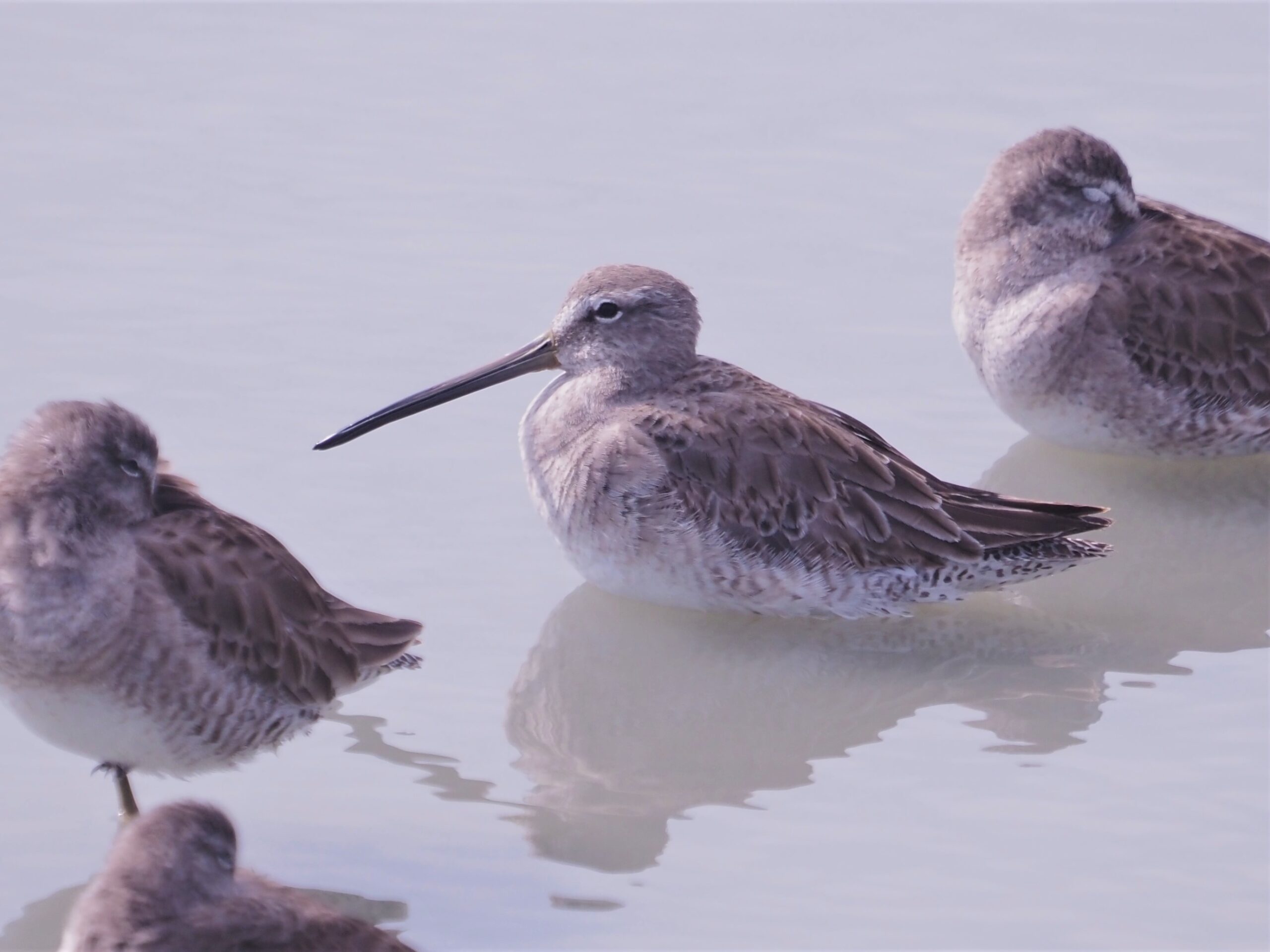
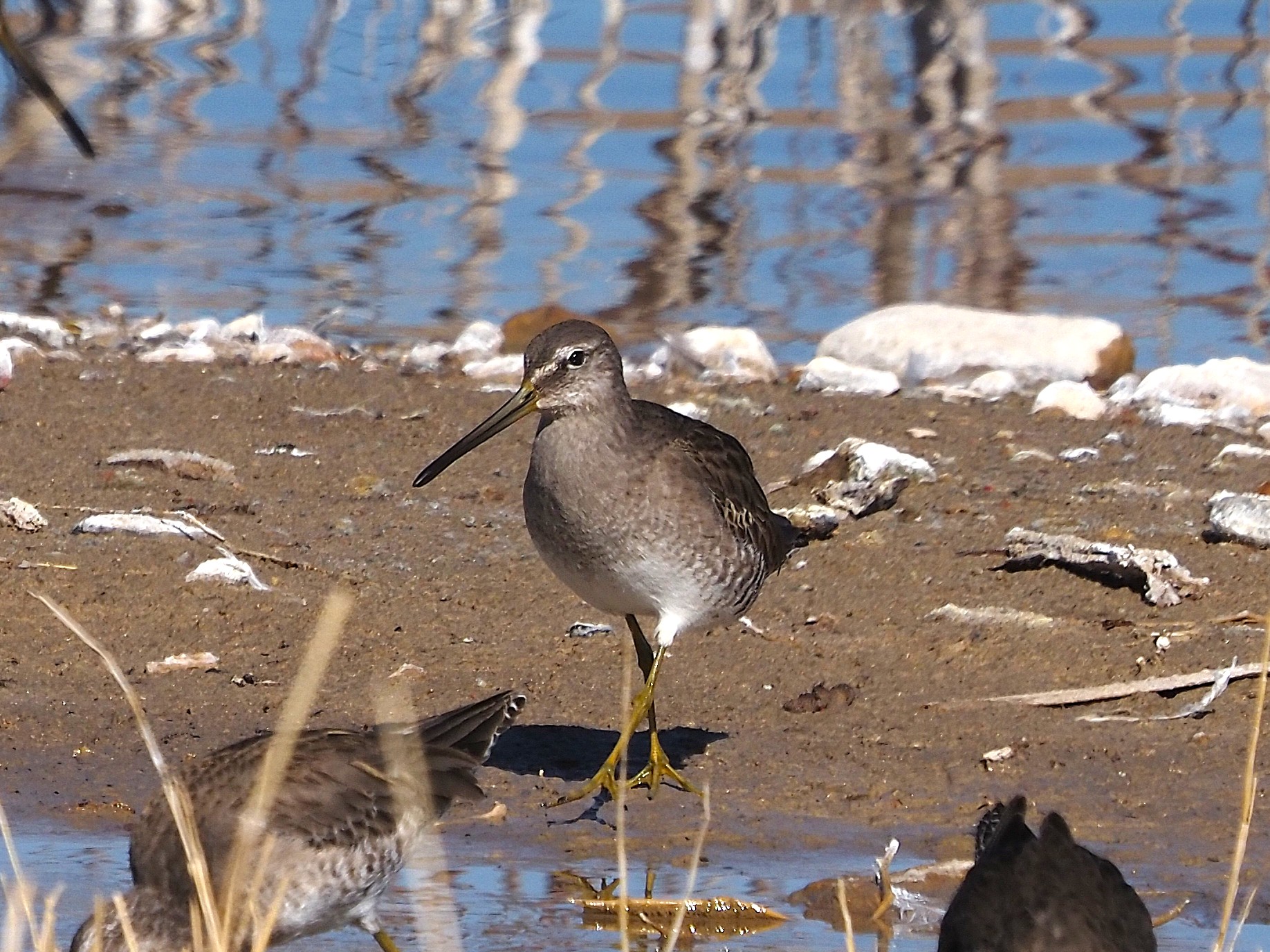
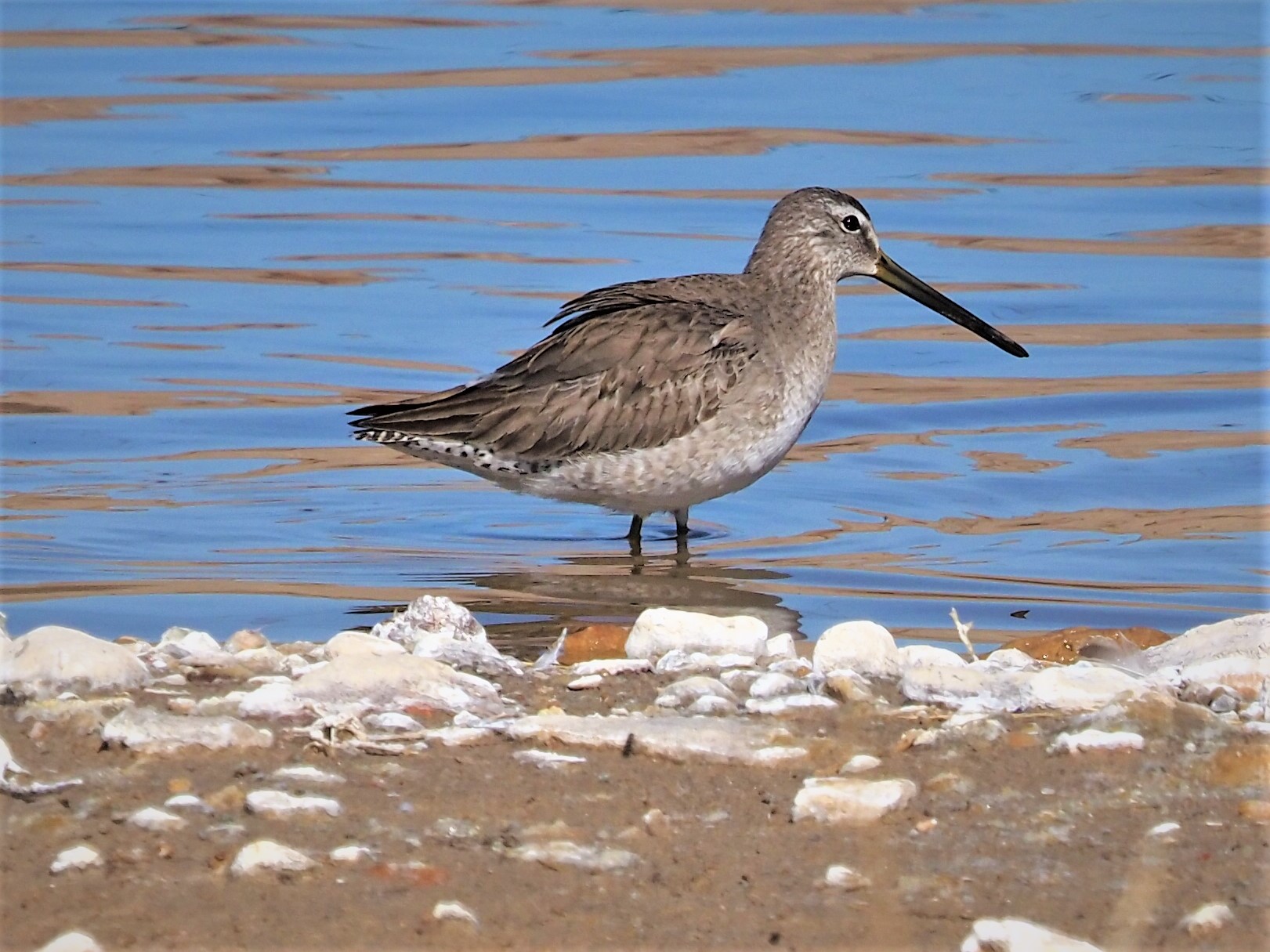
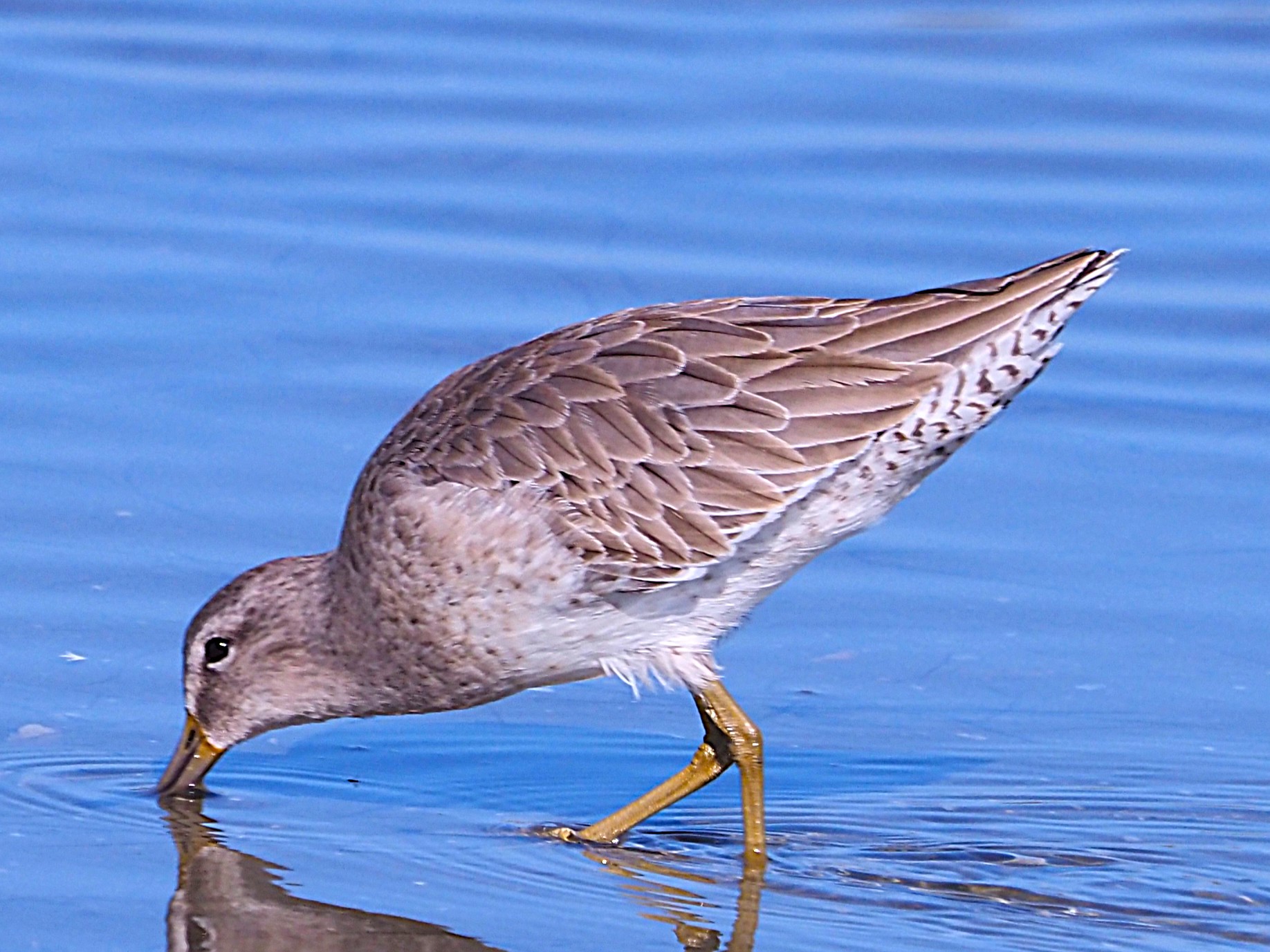
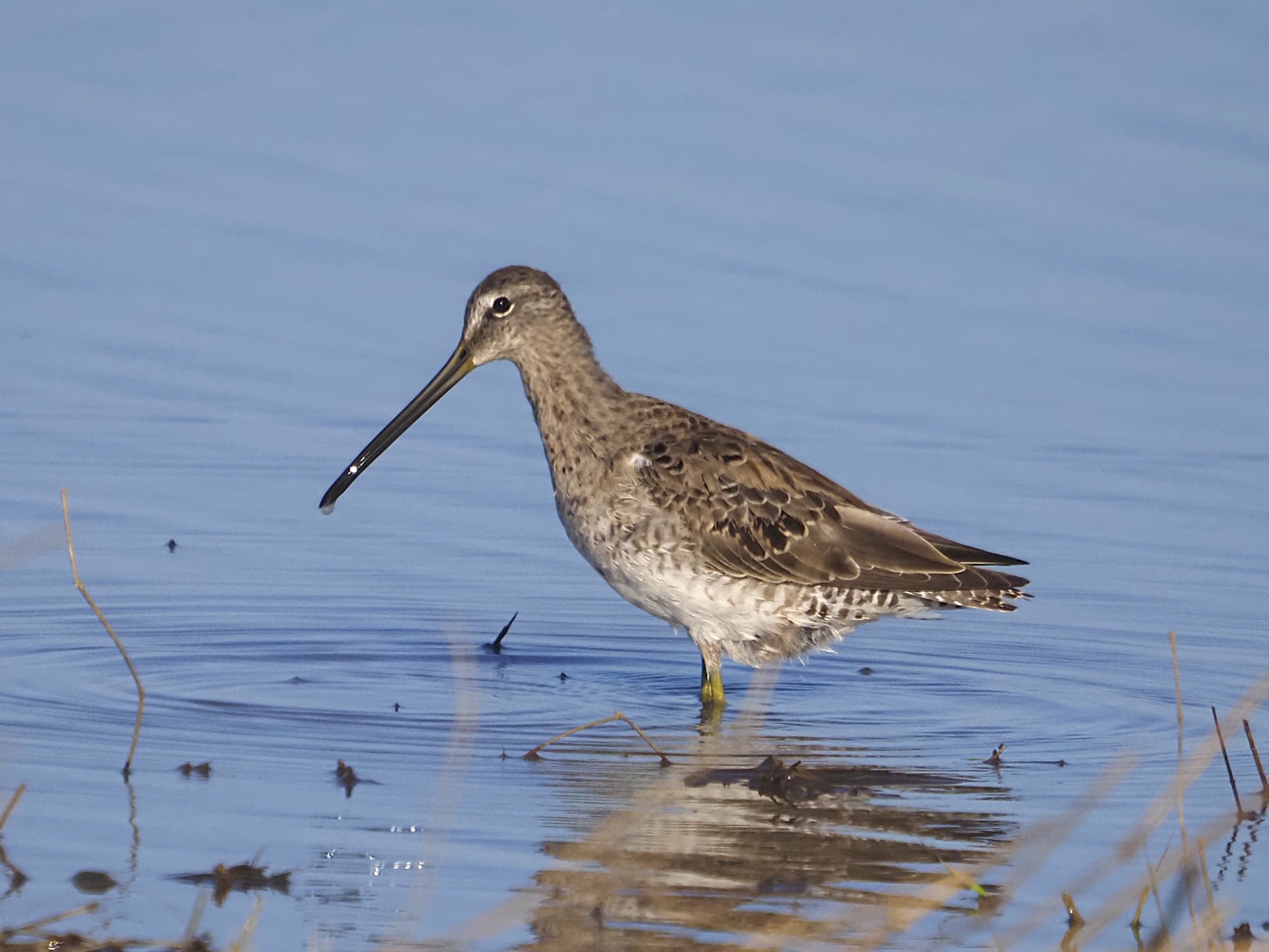
The Short-billed in basic plumage is shown in the gallery below.
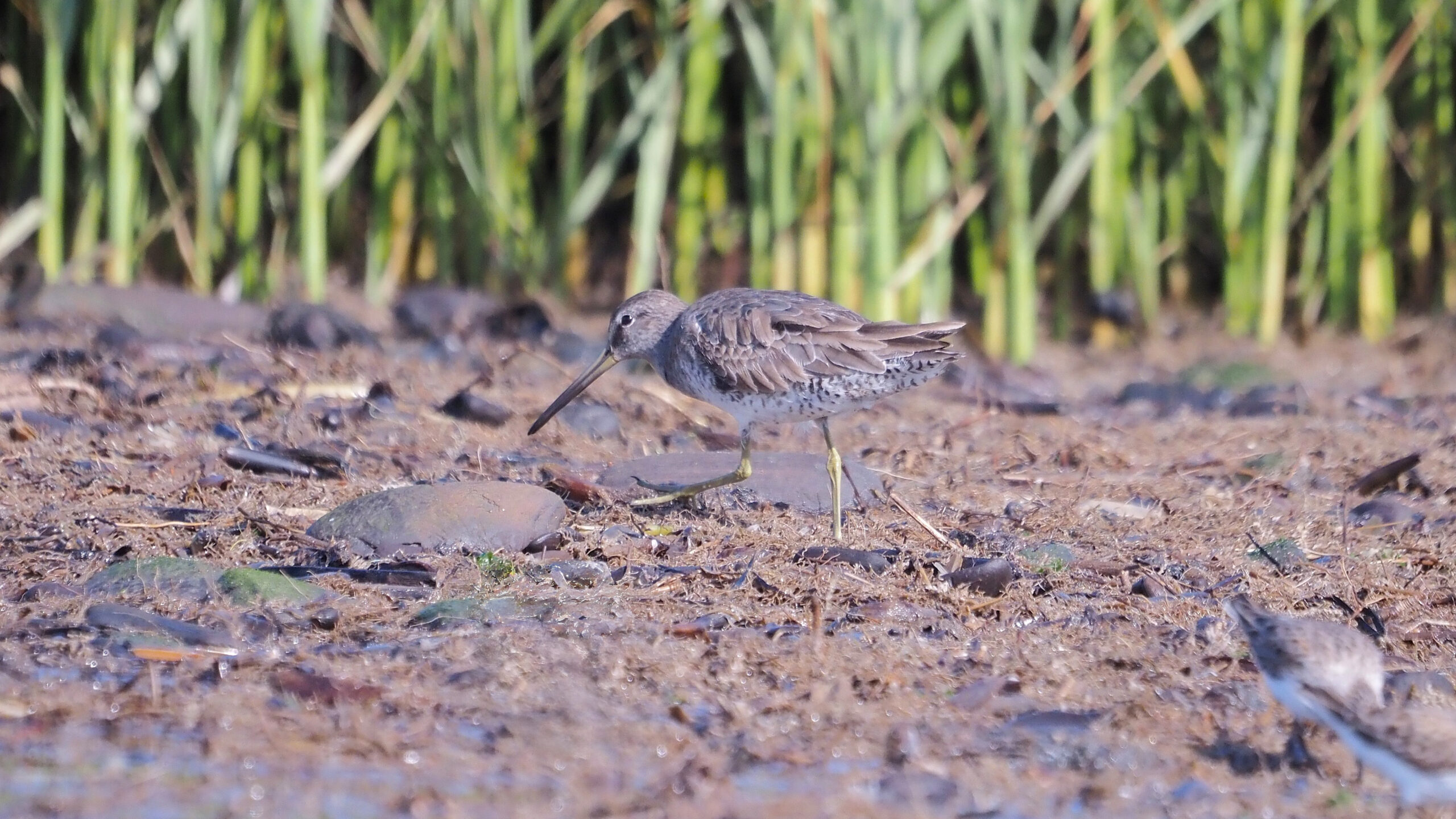
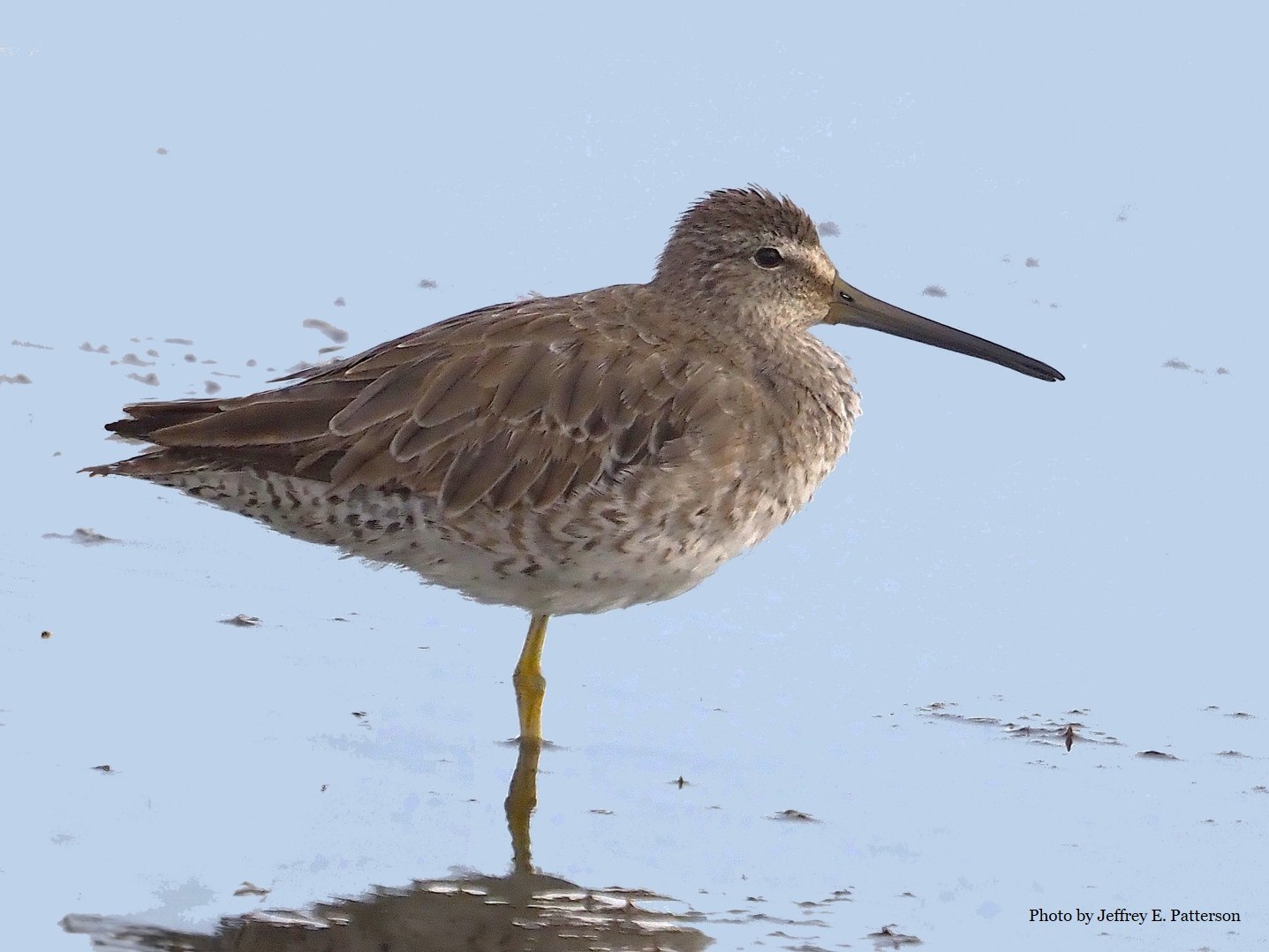
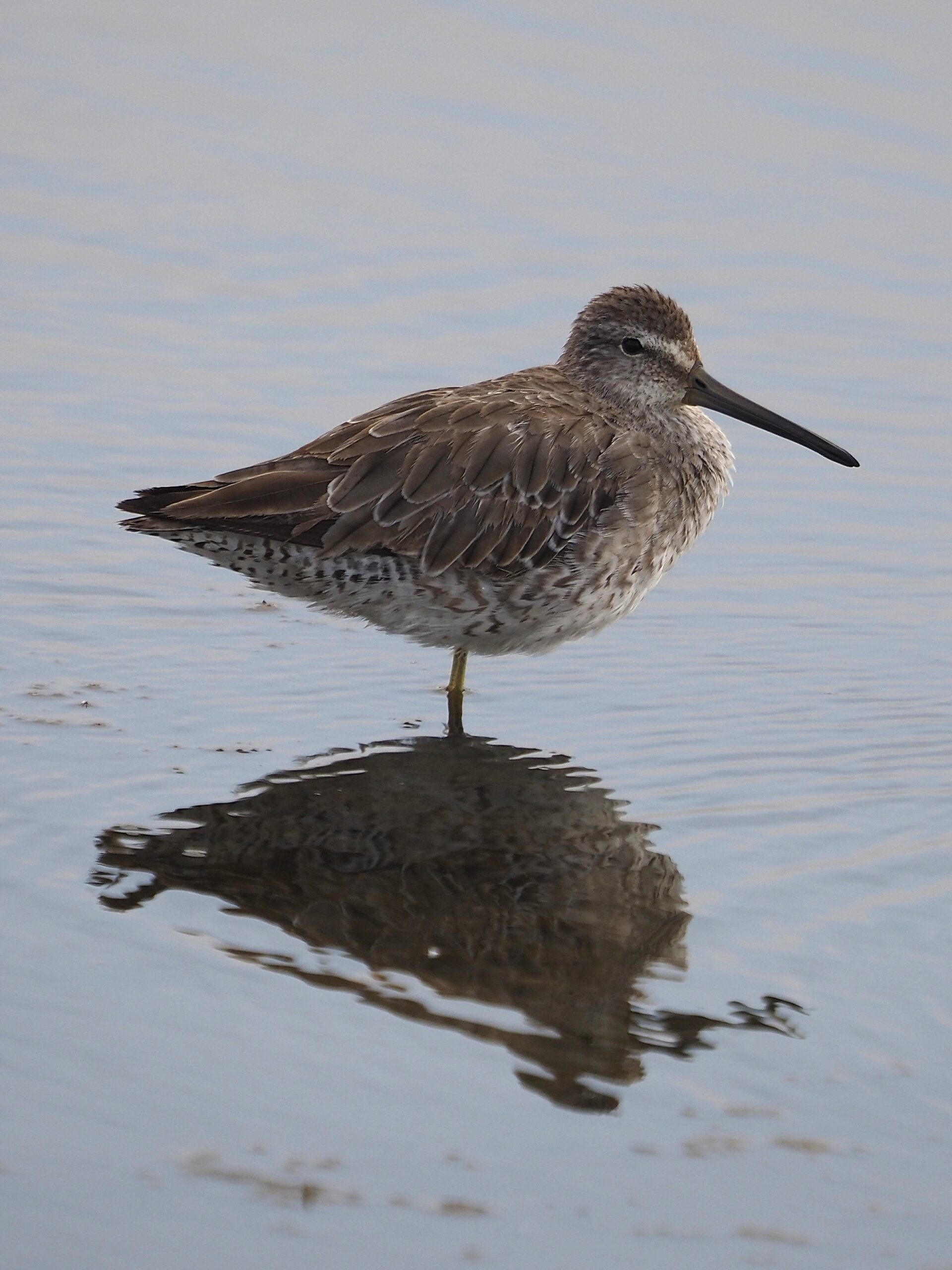
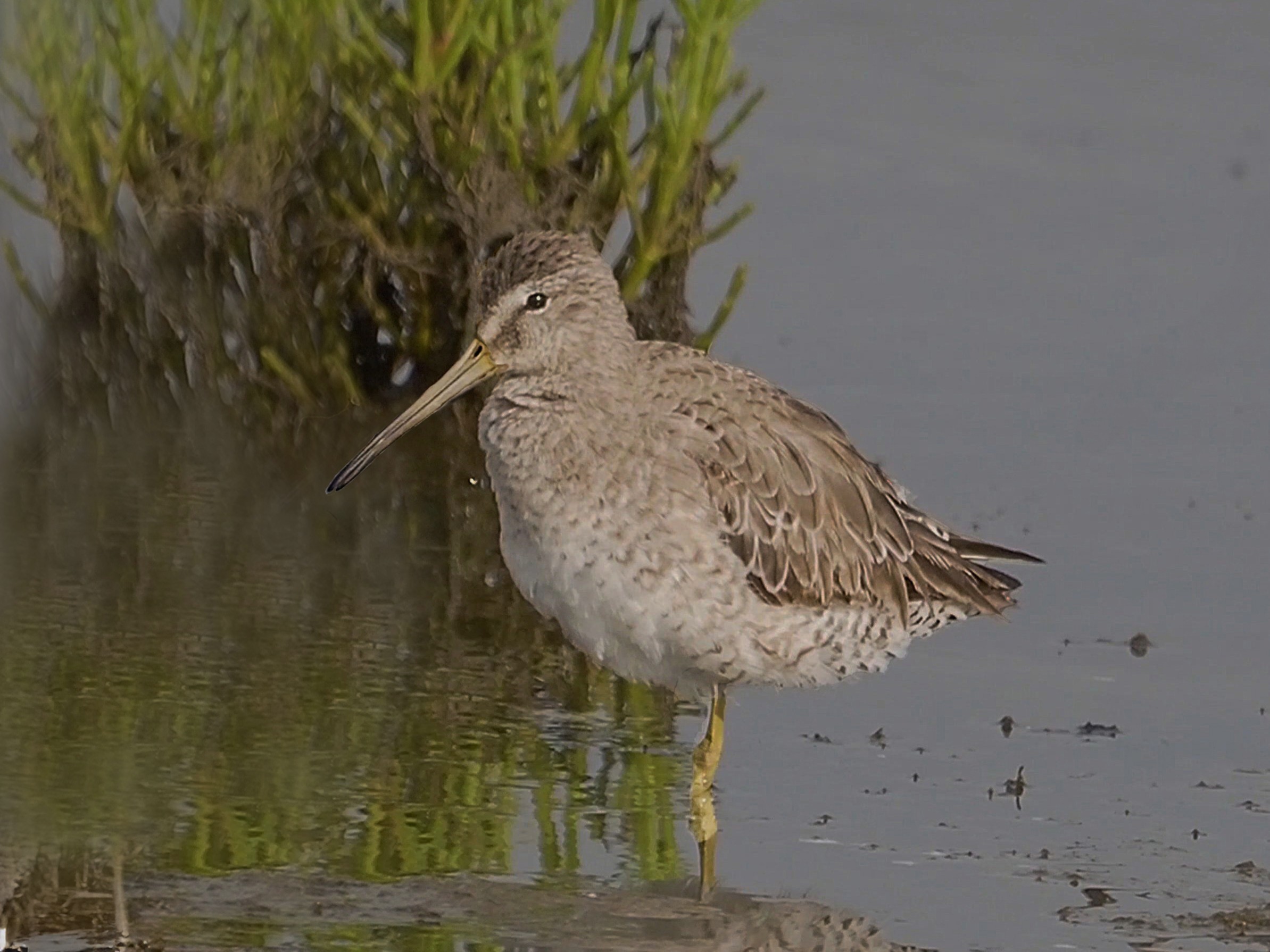
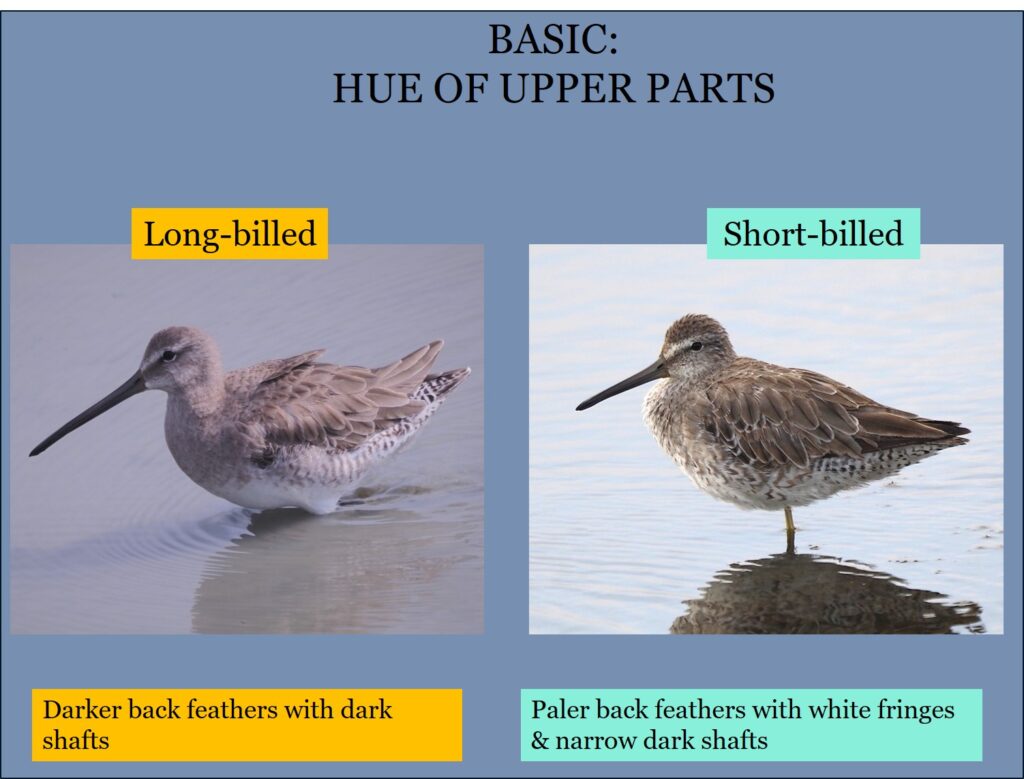
Hue of Upper Parts
The upper parts of the two Dowitchers in basic plumage are said to have slight differences as shown in the photo below. However, these clues are highly subject to lighting conditions and photographic settings.