Myiarchus
The myiarchus genus of flycatchers contains 22 species, most of which reside in central and South America. Six species are found in North America with La Sagra’s Flycatcher generally restricted to Florida, Cuba, the Bahamas and other Caribbean Islands.
Five myiarchus are found in Texas with the Nutting’s Flycatcher being very rare having only 4 accepted records with the Texas Bird Records Committee (TBRC). The historically infrequent Dusky-capped Flycatcher seems to be increasing in the mountains of the Trans-Pecos and the Lower Rio Grande Valley. It was removed from the TBRC Review List in 2010.
The final 3 myiarchus, the Ash-throated Flycatcher, Great-crested Flycatcher and Brown-crested Flycatcher are fairly regular in the right habitat, season and location in Texas. These 3 species are discussed in contrast to one another below. Since I am lacking photos of the Dusky-capped only a few comments are provided on that species. As with most flycatchers the vocalizations are the best method to identify myiarchus flycatchers.
Like many flycatchers, myiarchus are prone to wandering. The Ash-throated is typically a bird of Texas and the arid west, however it frequently shows up far out of its normal range. The Great-crested is a bird of Eastern North America, but also occurs in small numbers in the west. The Brown-crested appears to be the most restricted in range based on Ebird species maps, occurring in the southern & western portions of Texas and the west. (Note that Ebird maps can be explored at https://science.ebird.org/en, under the Explore, and Species Maps tabs).
The habitat of myiarchus can also be useful, though not determinative. The Great-crested prefers larger trees of woodlands, parks and neighborhoods, frequently, but not exclusively near water. The Ash-throated is typically found in arid environments of the hill country and West Texas, but frequently shows up near the coast as well. The range of the Brown-crested overlaps with that of the Ash-throated (and the Great-crested), but it is more likely found in areas with larger trees such as in riparian woodlands.
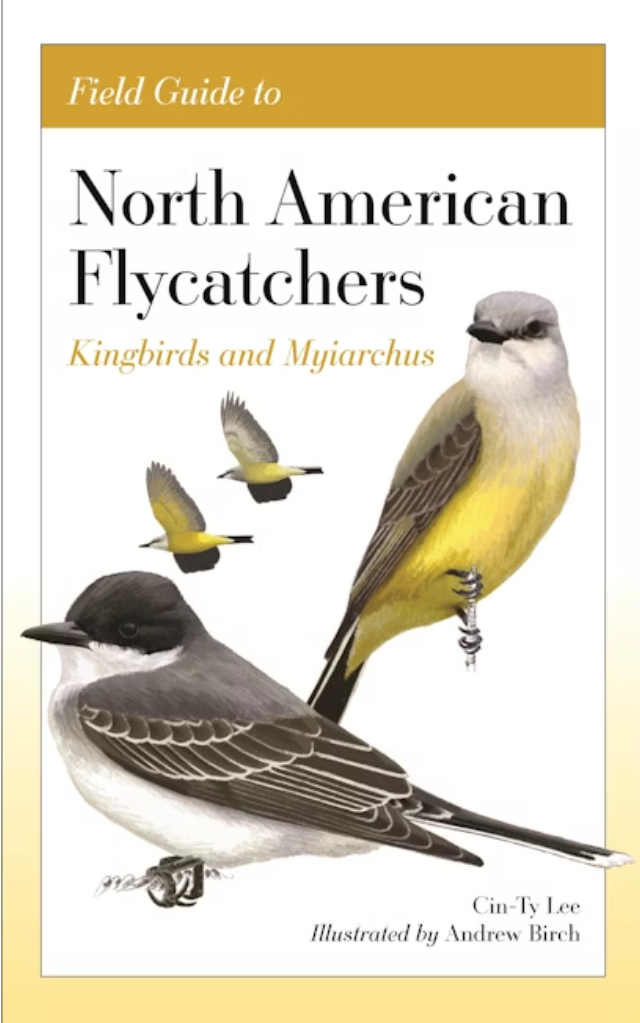
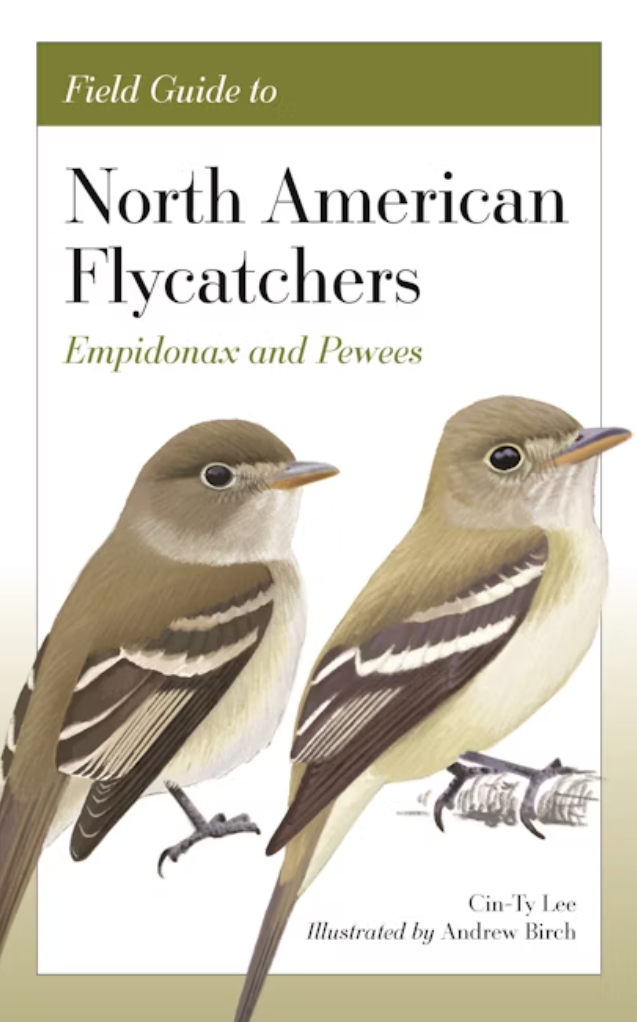
I have found the recently published (2024) book “Field Guide to North American Flycatchers, Kingbirds and Myiarchus” by Lee and Birch (Lee & Birch) to be an excellent resource for the study of flycatchers. Much of my discussion on myiarchus flycatchers is in relation to Lee & Birch’s fine book.
Structure: Body Size & Bill Length
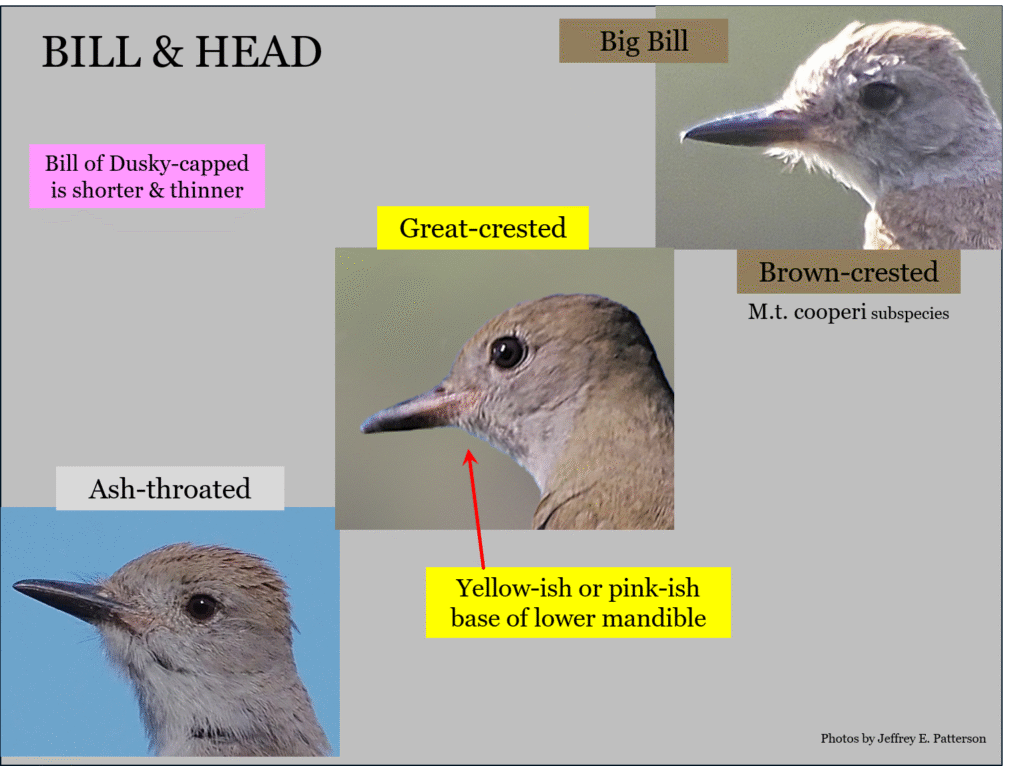
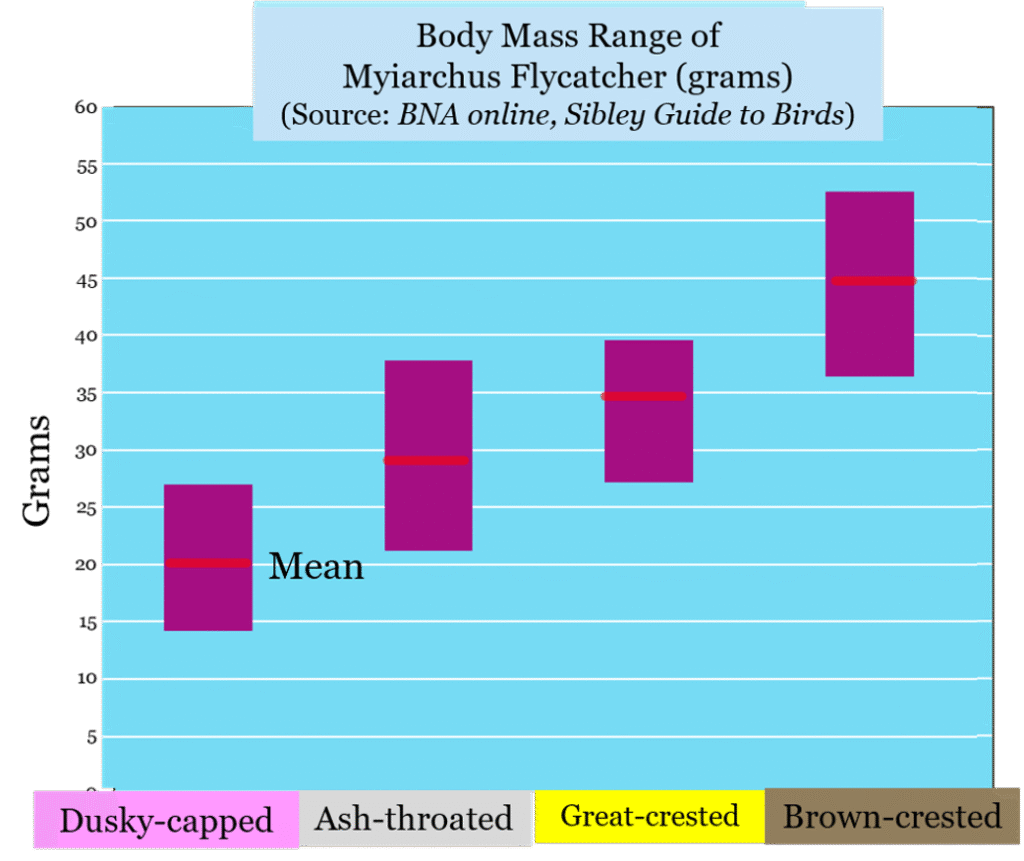
The Dusky-capped is noticeably smaller than the 3 regular myiarchus and has a shorter and thinner bill. Of the 3 regular myiarchus, the Ash-throated is the smallest with the smallest bill, Great-crested is of middle size with a medium bill, and Brown-crested is the most robust and has the largest bill. However, as shown in the table below there is much overlap for body size and bill length for these 3 species. Nevertheless, body size and bill length are usually an important first clue to identification.
Though it is difficult to be certain in a single comparison the slight difference in body bulk is noticeable, with the Ash-throated being the slightest and the Brown-crested the bulkiest. In the composite photo below note the large bill of the Brown-crested, the yellowish (sometimes pinkish) base to the bill of the Great-crested.
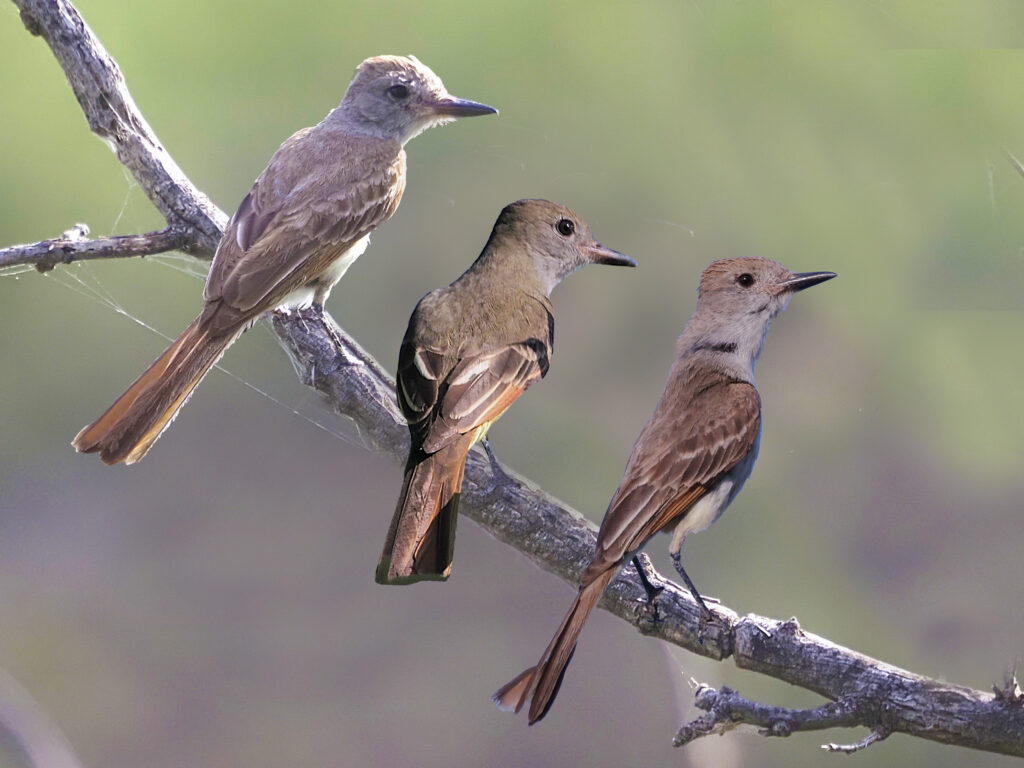
(Composite photo by Jeffrey E. Patterson)
Brightness, Demarcation & Contrast of the Lower Parts
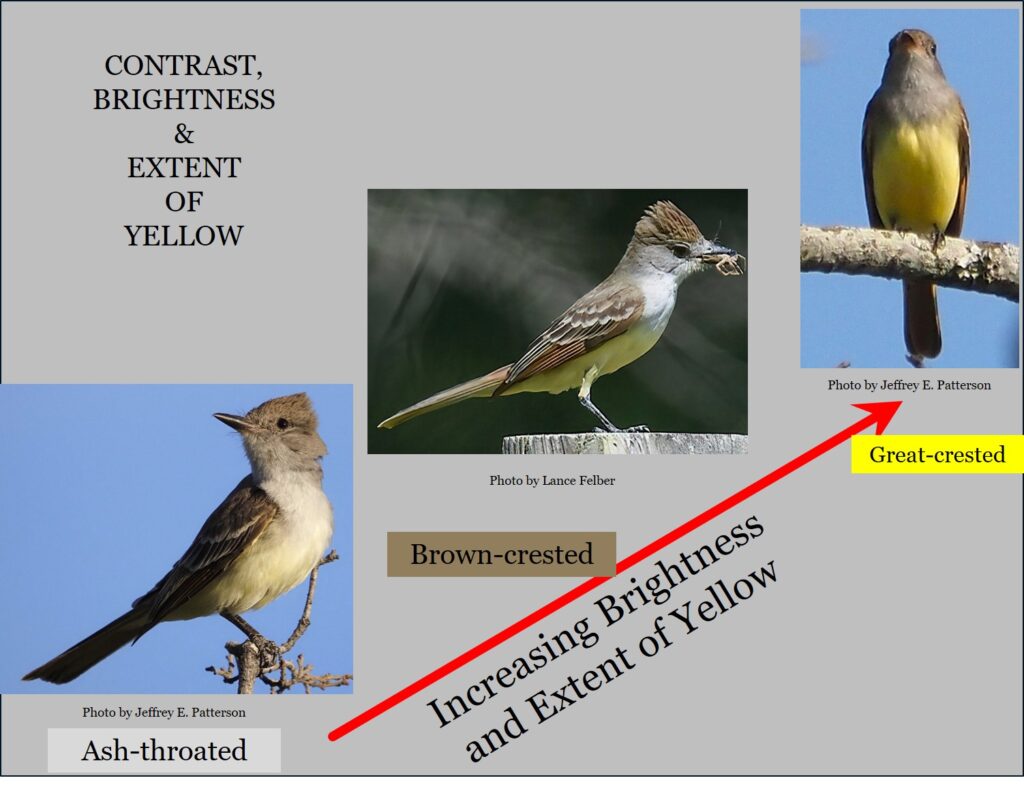
The next most useful identification point of the 3 regular myiarchus (after bill-size & overall-structure) is the coloration of the underparts (belly, chest & throat). The extent and brightness of yellow should always be noted.
Yellow Belly
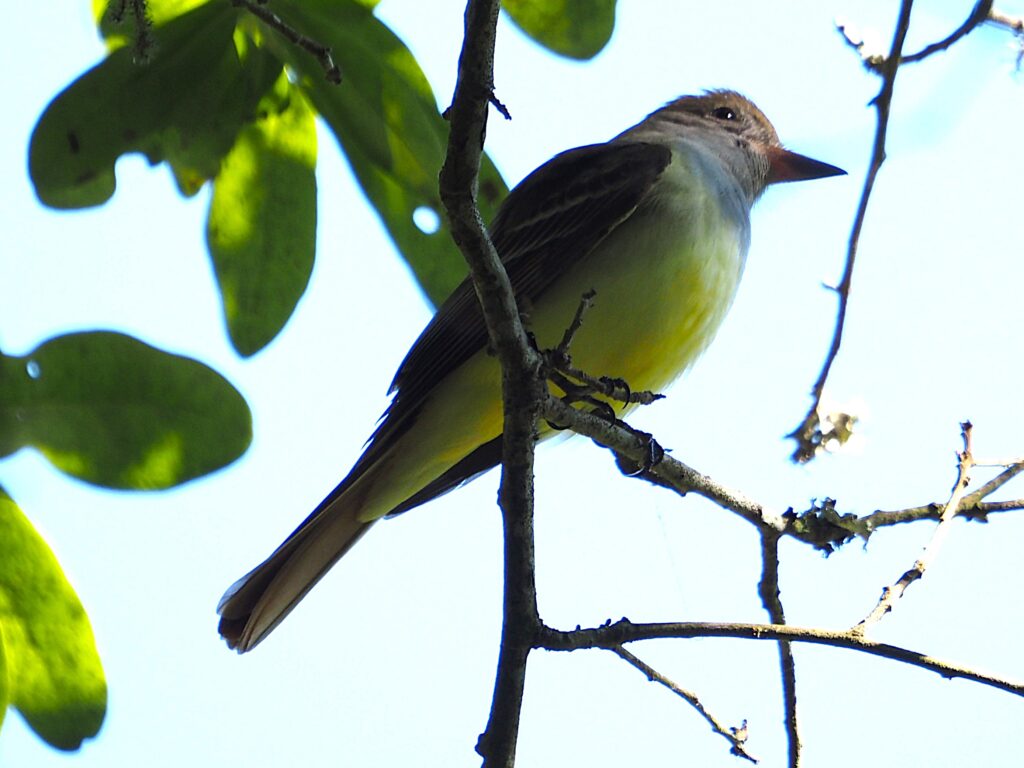
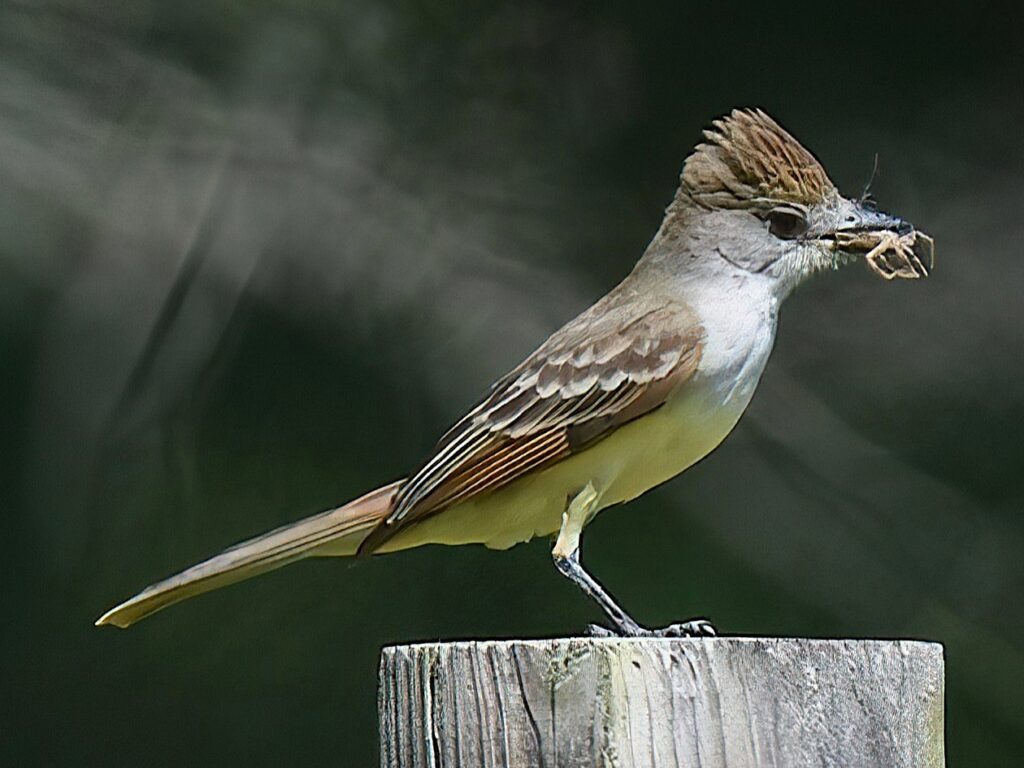
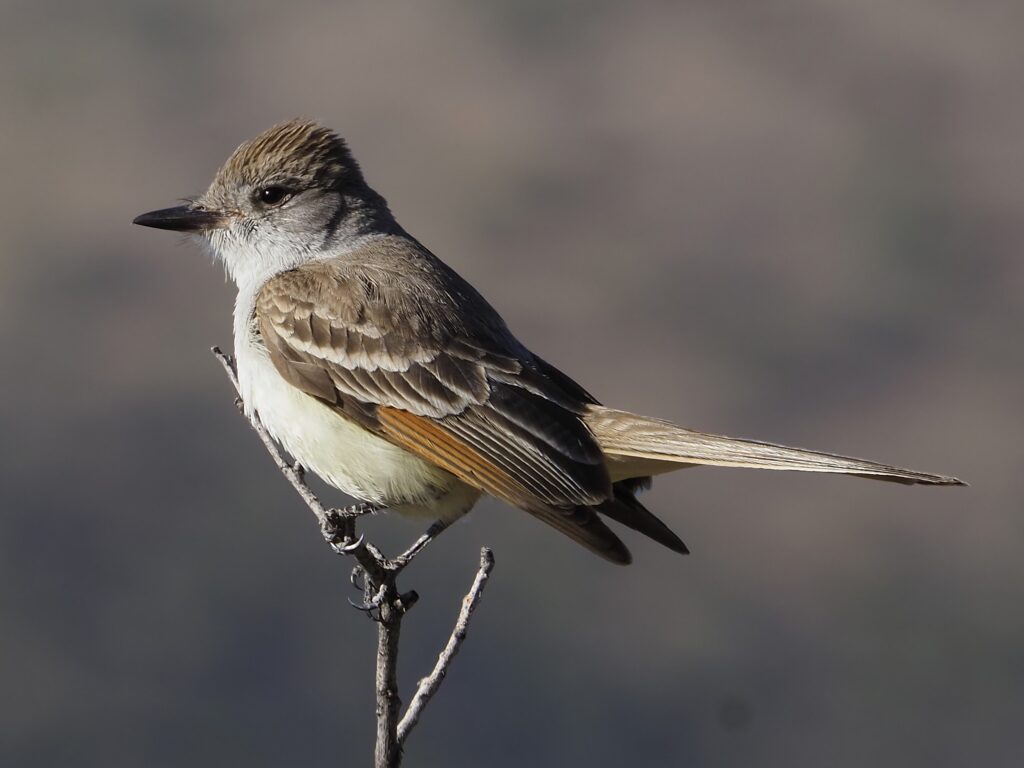
The Great-crested has the brightest yellow belly and the yellow reaches highest up into the chest. The yellow of the Brown-crested is usually less bright and is restricted to slightly lower on the chest/belly. The Ash-throated can be quite pale, even a dingy gray or cream rather than yellow on the belly & lower chest.
Demarcation & Contrast Between Yellow Belly & Gray Chest
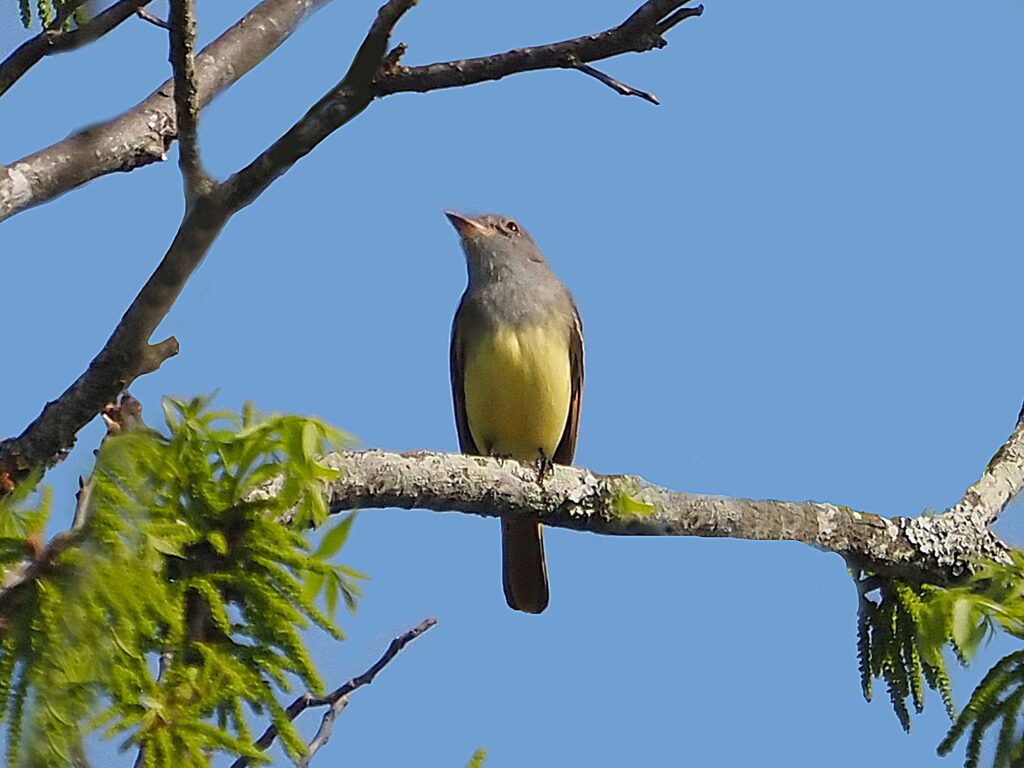
The demarcation and contrast between the yellow and gray of the underside should be noted. As shown below, the Great-crested has the sharpest division, having a fairly sharp demarcation between the yellow of the belly/chest and the dark gray of the upper chest & throat. This also makes for a much more dramatic contrast between yellow and gray. The Brown-crested is next with a noticeable but weaker contrast and less obvious demarcation between the yellow and gray. The Ash-throated shows a weak contrast between these two colors of the underside, and the demarcation between the two is often difficult to discern.
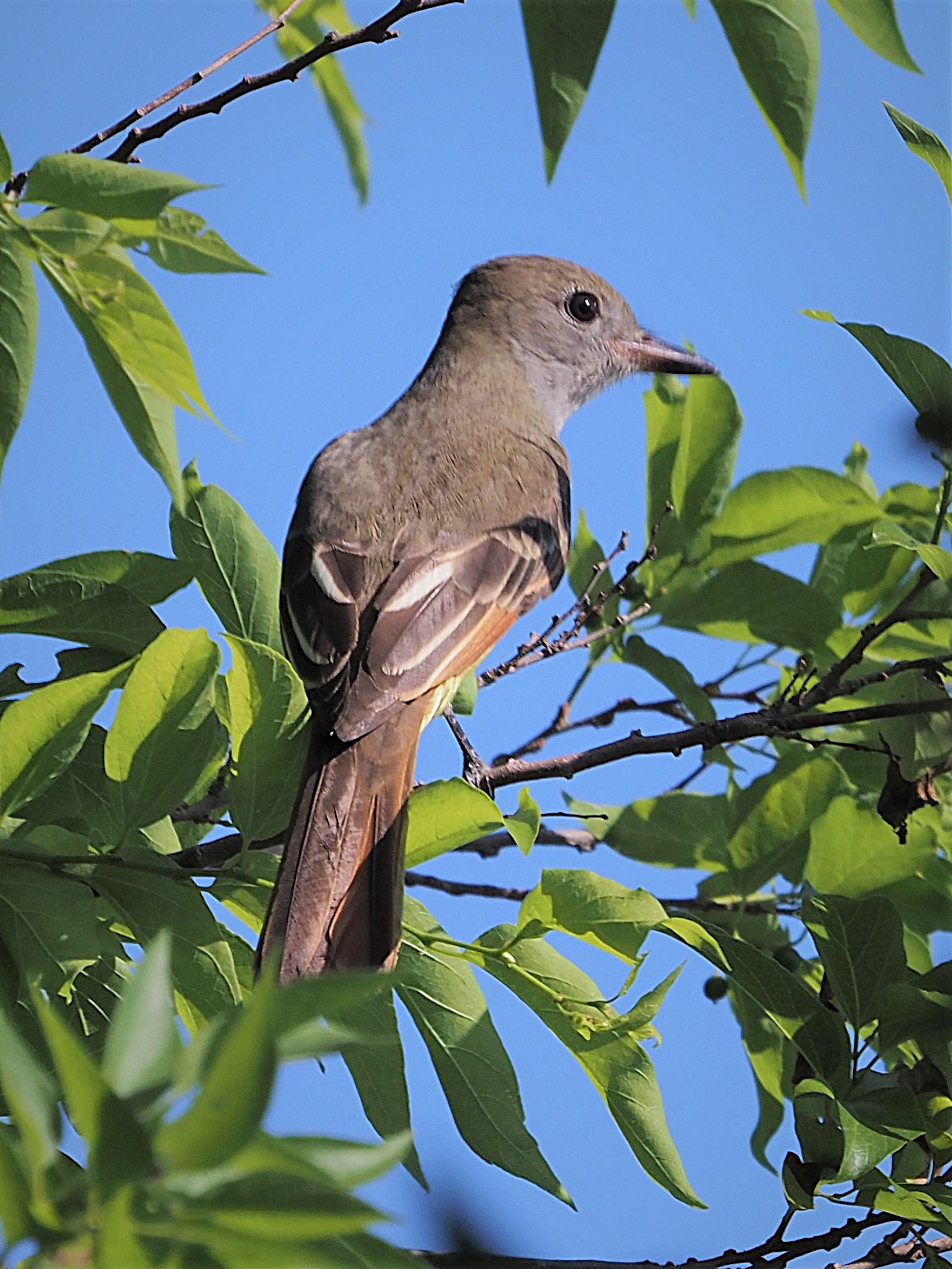
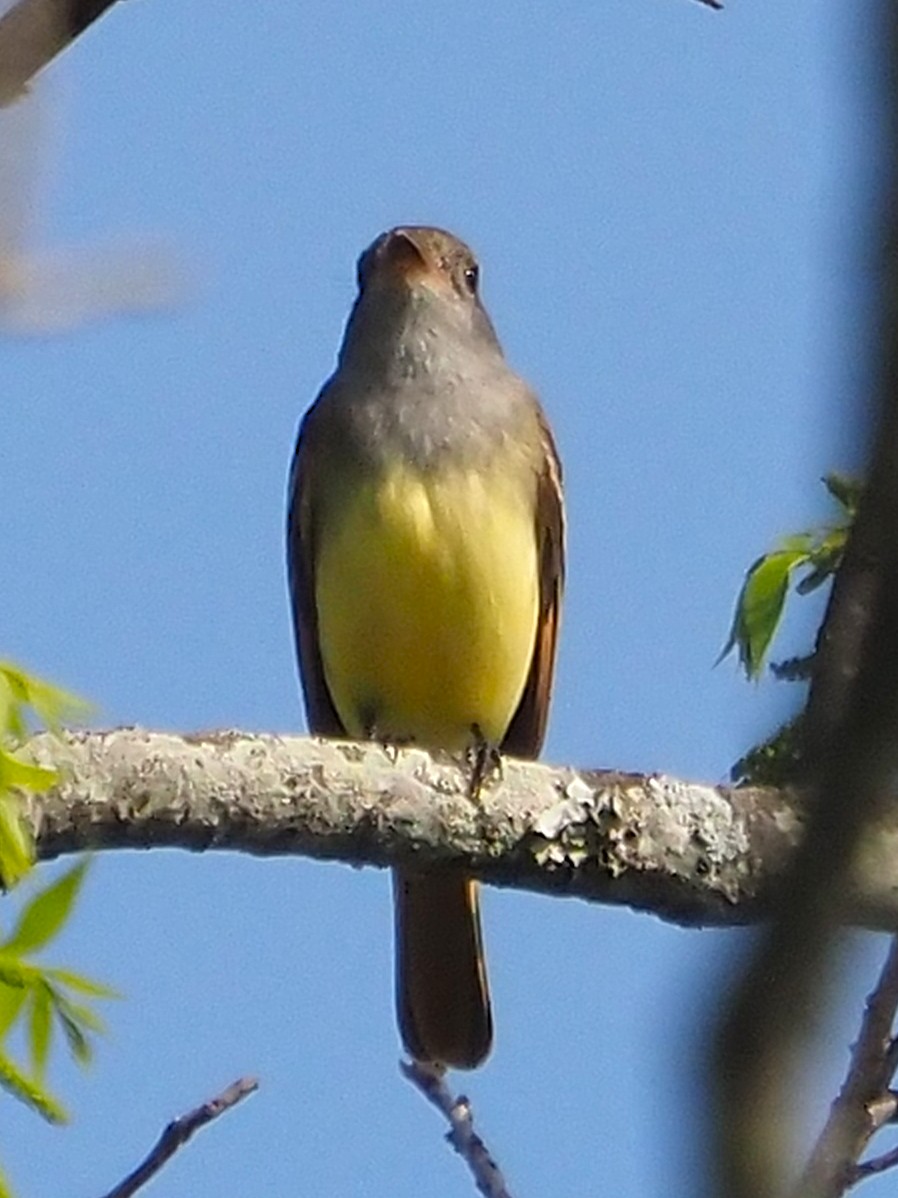
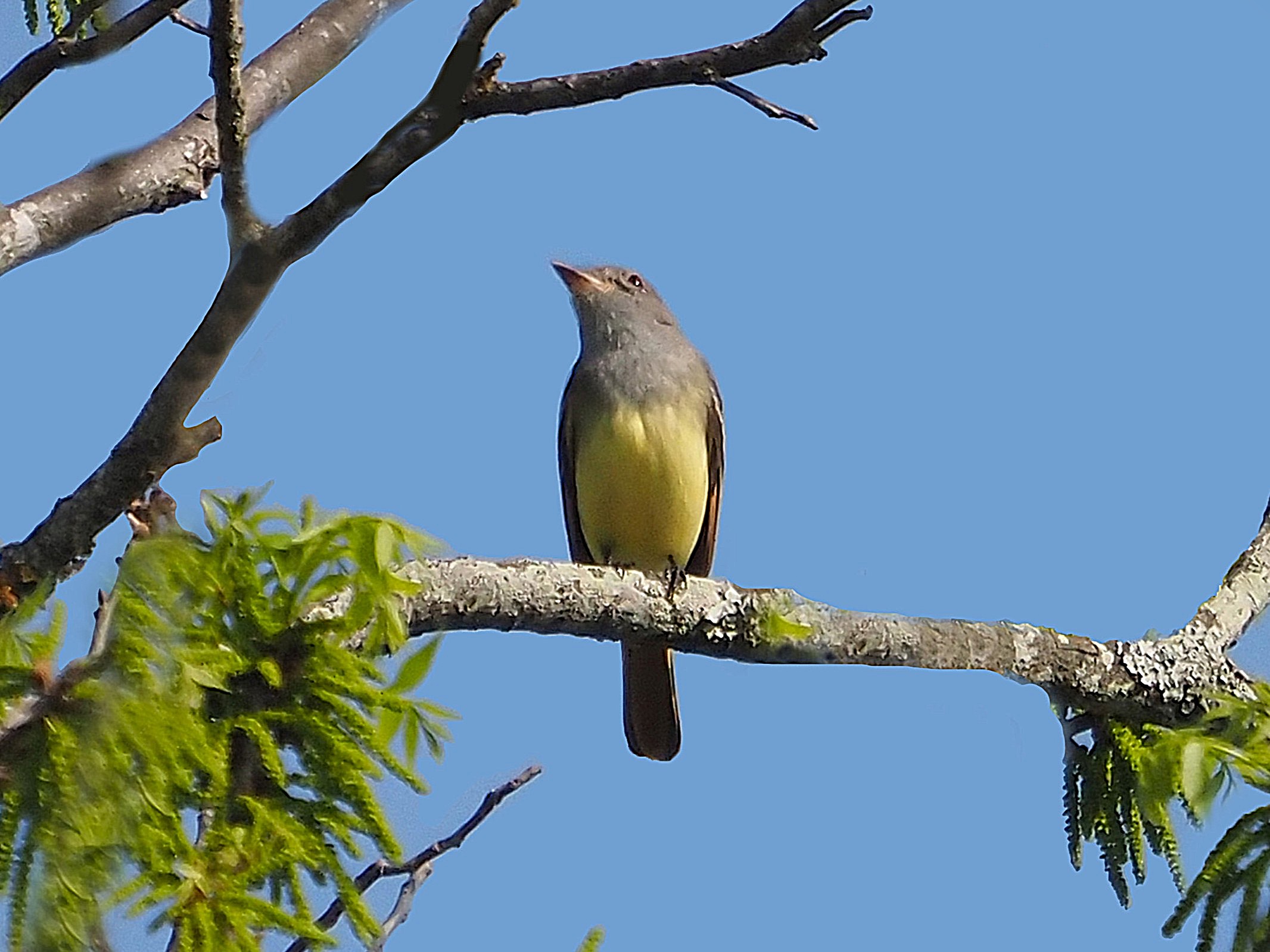
Great-crested Flycatcher (all photos by Jeffrey E. Patterson)
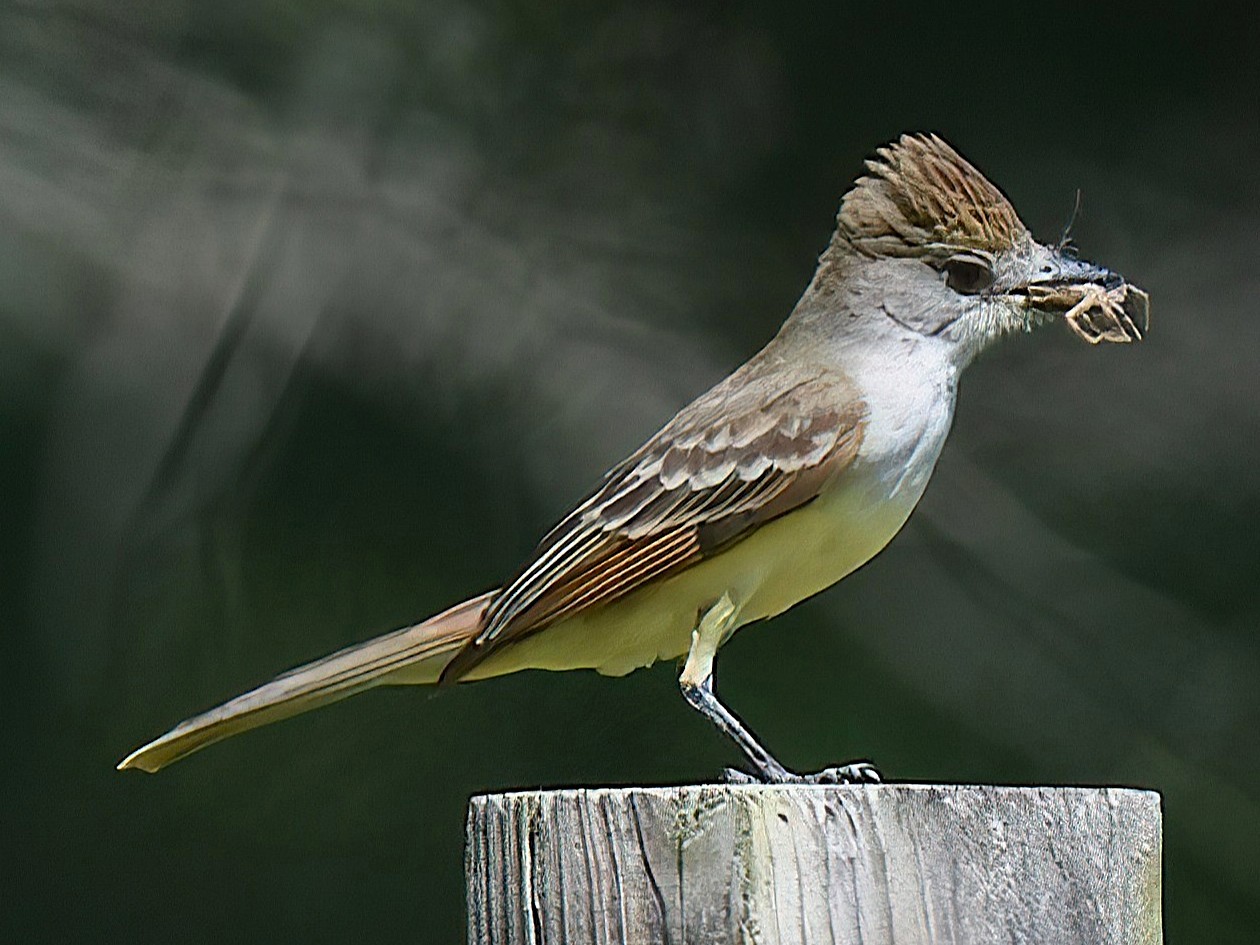
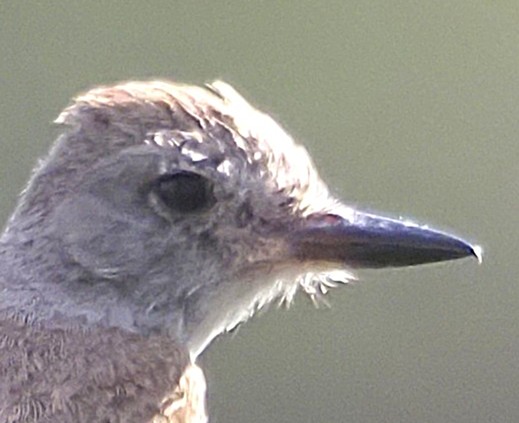
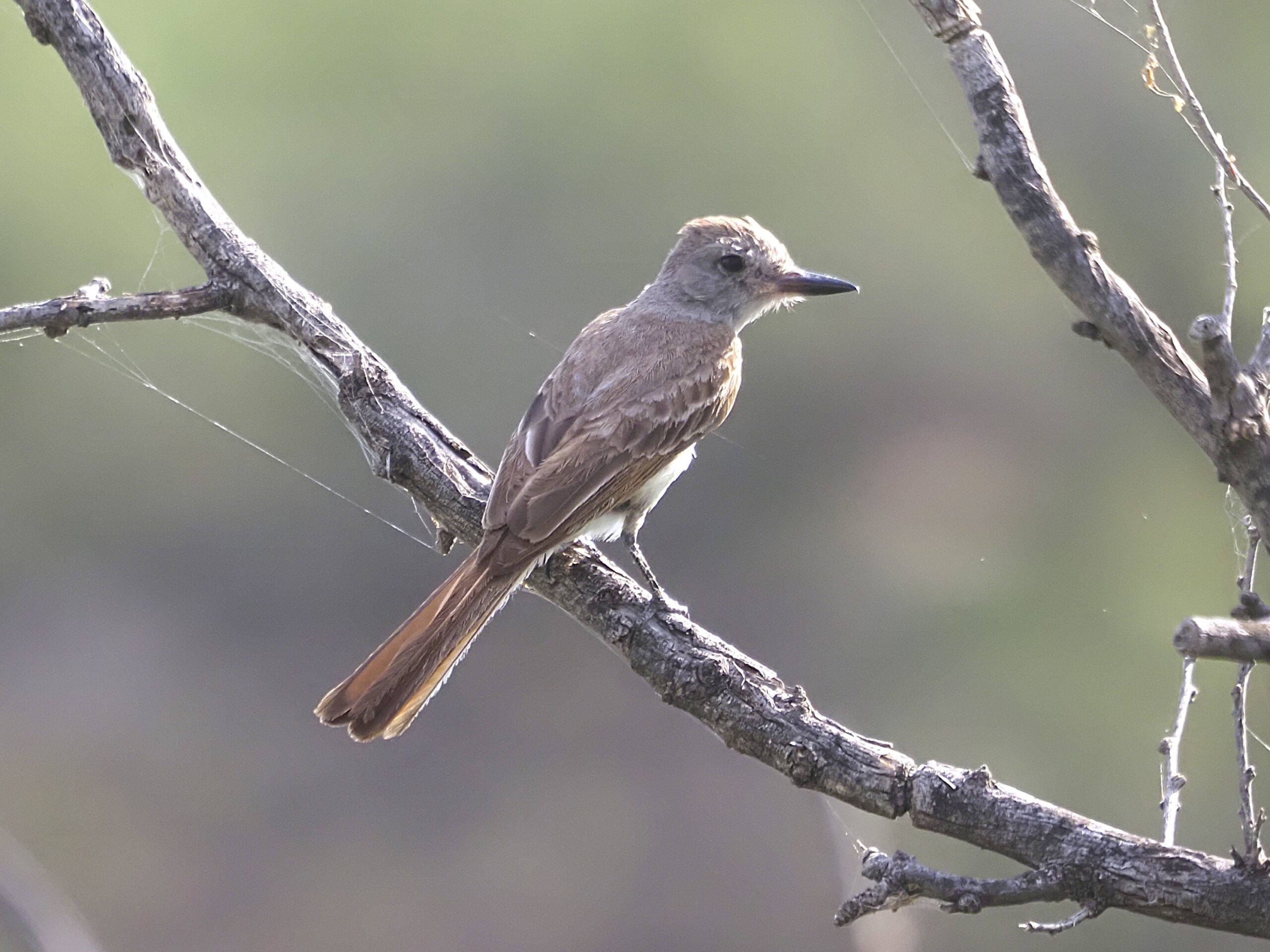
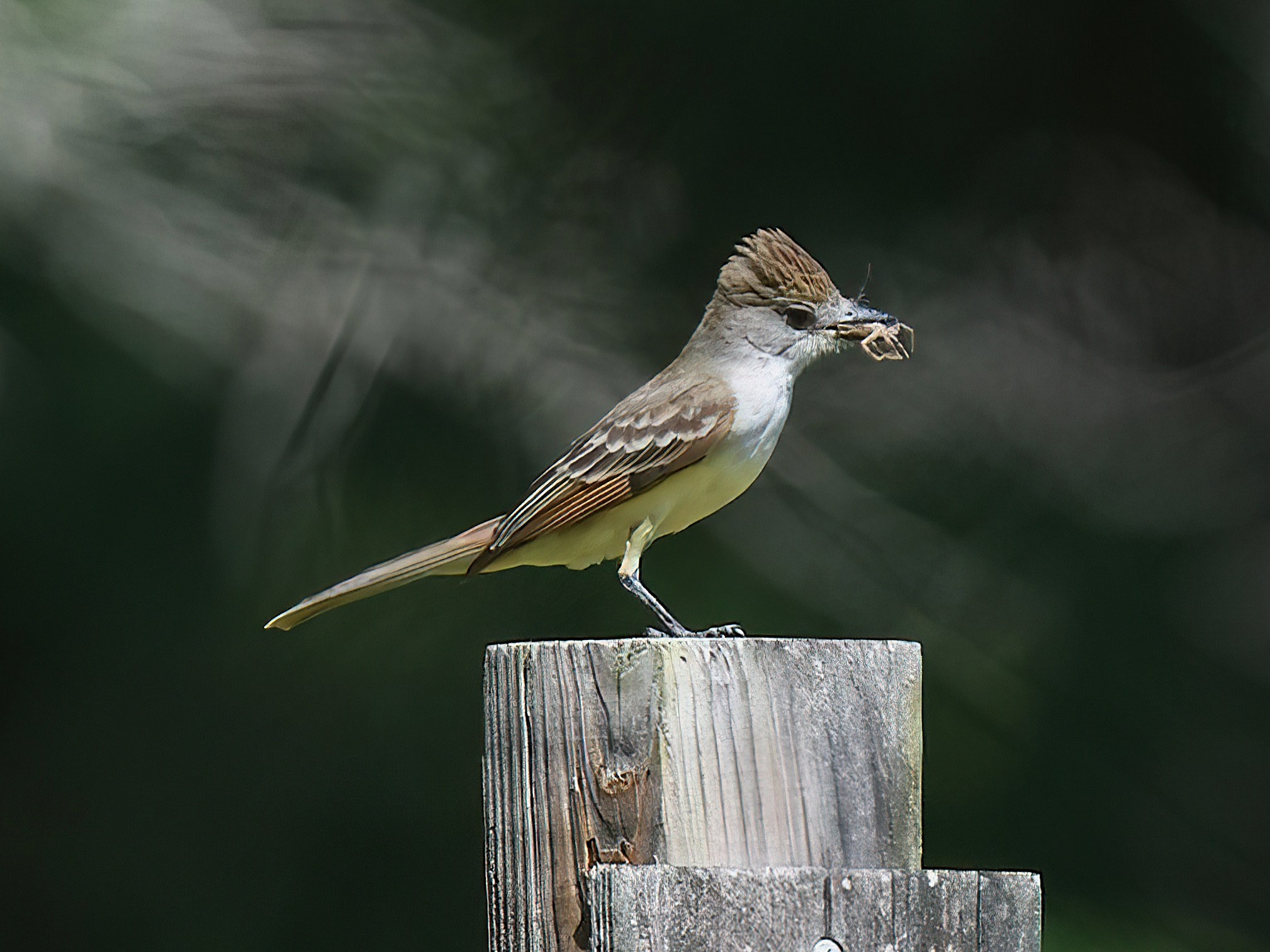
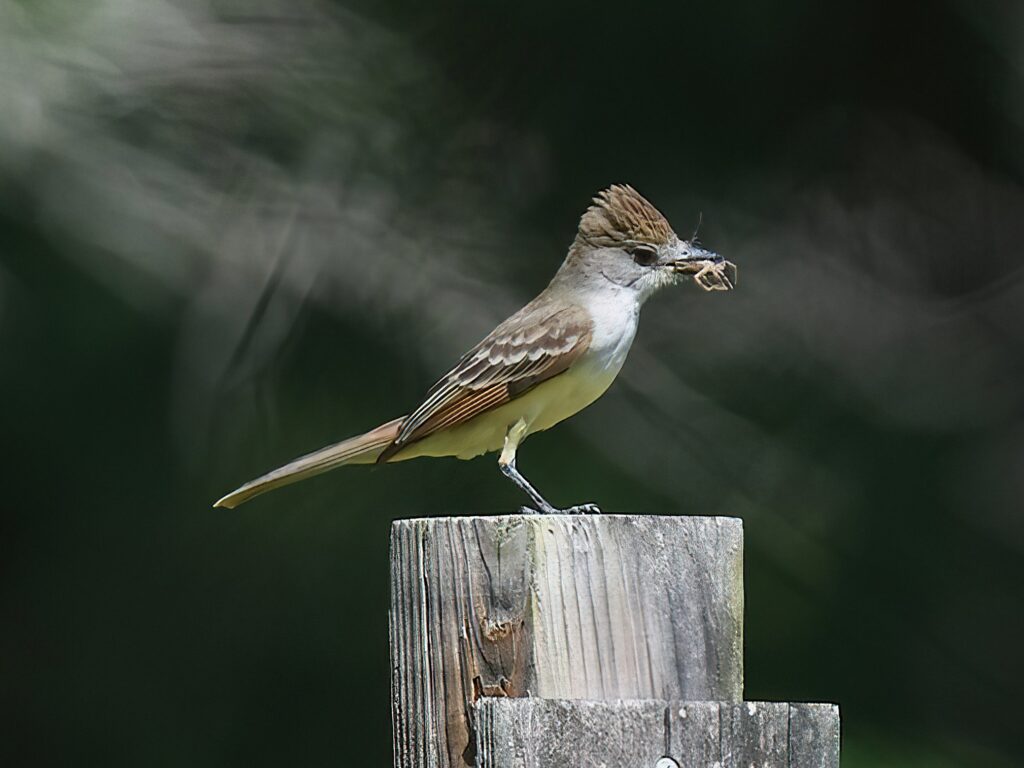
Brown-crested Flycatcher (photos on the wooden block by Lance Felber, other photos by Jeffrey E. Patterson)
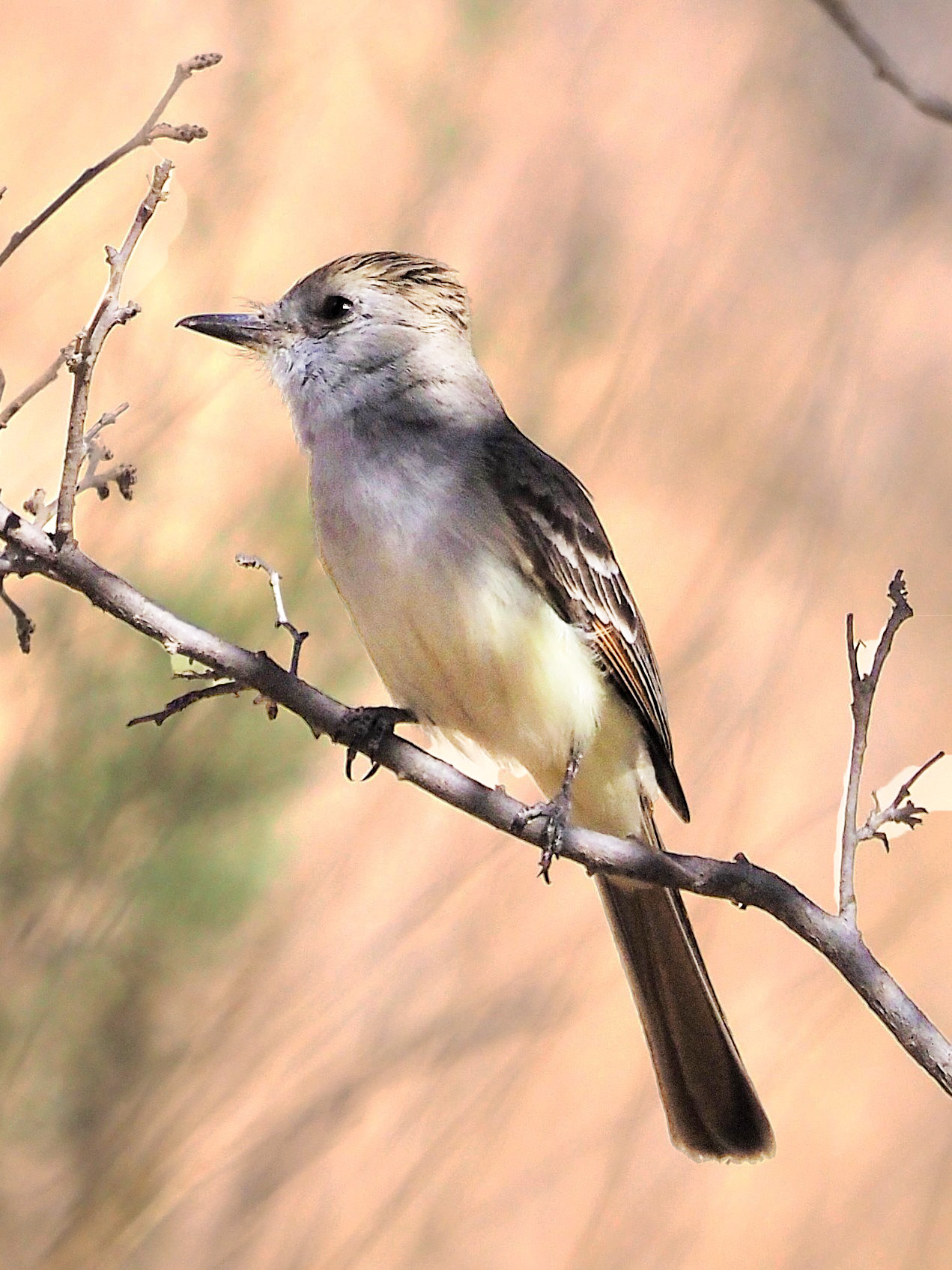
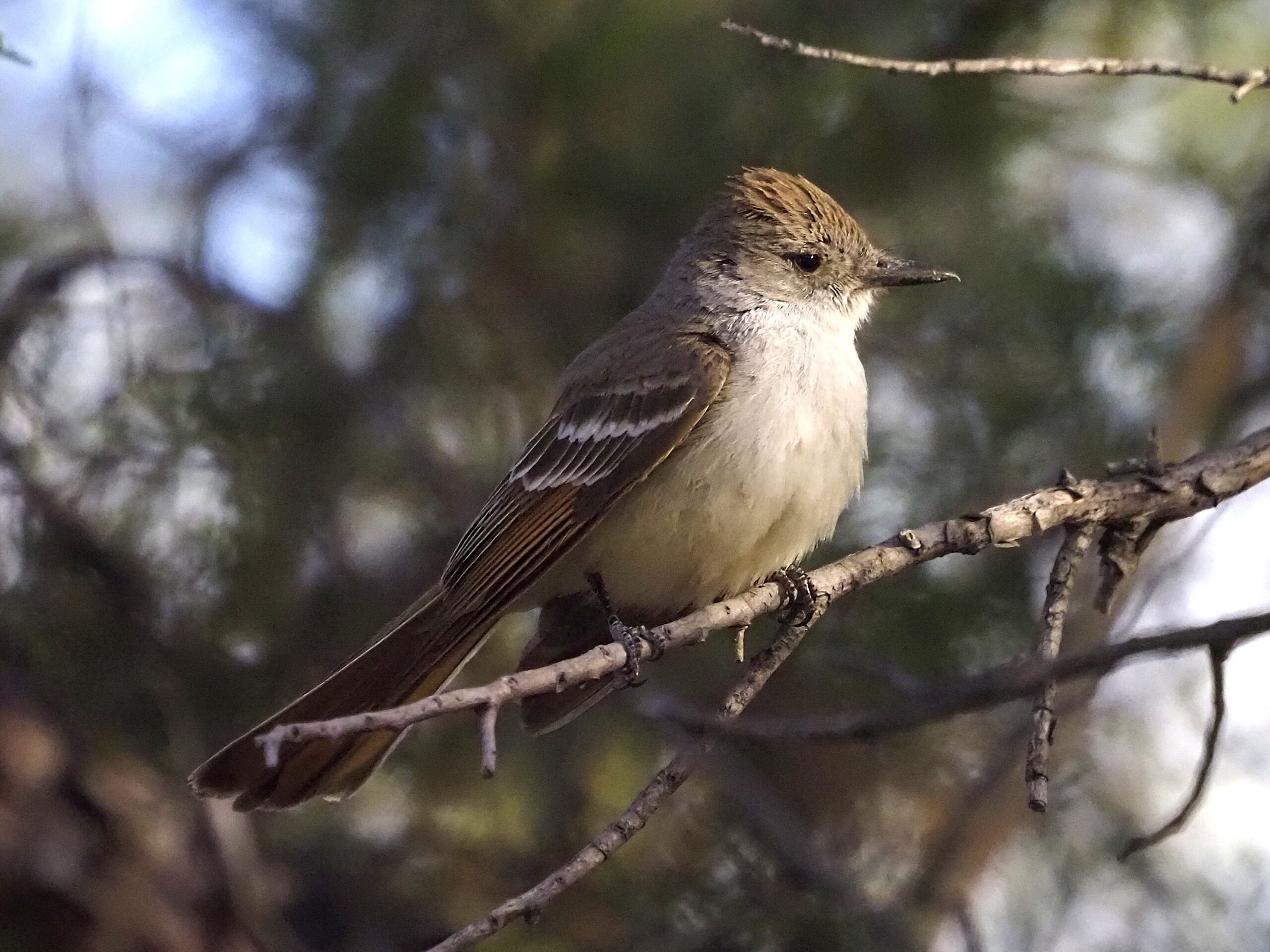
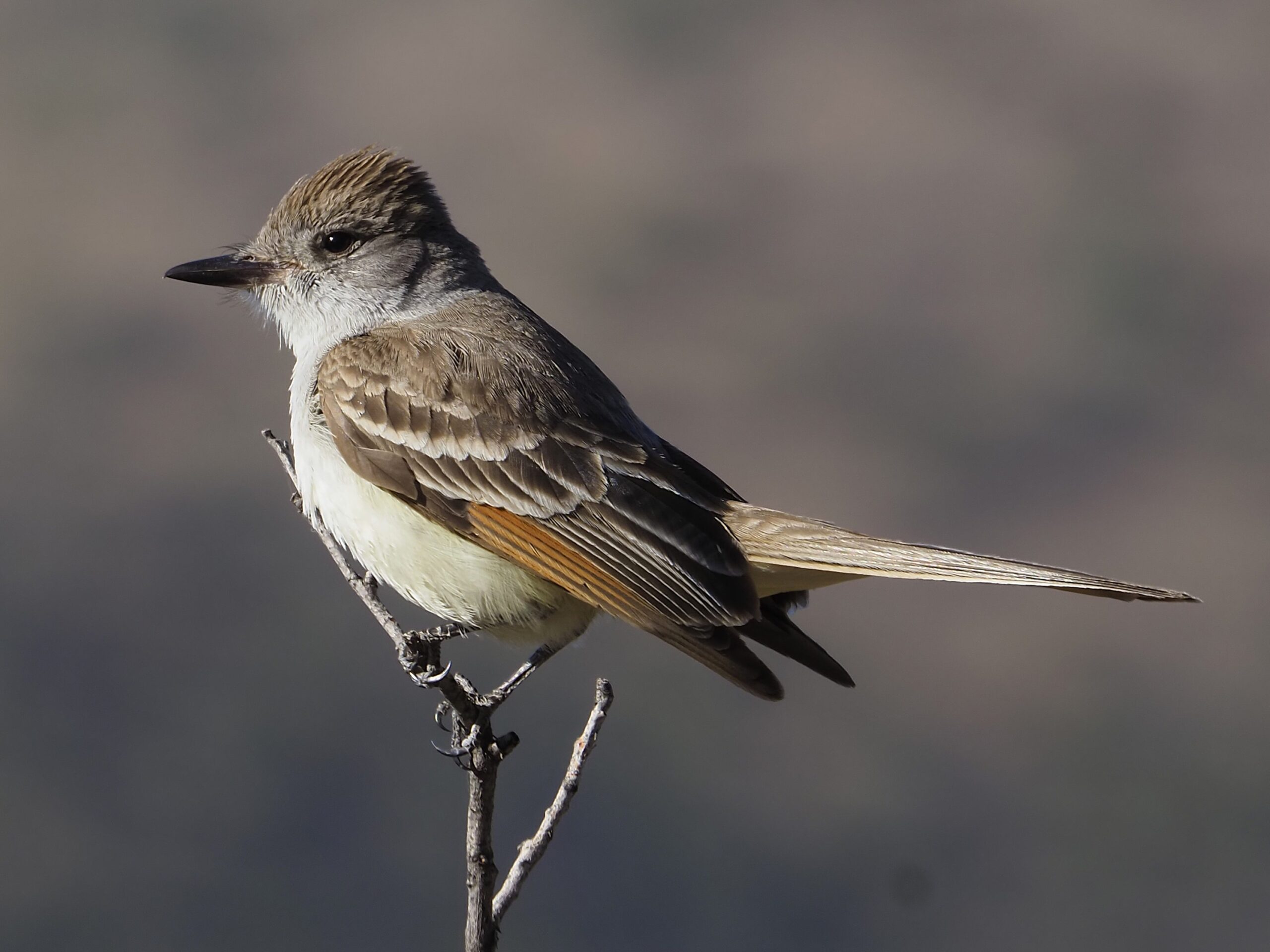
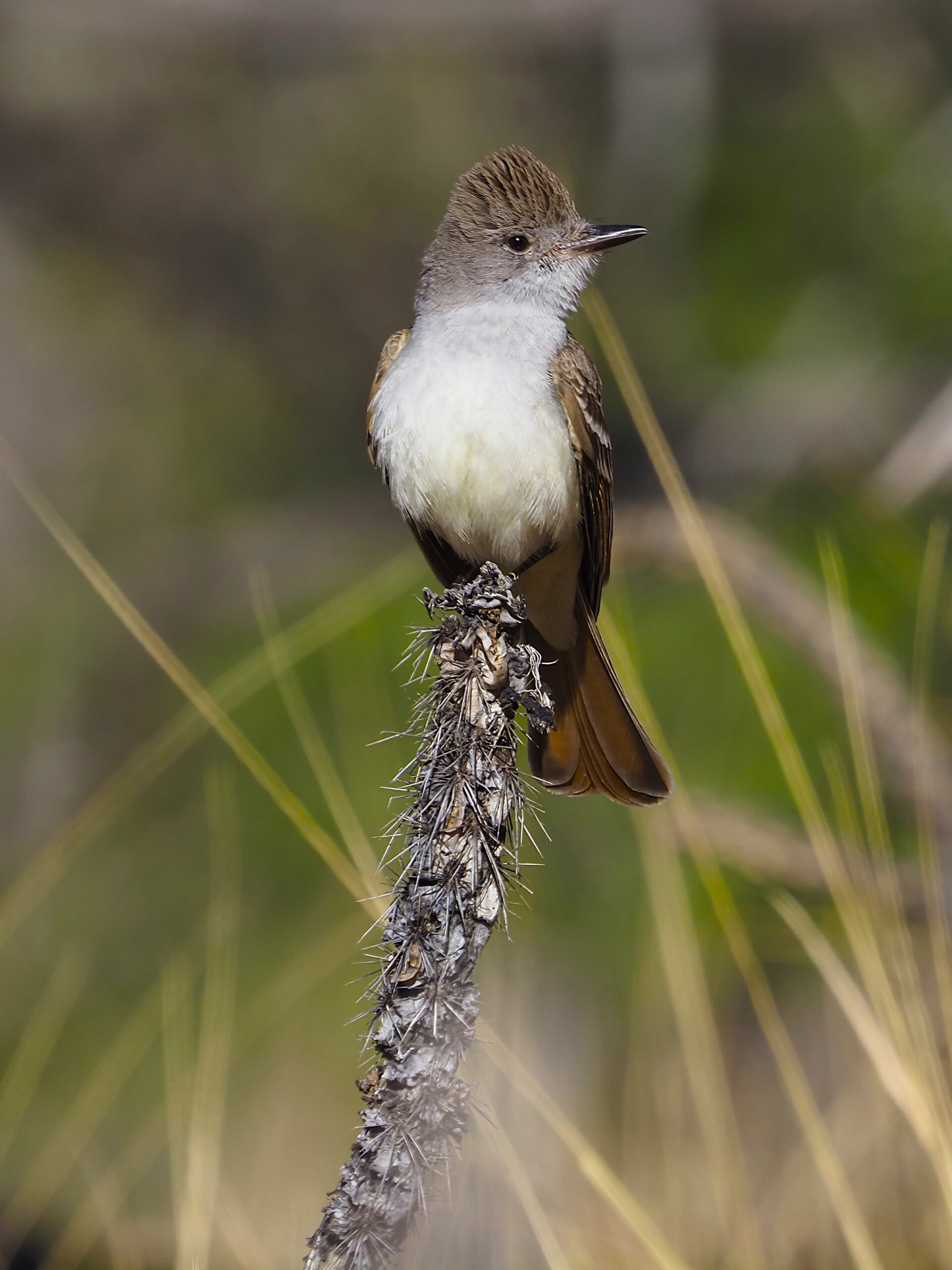
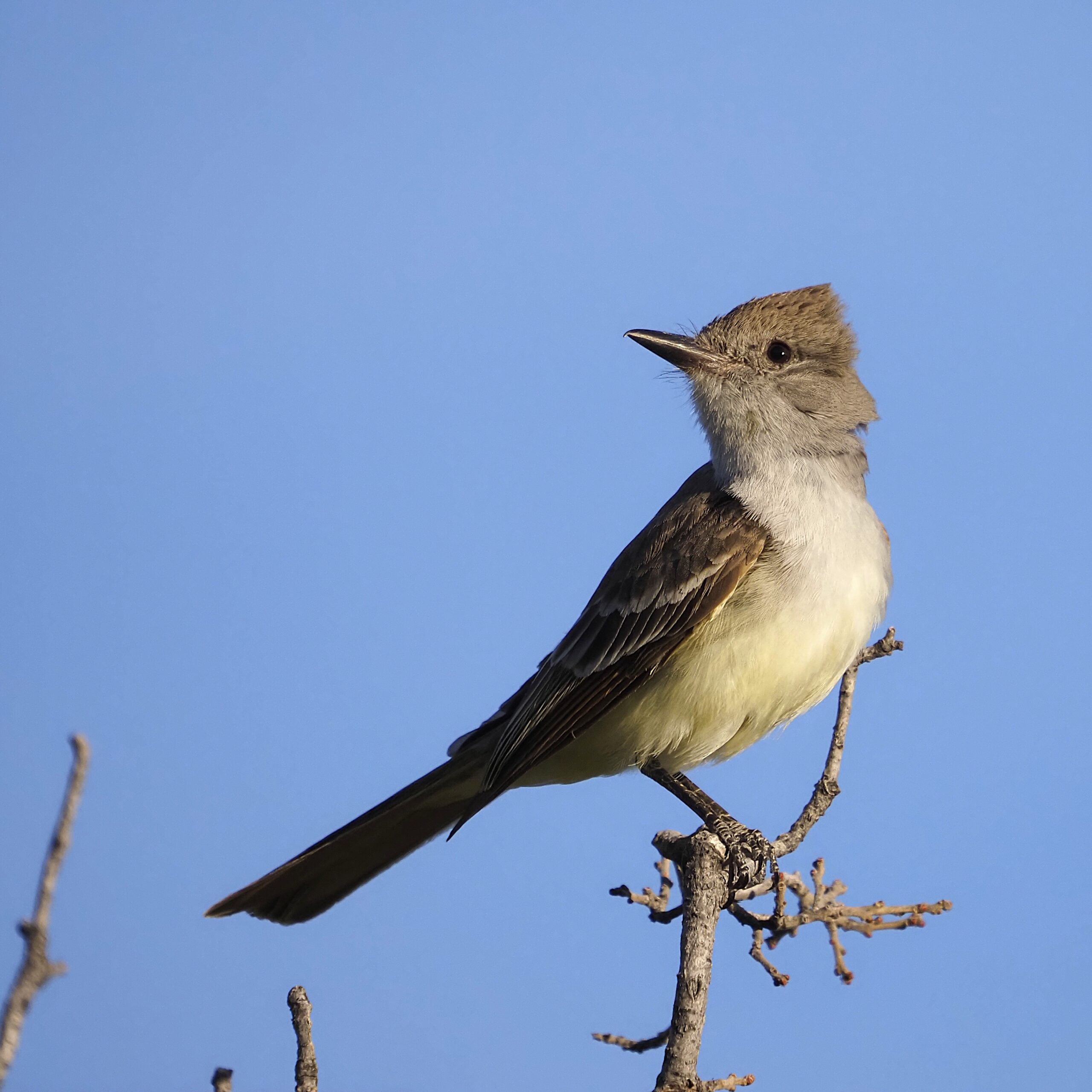
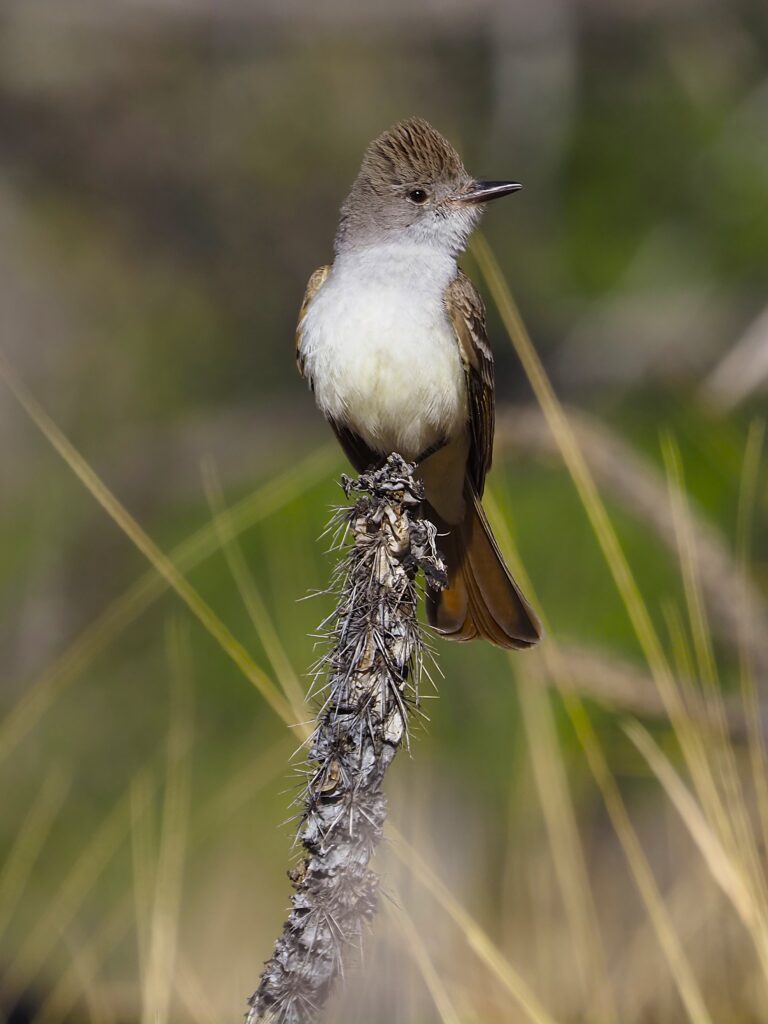
Ash-throated Flycatcher (all photos by Jeffrey E. Patterson)
Primary Projection
Lee & Birch note that “Great-crested typically has the longest primary projection” and that “Ash-throated’s primary projection is intermediate”. Therefore, presumably Brown-crested has the shortest primary projection (PP). However, they go on to say that in myiarchus “Primary projection….can sometimes be a useful supporting field mark at the extremes“. Therefore, if a very short PP is observed it might support Brown-crested, and if a very long one is seen Great-crested may be indicated. Otherwise, I don’t find PP to be a particularly useful field mark for myiarchus. My informal survey of photographs on the Macauley Library site supports Lee & Birch’s statements, where some extremes can be found (e.g. long PP on Great-crested), but many contrary examples are also present.
Underside of Tail
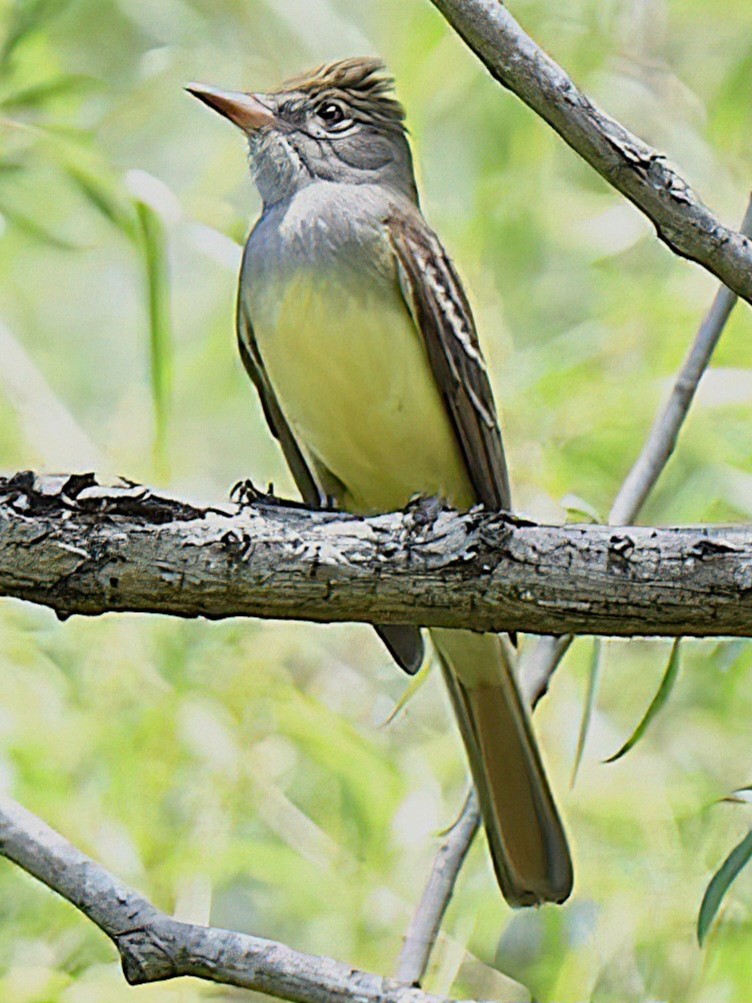
After overall-structure and bill size, the next most useful field mark may be the underside of the tail. More specifically the underside of R6, the outer-most (bottom-most) tail feather, is the most useful (see page Flycatcher Overview and Feather Groups for further explanation of feather groups and numbering systems). This field mark can be very difficult to observe due to lighting-conditions, molt and wear of the bird and individual variation. A photograph should be obtained if possible.
The underside of the Great-crested’s R6 has a narrow brown outer margin, usually with no brown across the bottom of the feather, making most of the feather rufous. The brown margin on R6 for the Brown-crested tends to be thicker than that of Great-crested and Ash-throated, but the brown does not extend across the bottom of the feather. Ash-throated exhibits the most noteworthy brown on the outer tail feather (R6); here the brown usually hooks around the tip of R6 and can sometimes make the tail appear entirely brown at the bottom edge. The photos below illustrate the tail patterns of the 3 most common myiarchus.
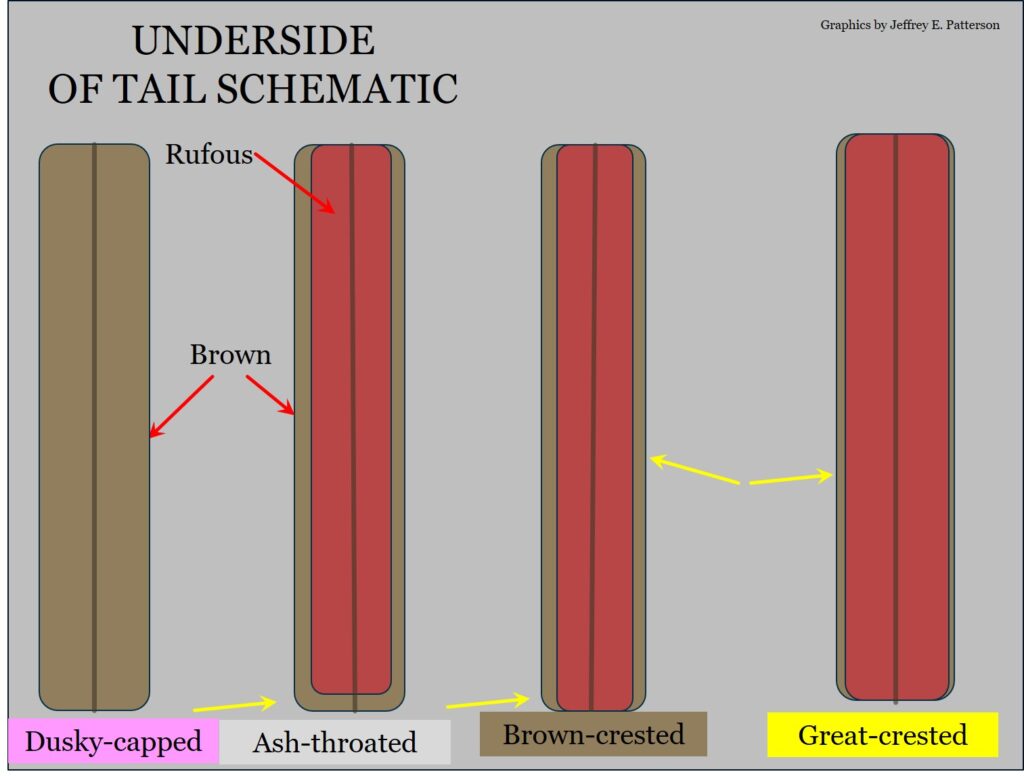
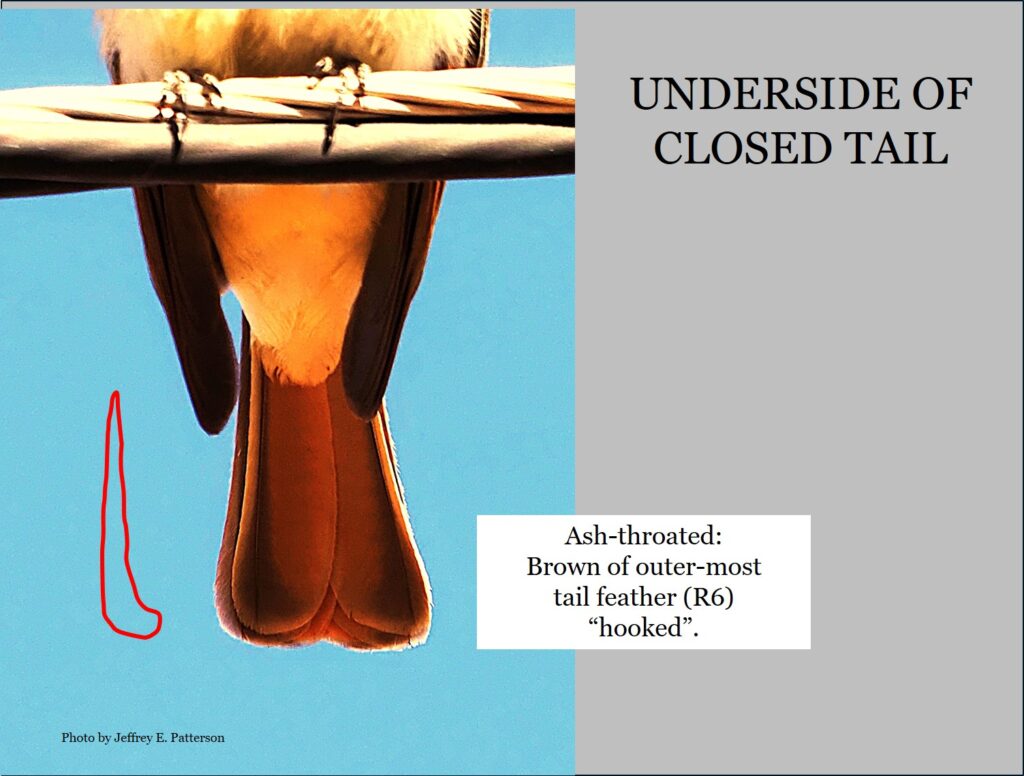
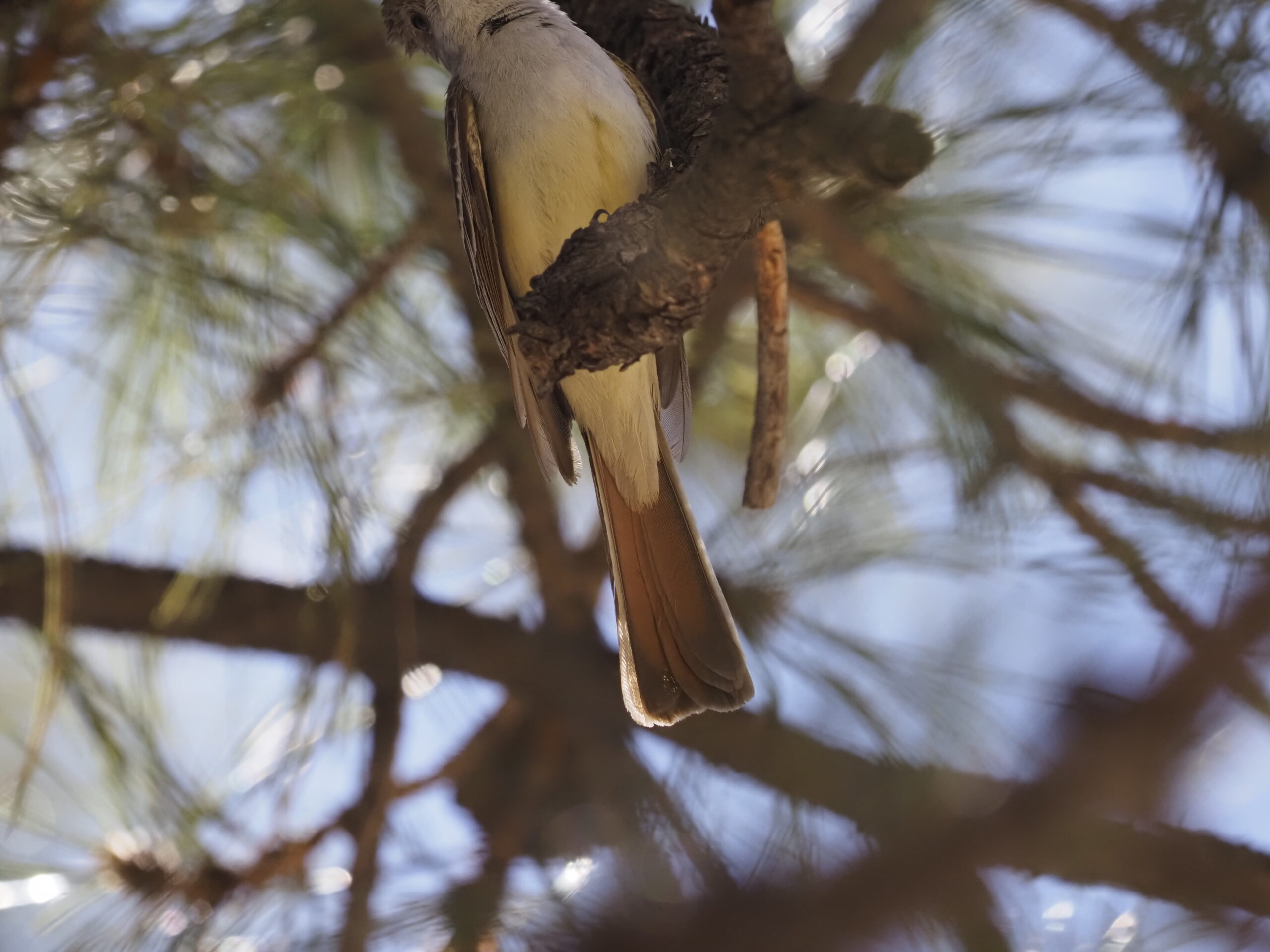
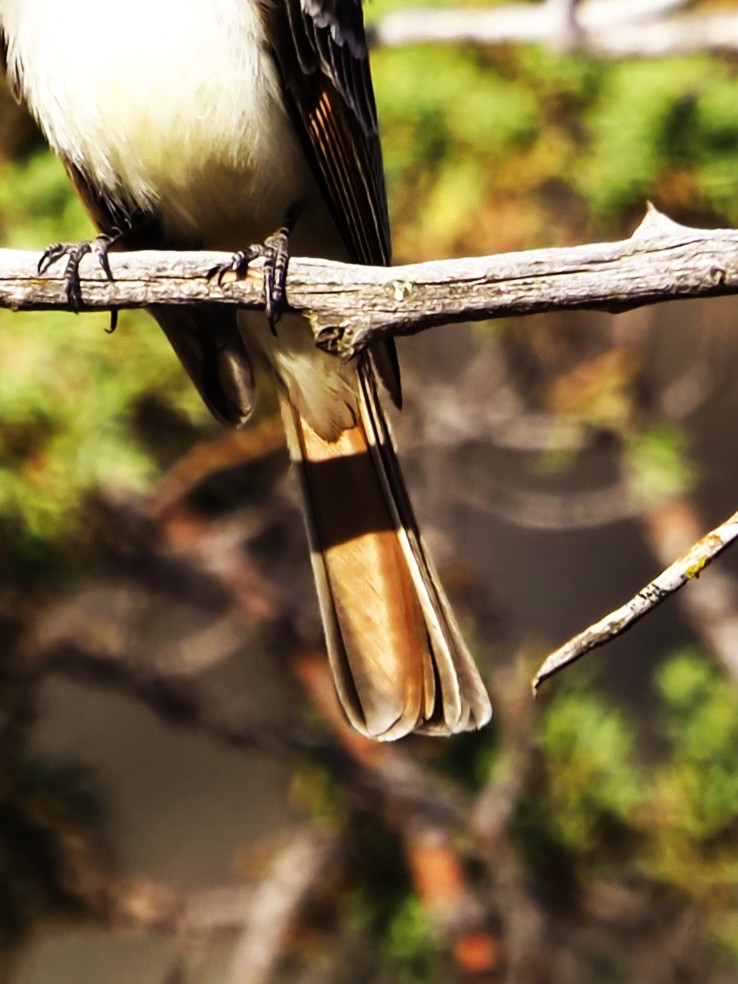
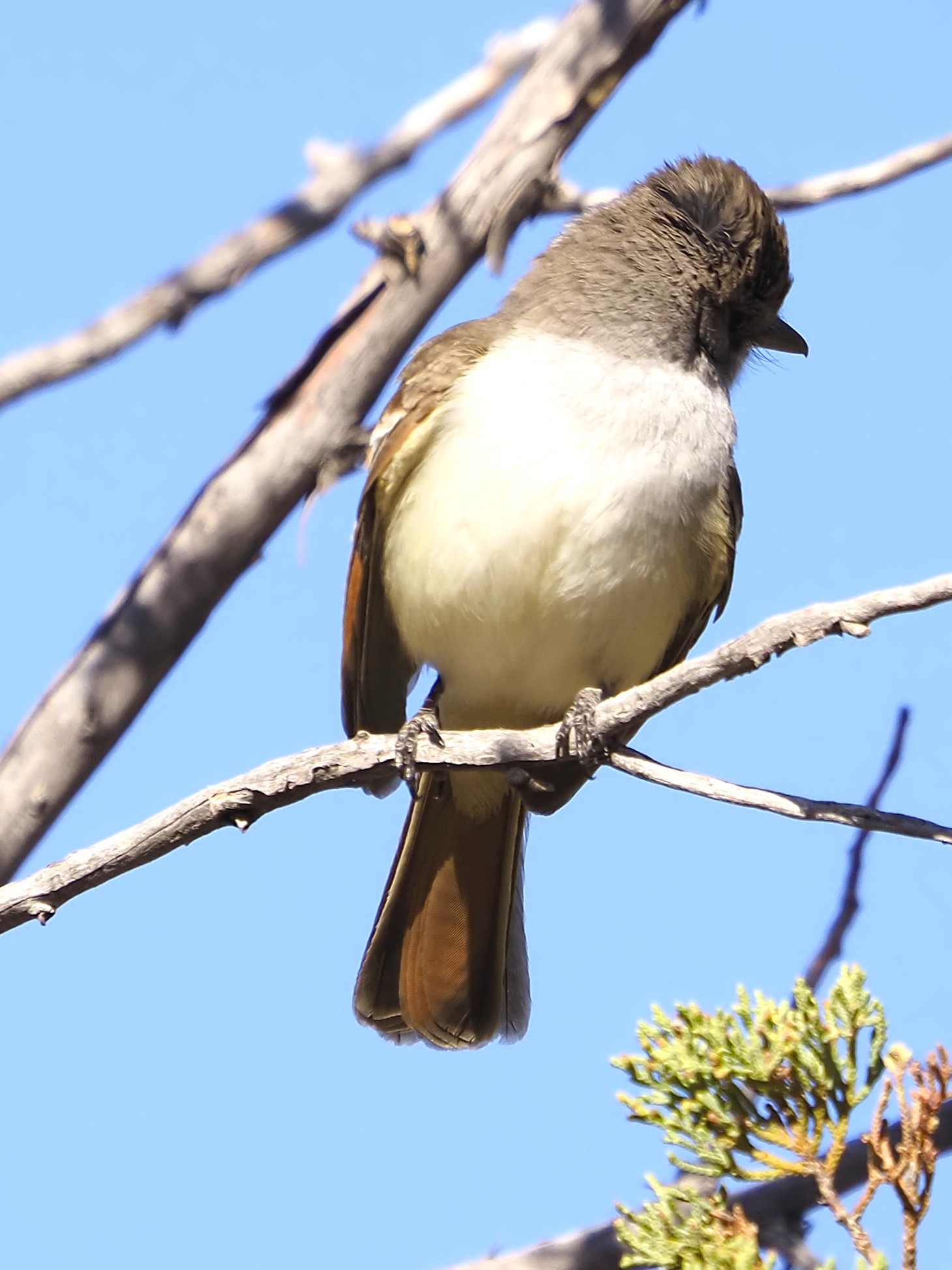
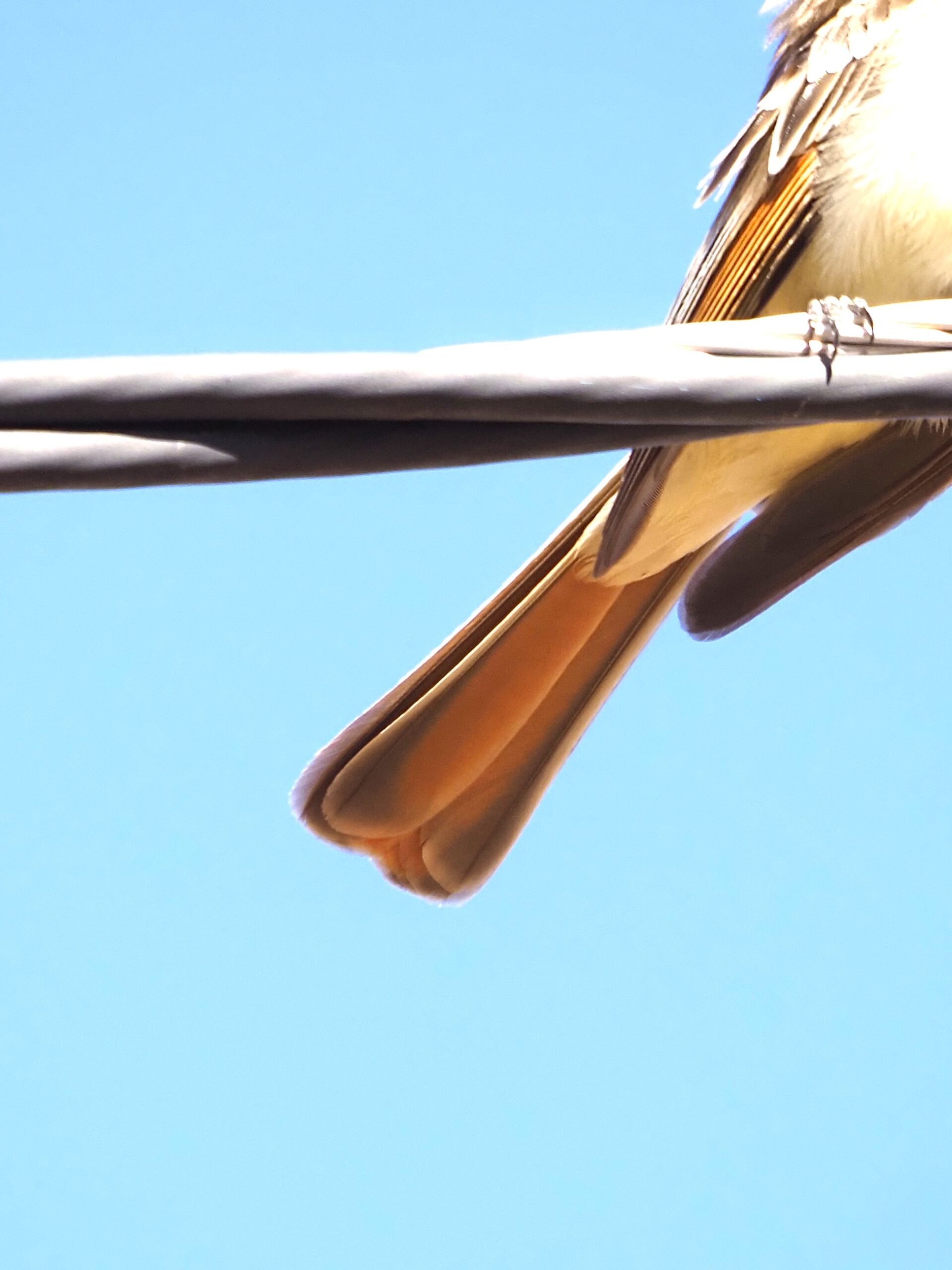
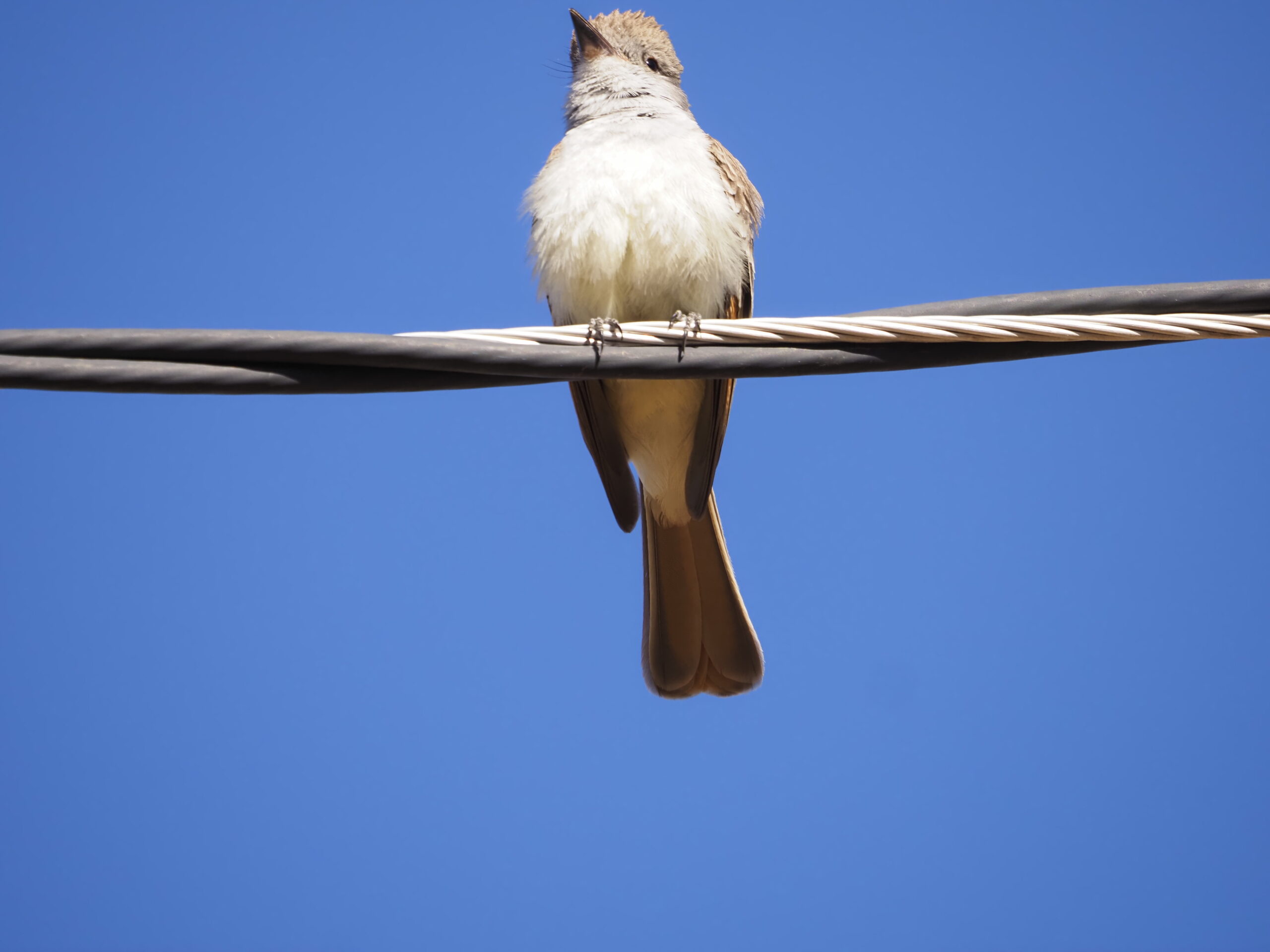
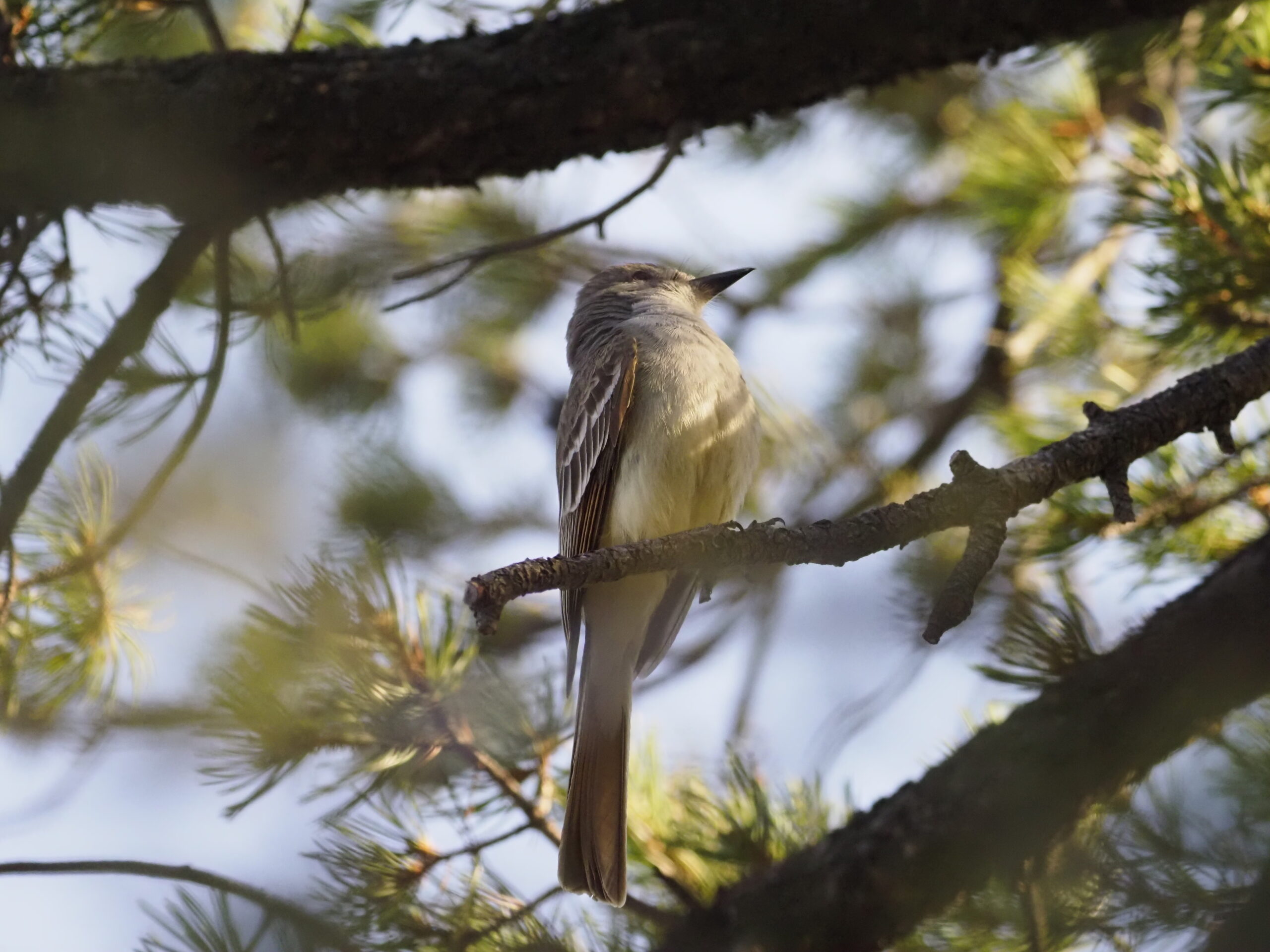
Ash-throated undertail (all photos by Jeffrey E. Patterson).
Color & Contrast of Wing Panel
The field marks discussed in this section, in my opinion, seem to be more subjective, difficult to observe in the field, more variable, and more likely to show overlap between the 3 regular myiarchus than those discussed above.
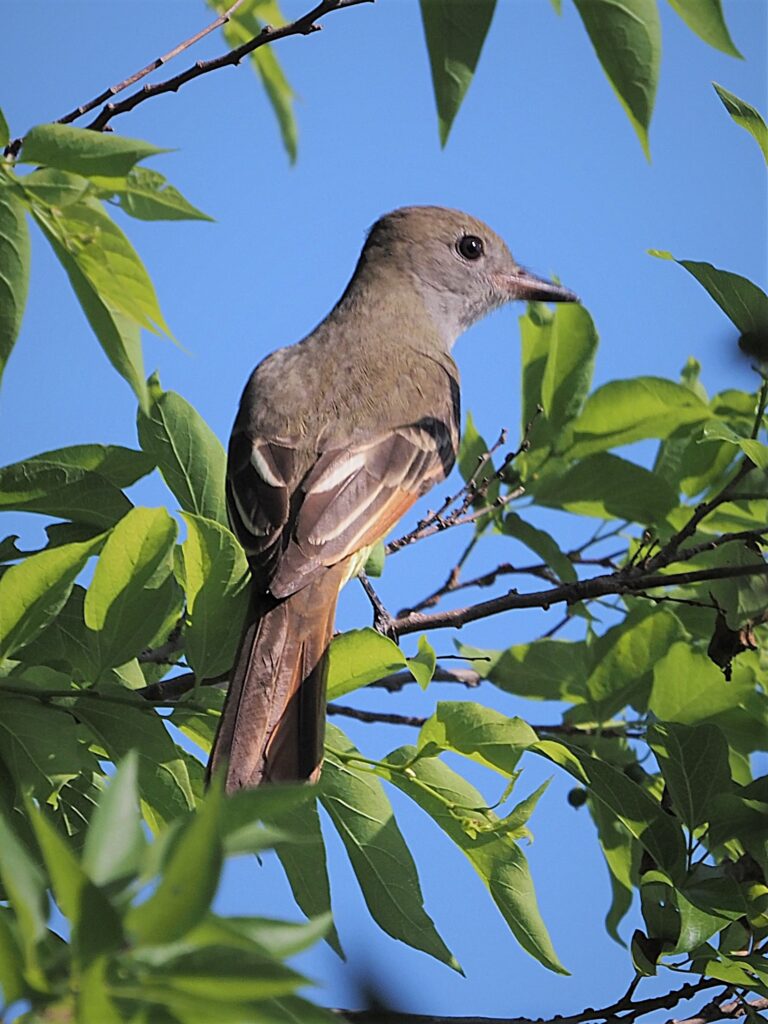
Lee & Birch describe a strong contrast between the rufous edges of the primaries and the white edges of the secondaries for both the Ash-throated and the Great-crested. Perhaps the most reliable field mark of the wing panels is the broad white edge of the uppermost tertial, especially near the base of the feather, in the Great-crested. These field marks are shown in single instances below. The photographs of the Macaulay Library should be consulted for additional examples (https://search.macaulaylibrary.org/catalog).
Contrast Between Throat, Face & Crown
The Great-crested usually has a dark gray throat, face and brownish or brownish-gray crown. Because these colors are similar in intensity there is little contrast between these areas. The Great-crested often seems to have a “hooded” look from the throat upwards.
On the Brown-crested the gray chest and throat contrast moderately with the brownish crown.
With its light-gray throat, medium-gray face and darker grayish-brown crown, the Ash-throated shows the most contrast between throat/chest and crown.
To Flycatchers Overview & Feather Groups