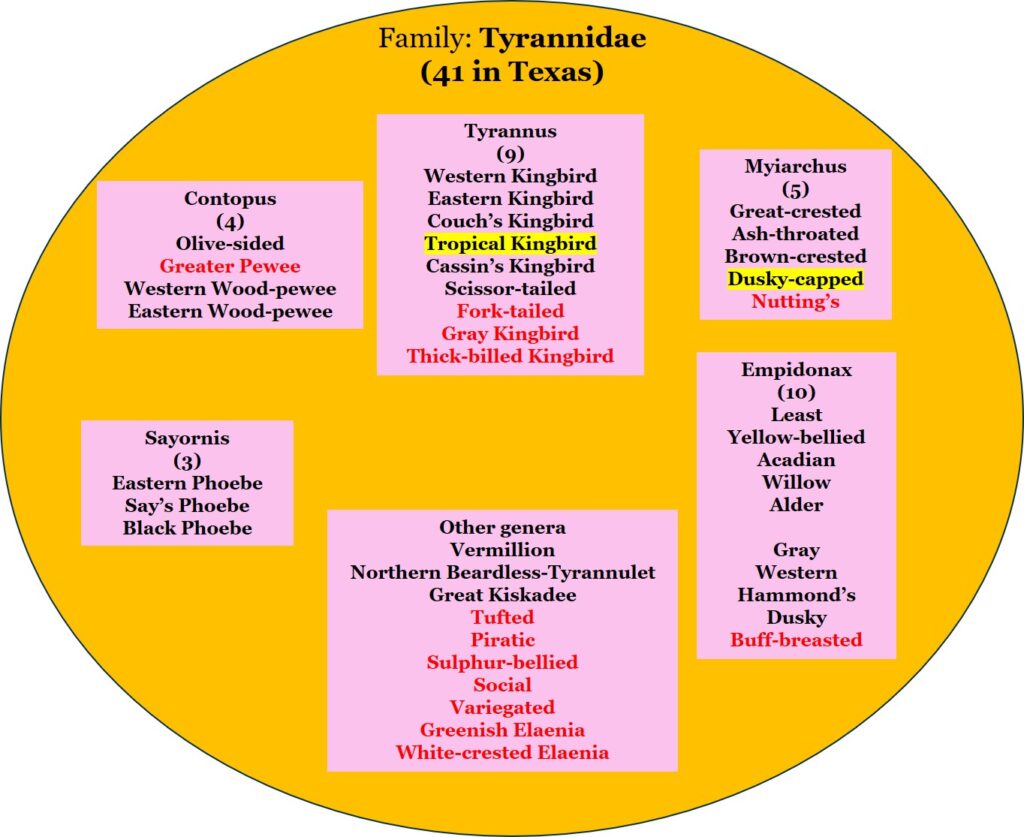
41 species of flycatchers have been recorded in Texas. 28 of these species are fairly regular. The calls & songs of flycatchers are usually distinctive and aid greatly in identification. Flycatchers are best studied in groups according the their genus as shown below. (Species shown in red below are rare in Texas. Those highlighted in yellow appear to be expanding their range and frequency in Texas).
Feather Groups (Bird Topology)
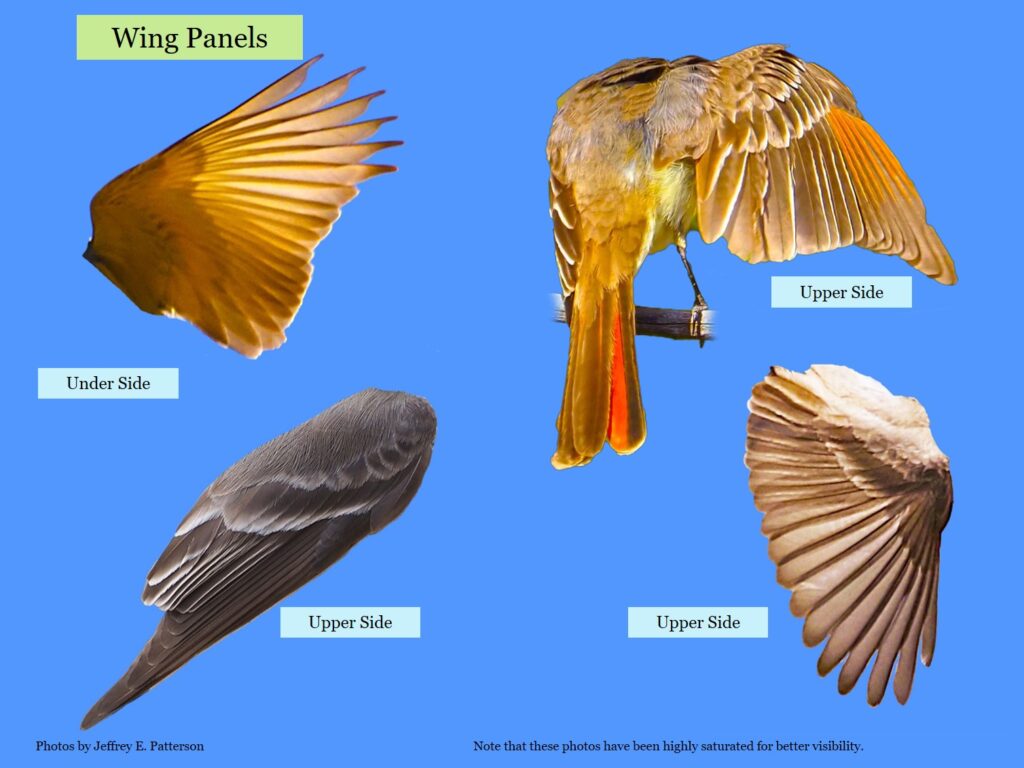
The arrangement of feathers on a bird is not random; feathers are arranged in consistent groups. Although there are differences, these feather groups are generally consistent across bird species, from hummingbirds to pelicans. The following photos show several views of the feathers of flying and sitting flycatchers.
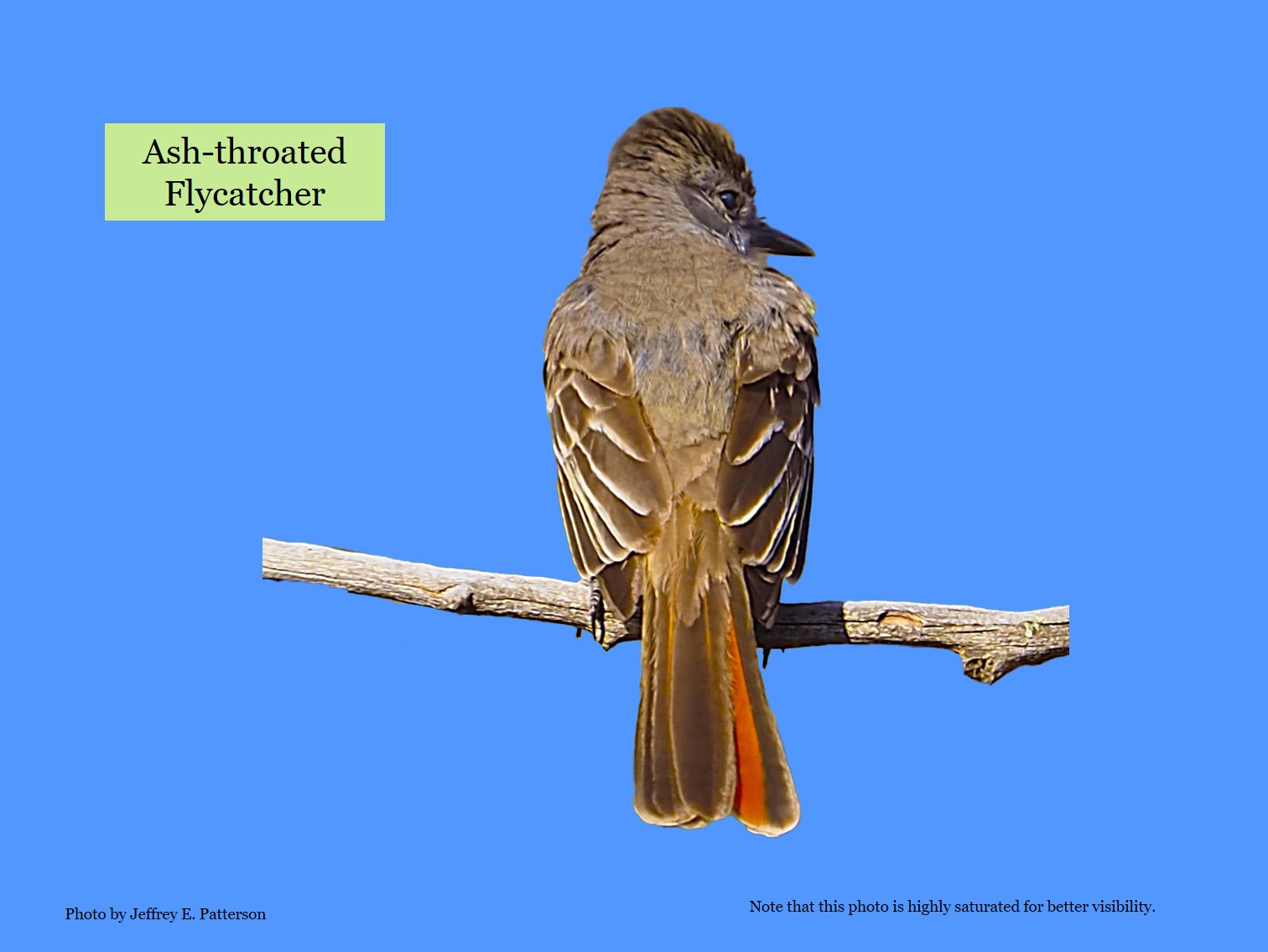
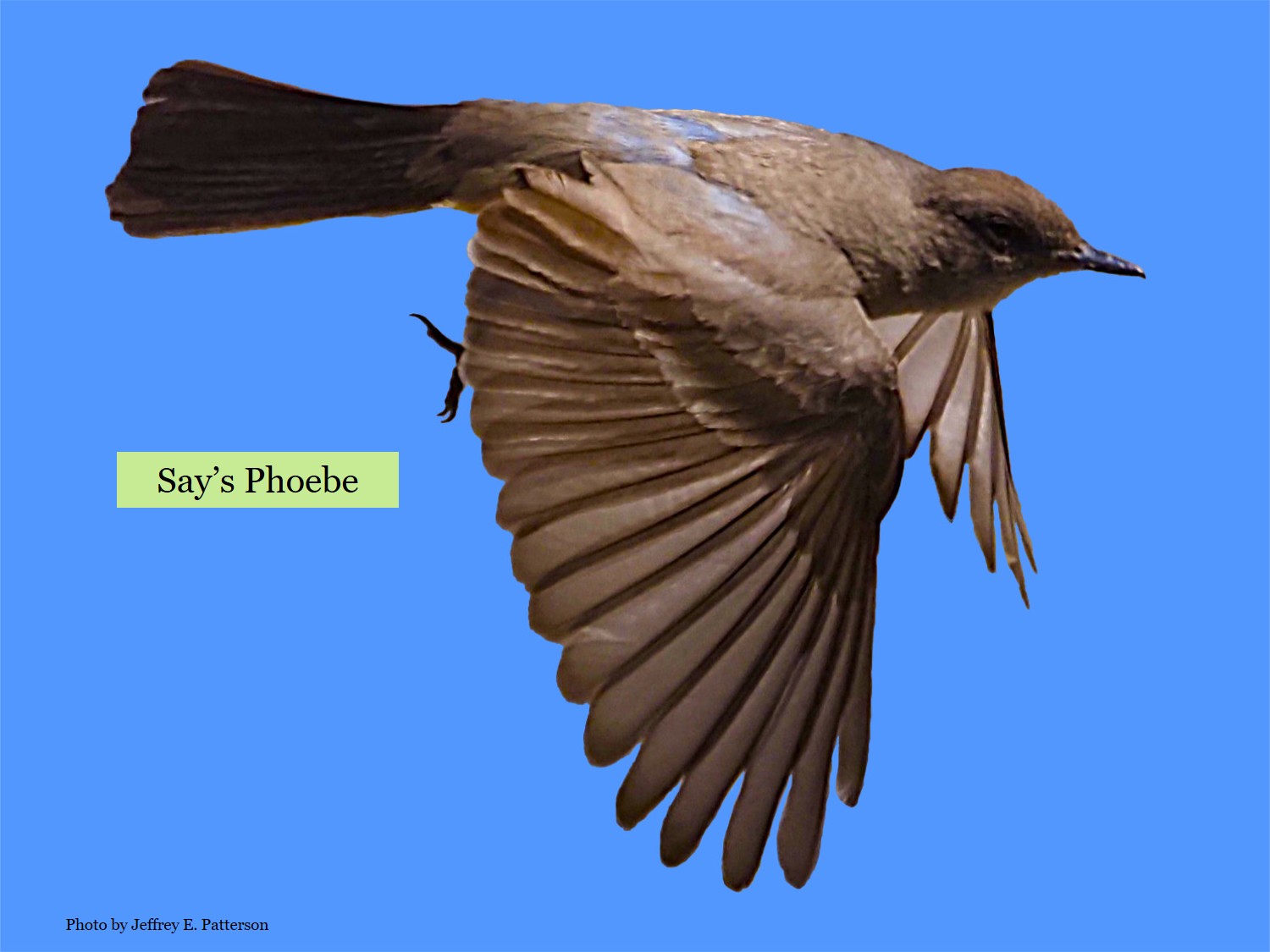
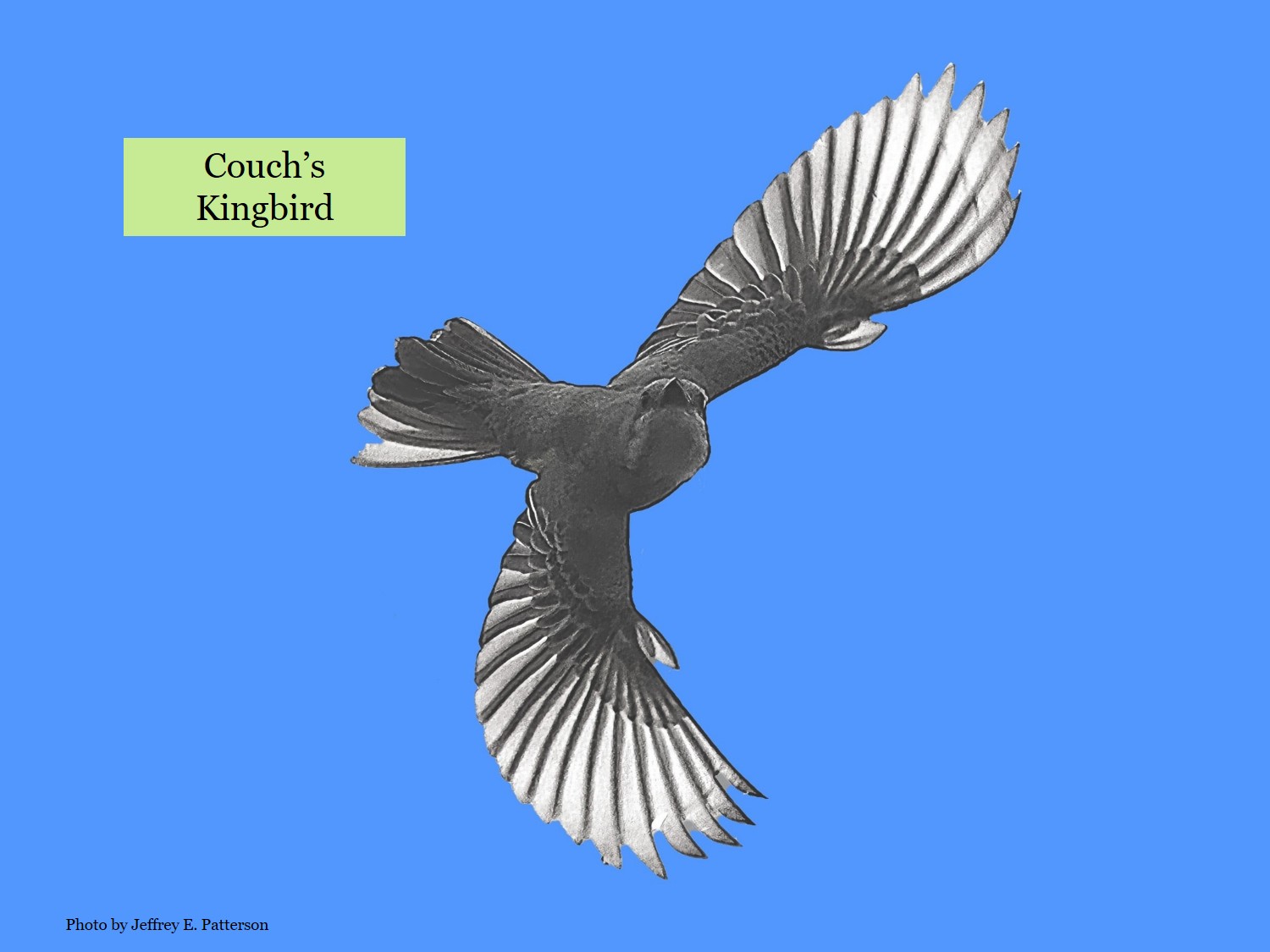
Flycatchers may be one of the first groups of birds that developing birders study where it is important to learn the names, locations and interactions of the feather groups (bird topology or topography). In some cases, an identification may be based on very small differences in feather groups or individual feathers. The next few photos show important feather groups and their relationships to each other. Note how the different feathers and feather groups fold, open and interact, how they sit one atop another to form both an insulated covering when folded, and a streamlined surface which allows lift and reduces drag during flight.
Flight Feathers
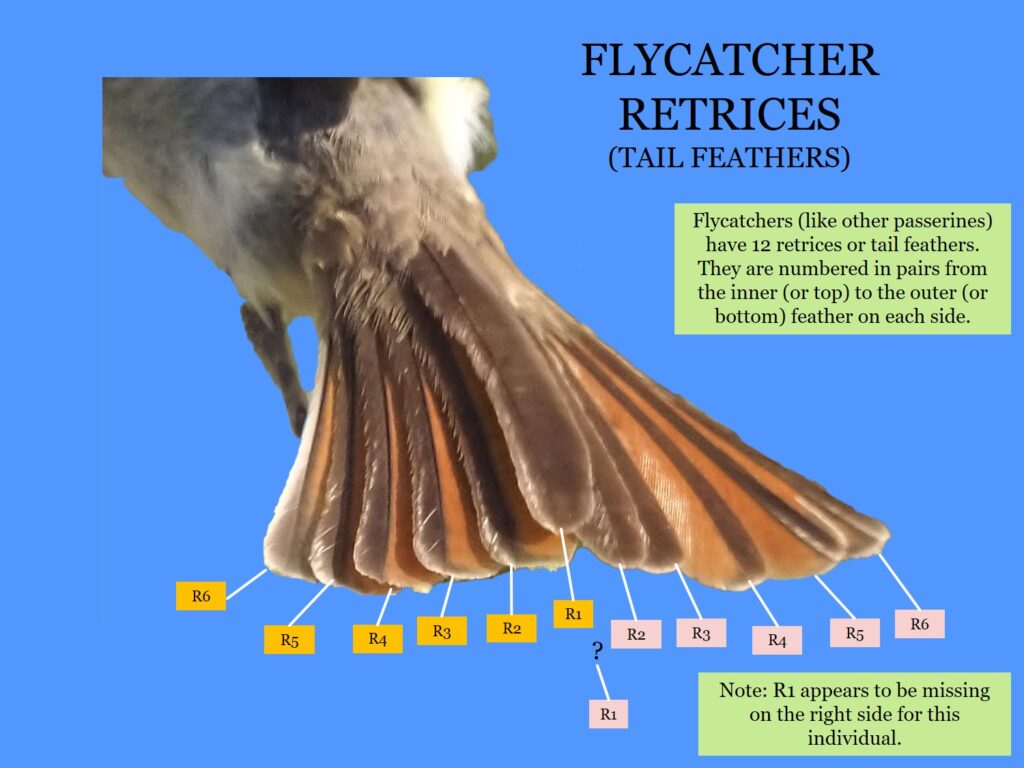
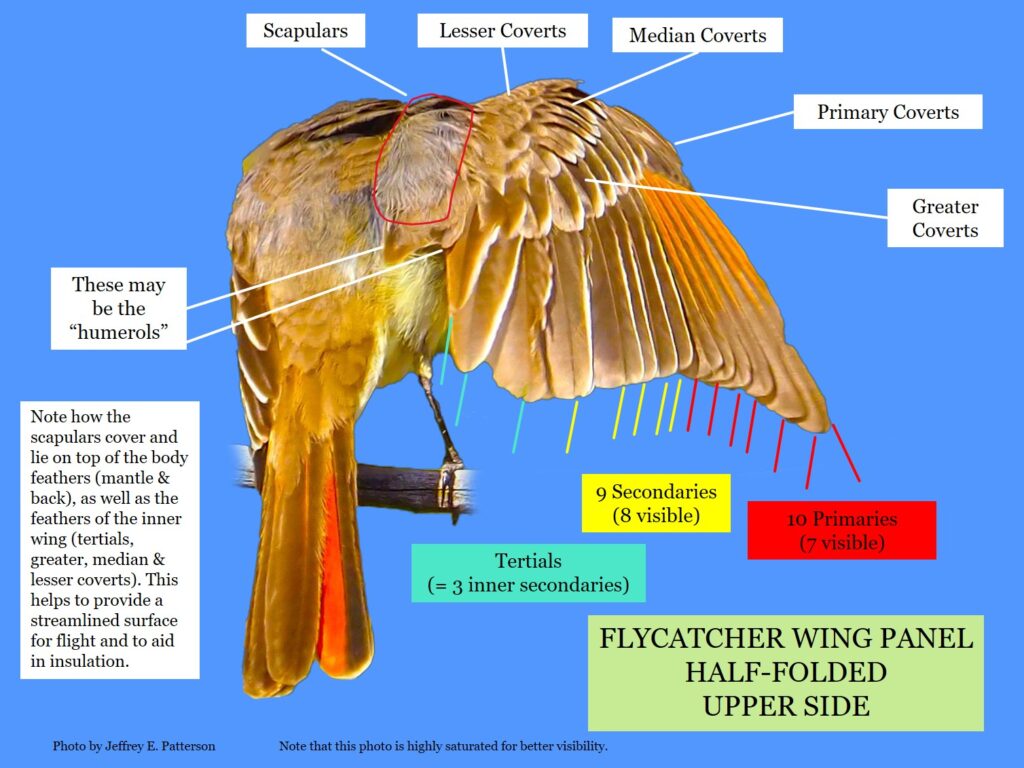
The flight feathers (primaries, secondaries, tertials and tail feathers (retrices)) are the most important groups of feathers for the bird’s flight, as well as for the birder’s identifications. Flycatchers have 10 primaries and 9 secondaries. The inner 3 secondaries which sit atop the folded wing, are sometimes called the tertials (more on the tertials below).
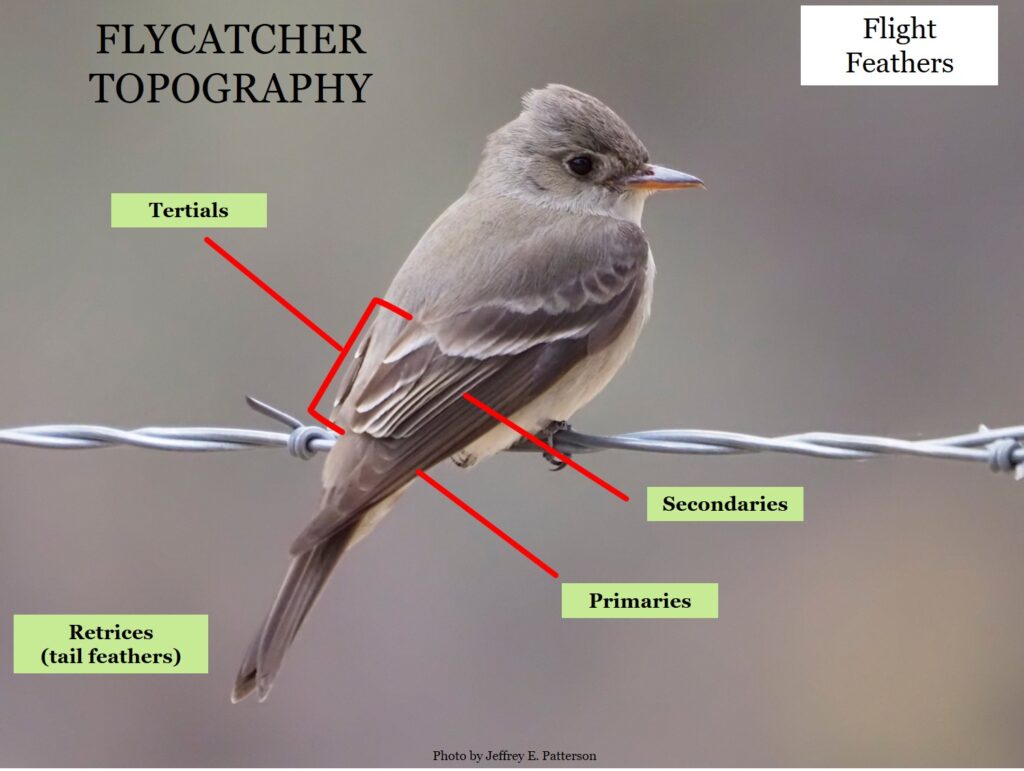
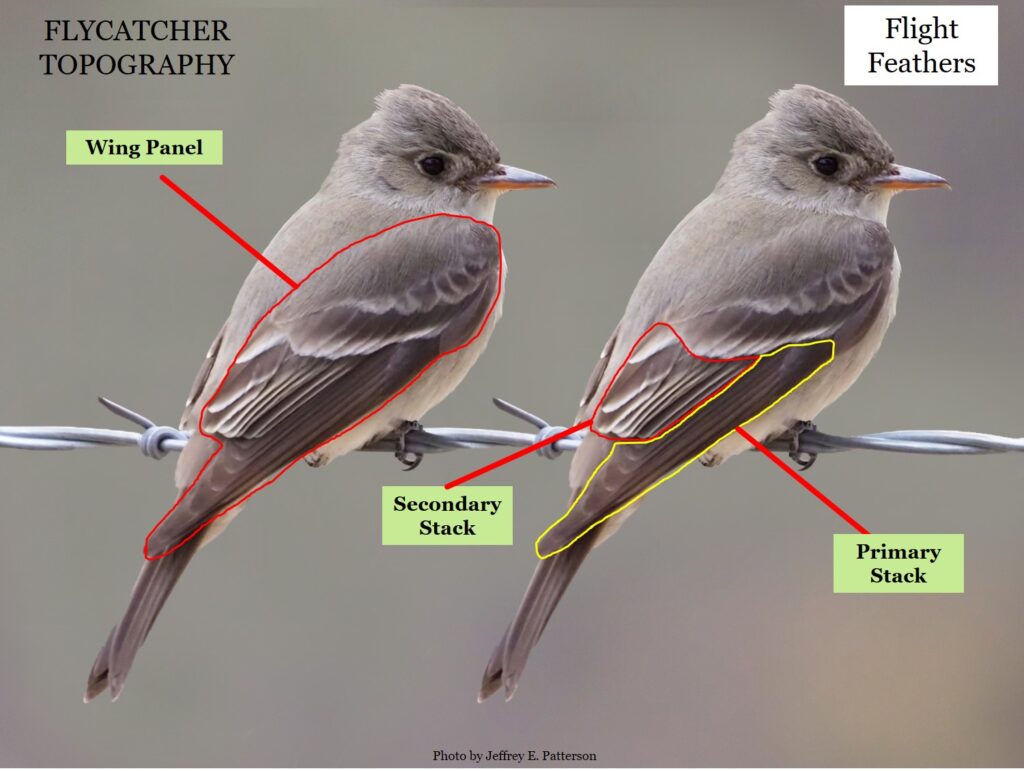
As a group on the folded wing, the primaries, secondaries and tertials (along with coverts and a bit of the scapulars) are sometimes called the wing panel. Individually these groups of feathers may be called the primary stack, and the secondary stack.
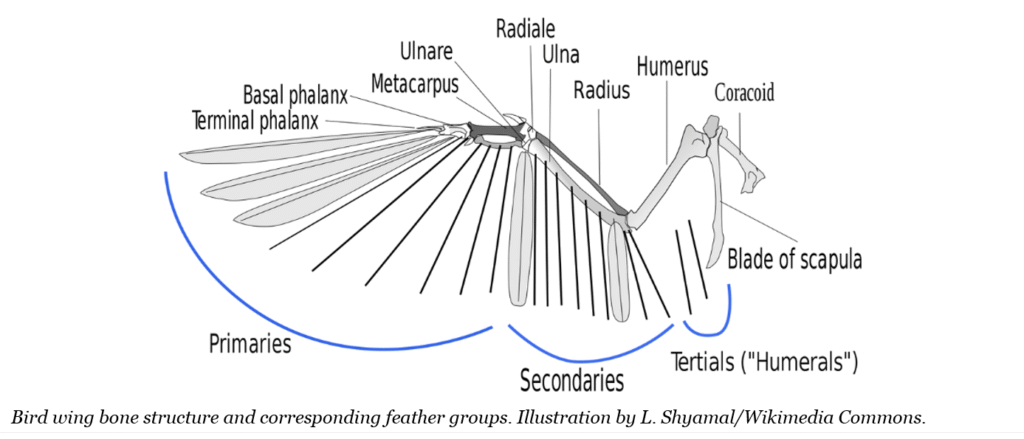
The primaries and secondaries are distinct groups of feathers and their distinction is based on the parts of the skeleton to which they attach. They also have different molt sequences, and differ in shape and purpose in flight. As shown in the diagram below, the secondaries attach to the ulna, while the inner most 5 primaries attach to the metacarpus and the outer 5 attach to the phalanges (analogous to human fingers).
The 10 primaries of most passerines are numbered starting with the inner-most primary as “p1”, making the outermost primary “p10”. The secondaries are numbered similarly, however the sequence starts with the outermost secondary as “s1” and then sequences inwards (see below).
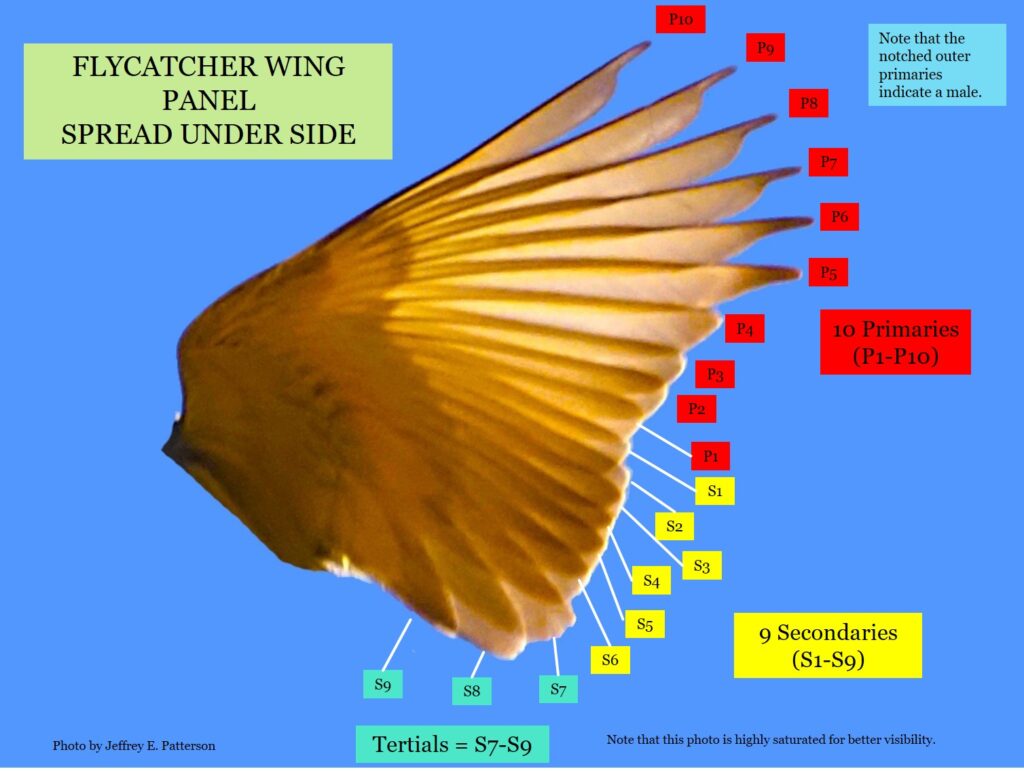
The term “tertials” (and the synonym “tertiaries”) is a term with a confusing history of usages. Many authorities use the term for the innermost 3 feathers attached to the ulna (e.g. the secondaries s7, s8 and s9 in passerines) and this is the way I use the term in class and below. However, other authorities use the term for feathers attached to the humerus (which would more clearly be called “humerols”). (See further discussion by Hickman here The Trouble with Tertials (Hickman, Scott, The Trouble with Tertials, 2008, BioOne Digital Library).
Primary Projection
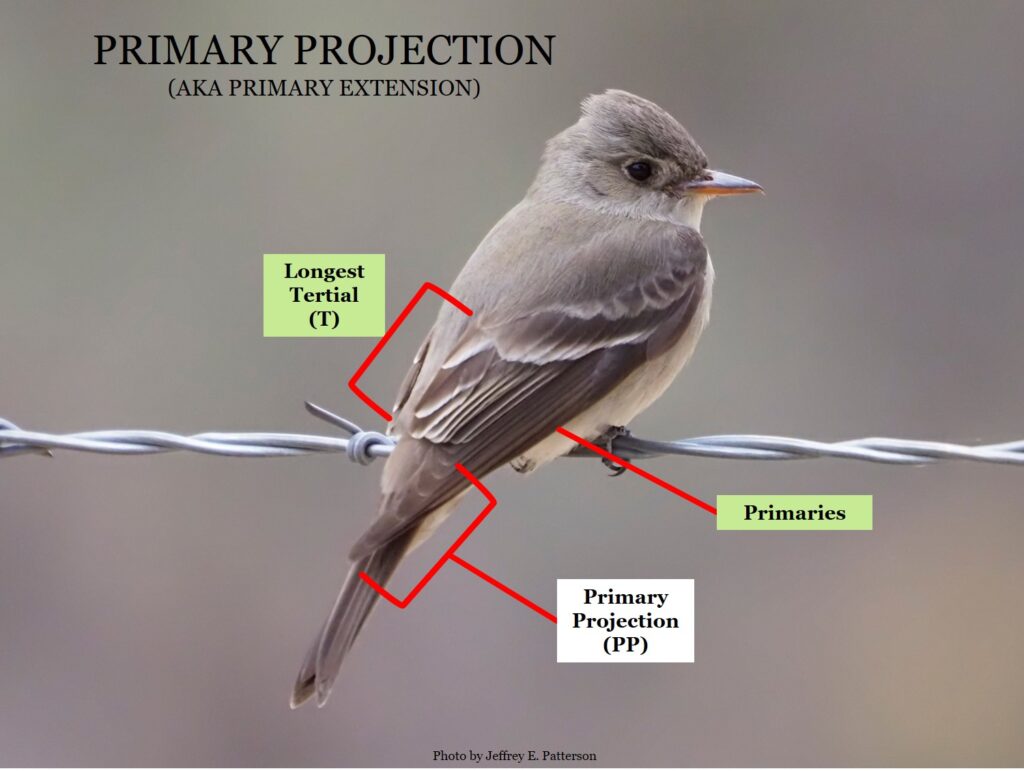
In flycatchers the length of the primary projection (aka primary extension) can be an important point of separation between species. On the folded wing the primary projection is defined as the length that the longest primary juts out beyond the secondary stack, usually as defined by the longest tertial.
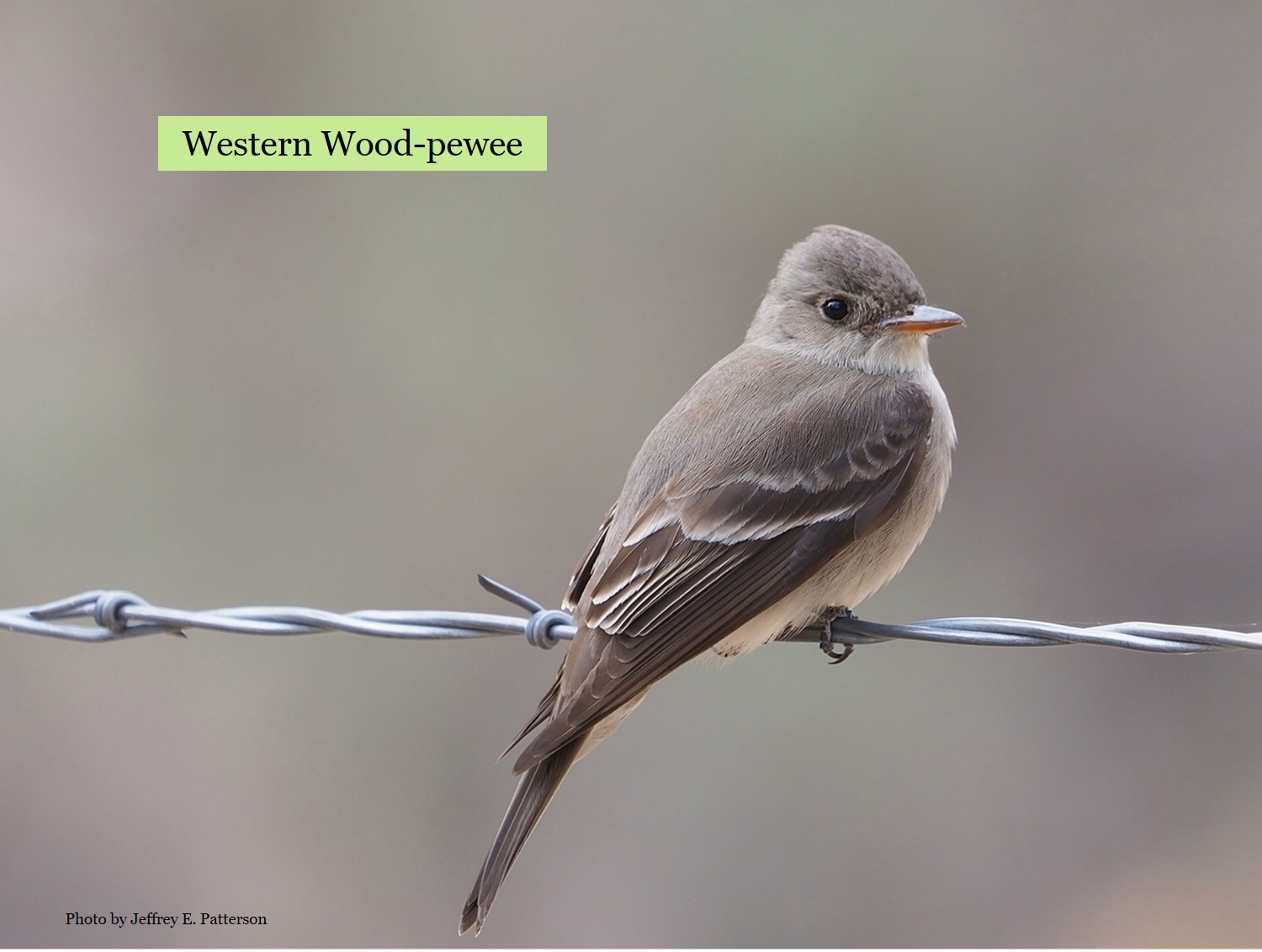
For classification and comparison purposes the longest visible tertial can be visually measured (in person or in a photograph) against the primary projection. Below is the fairly long primary projection of a Western Wood-pewee which in this individual is almost equal to the length of the longest tertial (T).
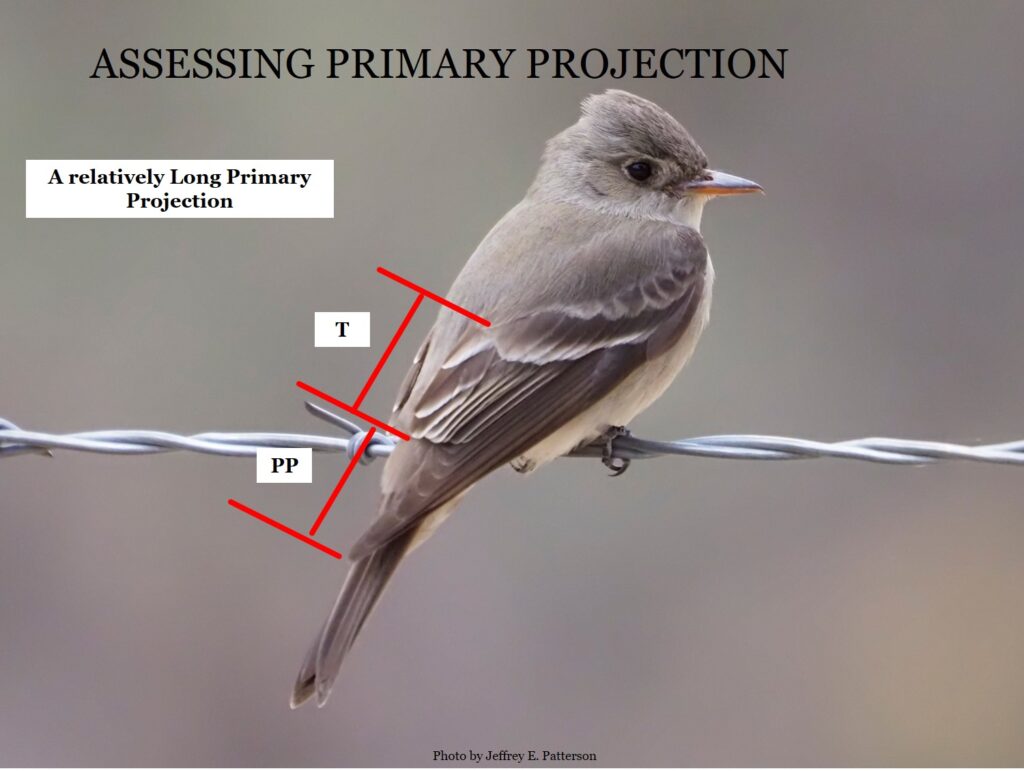
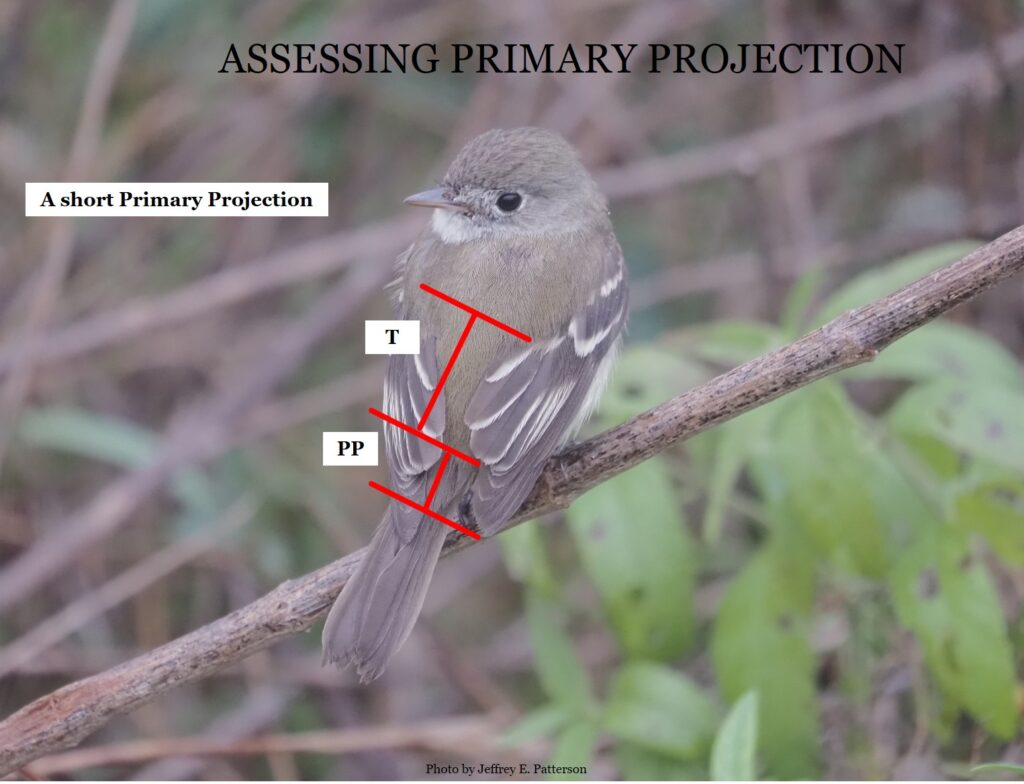
In this way the primary projection can be qualified (e.g. as short, medium or long) and compared to other birds and species. Below is an example of a short primary projection of a Least Flycatcher (an empidonax).
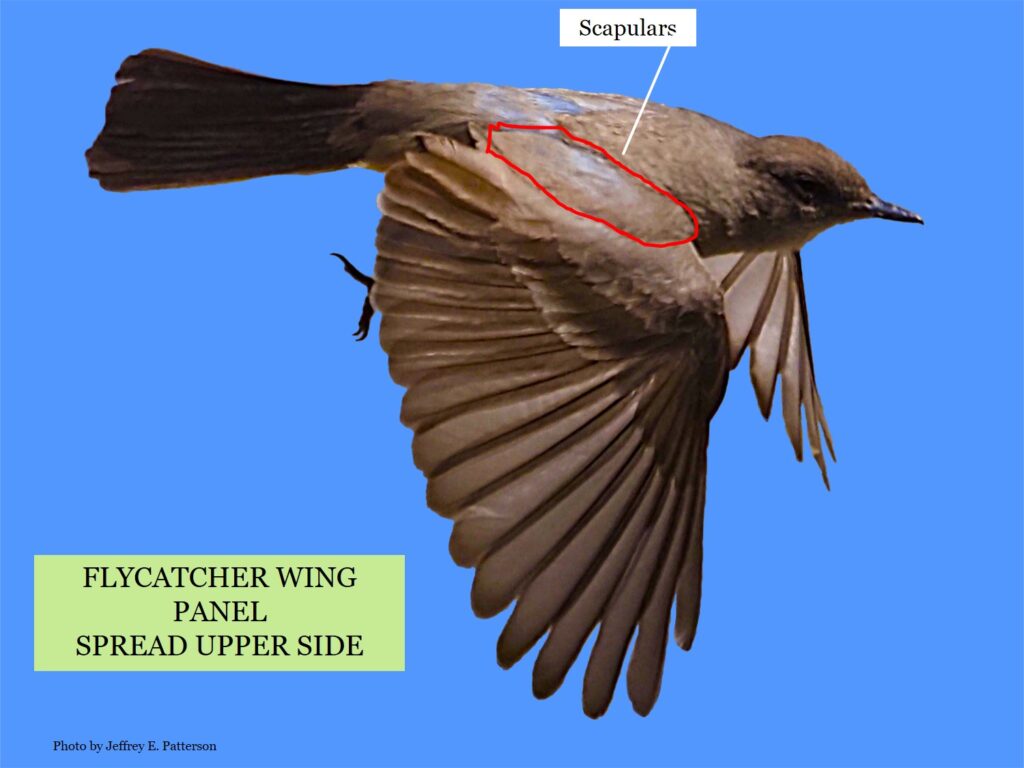
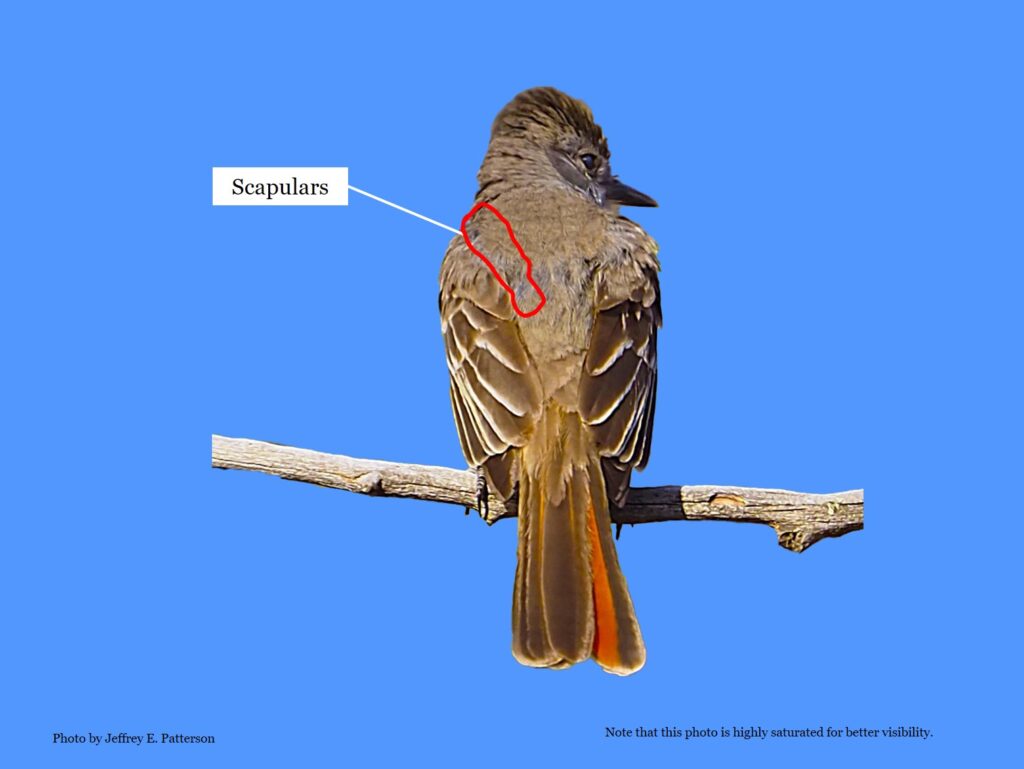
Scapulars
The scapulars are a sometimes confusing group of feathers because the feathers of the wings (e.g. the lesser and perhaps the median coverts) can be overlapped by the scapulars when the wings are folded. But at other times the scapulars appear in neat groups exactly as diagramed in references. Additionally, the scapulars are frequently the same color as the back, mantle and coverts. In shorebirds the scapulars can be a key to identification, but in flycatchers they are less important for ID.
Retrices (Tail Feathers)